

Opioid use disorder has killed over 500,000 Americans in two decades. Traditional treatments help some patients, but relapse rates stay high. Access to medication-assisted treatment remains limited in many areas. Medical marijuana for opioid use disorder offers a different path.
Research shows cannabis may ease withdrawal symptoms and reduce cravings. Some states now list opioid addiction as a qualifying condition for a medical marijuana card for opioid addiction.
This guide breaks down how cannabinoids interact with your brain’s opioid system. You’ll learn what clinical studies reveal about cannabis for opioid withdrawal and relapse prevention. We cover qualifying conditions by state so you can get a card for OUD. You’ll see specific dosing protocols for each recovery stage. We also explain how to safely combine medical marijuana and MAT medications like buprenorphine or methadone.
The science behind medical marijuana for opioid use disorder is complex but clear. Cannabis doesn’t replace proven treatments. It works alongside them. Let’s examine how this approach might fit your recovery plan.
What Is Opioid Use Disorder? Understanding Medical Marijuana for Opioid Use Disorder Treatment
Opioid use disorder (OUD) is a chronic brain disease. It involves compulsive opioid use despite harmful consequences. The condition stems from neuroadaptations in reward, motivation, and stress circuits. These changes make it difficult to stop using opioids even when you want to.
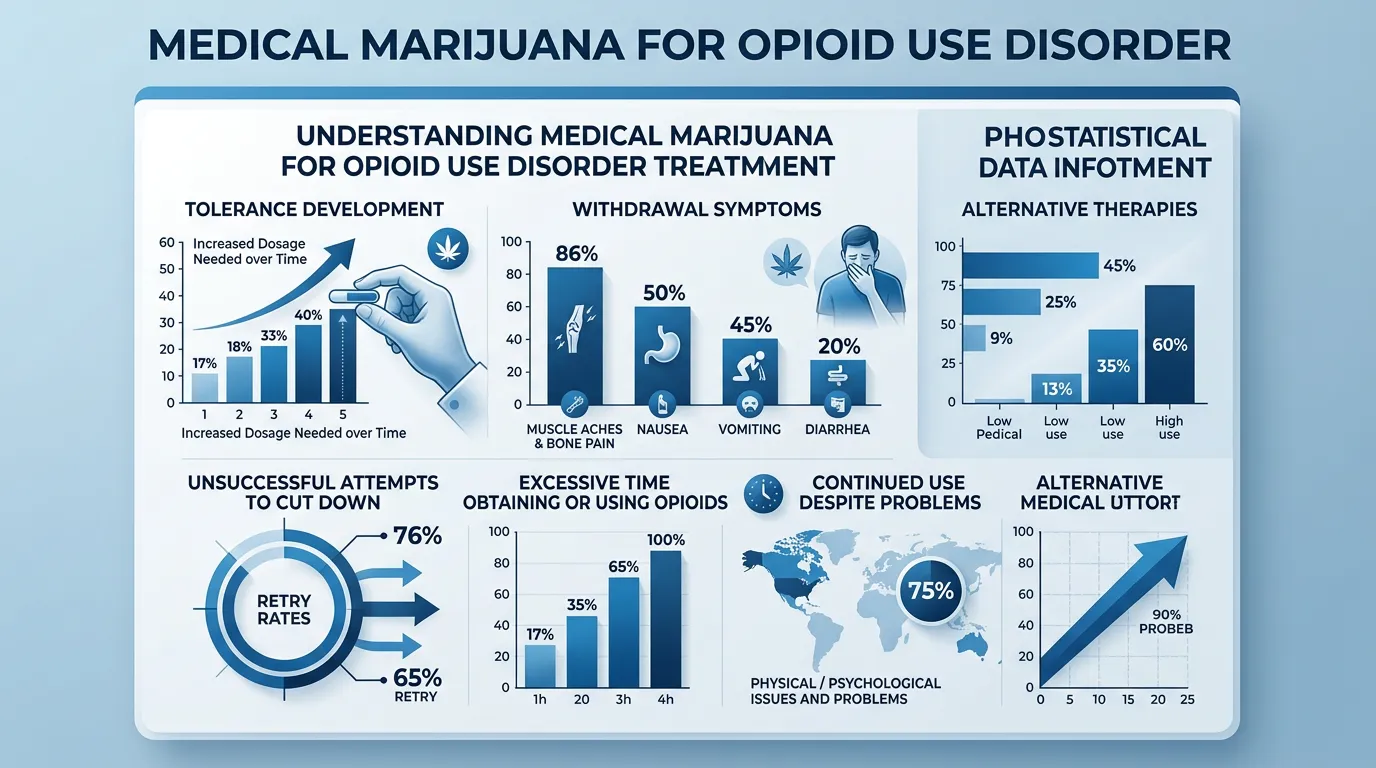
The diagnostic criteria for opioid use include several key markers. Tolerance develops, meaning you need higher doses to feel the same effect. Withdrawal symptoms appear when you stop using. You make unsuccessful attempts to cut down. You spend excessive time obtaining or using opioids. You continue use despite physical or psychological problems.
Definition of Opioid Use Disorder
OUD is not simply a choice or moral failing. It is a medical condition recognized by the American Medical Association and the American Society of Addiction Medicine. The brain’s reward system becomes hijacked by repeated opioid exposure. This creates powerful cravings that override rational decision-making.
The condition affects millions of Americans. It crosses all demographic boundaries. People from every background, income level, and age group can develop OUD. The opioid crisis has evolved to include fentanyl and synthetic opioids. This makes overdose risk higher than ever before.
Common Symptoms of OUD
Physical dependence is a hallmark symptom. Your body adapts to the presence of opioids. You need escalating doses to avoid withdrawal. Intense cravings dominate your thoughts and drive behavior.

Withdrawal symptoms appear within hours of your last dose. These include:
-
Severe muscle aches and bone pain
-
Nausea, vomiting, and diarrhea
-
Anxiety and restlessness
-
Insomnia and sleep disturbances
-
Sweating and chills
-
Rapid heart rate
Loss of control over use becomes evident. You take opioids in larger amounts or for longer than intended. You neglect responsibilities at work, school, or home. You give up activities you once enjoyed. Social isolation increases as the drug becomes your primary focus.
How OUD Affects Daily Life
OUD disrupts every aspect of daily functioning. Work performance suffers as concentration and reliability decline. Many people lose their jobs. Family relationships deteriorate under the strain of addiction. Trust breaks down. Financial stability collapses as money goes toward obtaining drugs.
Physical health declines rapidly. Overdose risk increases as tolerance develops. Fentanyl contamination in the drug supply has made this risk catastrophic. Many people who use opioids now face exposure to fentanyl without knowing it. This can be fatal even for experienced users.
Standard medication-assisted treatment (MAT) with methadone, buprenorphine, or naltrexone reduces overdose risk by 50%. However, 40-60% of patients still relapse within one year. This treatment gap has led many to explore for medical marijuana as an adjunctive therapy. The opioid crisis demands new treatment approaches. Medical marijuana for opioid use disorder represents one emerging option that shows promise in early research.
How Medical Marijuana May Help With Opioid Use Disorder
The endocannabinoid system (ECS) and opioid system share deep connections in the brain. CB1 receptors modulate opioid receptor activity in pain and reward circuits. This overlap explains why cannabis shows promise for opioid use disorder treatment. Research suggests cannabinoids may address multiple aspects of addiction recovery.
The mechanisms are complex but clinically relevant. THC and CBD interact with brain pathways that drive cravings and withdrawal. Understanding these interactions helps patients and providers make informed treatment decisions.
Medical Marijuana and Opioid Withdrawal
Opioid withdrawal produces severe physical symptoms. Muscle aches, nausea, insomnia, and anxiety make early recovery extremely difficult. Many patients relapse during this critical window.
Animal studies show cannabinoids reduce withdrawal severity. CBD specifically dampens the hyperactive stress response that amplifies withdrawal symptoms. This effect occurs without producing intoxication or dependence.
The endocannabinoid system regulates stress hormone release. When opioids are stopped, the body’s stress response goes into overdrive. Cannabinoids help recalibrate this system toward normal function. This may explain why some patients report easier withdrawal when using medical cannabis.
THC at low doses can address specific withdrawal symptoms. It may reduce nausea and improve sleep quality. However, high doses risk worsening anxiety in vulnerable individuals. Careful dosing is essential during this sensitive period.
Medical Marijuana During OUD Treatment
Medication-assisted treatment (MAT) with buprenorphine or methadone remains the gold standard for opioid use disorder. These medications save lives by preventing overdose and supporting long-term recovery. However, MAT alone doesn’t fully control all symptoms for every patient.
Cannabis may address residual symptoms that MAT medications miss. Some patients experience persistent anxiety, sleep problems, or chronic pain despite stable MAT dosing. Medical marijuana can complement MAT by targeting these unresolved issues.
The opioid-sparing effect of cannabis has been documented across multiple clinical contexts. Patients using cannabis alongside pain management protocols often need 40-60% less opioid medication. This reduction addresses a major driver of prescription opioid addiction. For those seeking guidance on accessing medical cannabis legally, understanding how to get your medical marijuana card provides a clear starting point.
Combining cannabis with MAT requires medical supervision. Drug interactions and individual responses vary significantly. Providers can monitor progress and adjust both treatments as needed. This integrated approach offers better outcomes than self-medication alone.
Medical Marijuana and Opioid Cravings
Cravings drive relapse even after successful detoxification. The brain’s reward circuits remain sensitized to opioid cues for months or years. Environmental triggers, stress, and emotional states can activate intense drug-seeking behavior.
CBD shows particular promise for reducing drug-seeking behavior in preclinical addiction models. It dampens the anxiety and stress response that fuel cravings during early recovery. According to research examining cannabinoid mechanisms, CBD and THC can reduce opioid cravings and anxiety by modulating stress pathways in the brain.
The endocannabinoid system plays a key role in cue-induced cravings. When former users encounter drug-related cues, their brains release stress hormones and activate reward circuits. Cannabinoids interrupt this cascade before it escalates into full relapse.
THC at microdoses may provide additional craving control. Low doses produce subtle mood stabilization without intoxication. This helps patients manage the emotional volatility common in early recovery. Higher doses risk triggering anxiety or creating new substance dependence patterns.
Cannabis is not a cure for opioid use disorder. It functions as one tool within comprehensive addiction treatment. Behavioral therapy, peer support, and medical monitoring remain essential components. When used appropriately under medical guidance, cannabis may improve treatment retention and quality of life during recovery.
What the Research Says
The evidence base for medical marijuana in opioid use disorder is growing. But it remains observational and preliminary. No large-scale randomized controlled trials have directly tested cannabis as an OUD treatment. This limits the strength of clinical recommendations.
That said, the data we do have is compelling. States with medical marijuana programs show 25% lower opioid overdose death rates compared to states without programs. Multiple peer-reviewed analyses confirm this pattern. The correlation is consistent across regions and time periods.
Observational studies consistently find that chronic pain patients with access to medical cannabis reduce or eliminate opioid use at rates of 40-80%. Survey data from patients in recovery show cannabis helps manage withdrawal symptoms. It reduces cravings and improves sleep quality during early abstinence.
A 2026 study published in JAMA Network Open found medical cannabis users had significantly lower rates of opioid prescriptions. They also had fewer overdose events. This adds weight to the harm-reduction argument for cannabis access.
However, concerns exist about substituting one substance for another. Cannabis has far lower overdose risk and addiction liability than opioids. But it is not risk-free. Most research focuses on THC-dominant cannabis. CBD-specific protocols for OUD are understudied despite promising preclinical data.
If you’re considering this approach, you can get your medical card online through a licensed provider. The evidence base supports cannabis as an adjunct to comprehensive addiction treatment. It is not a standalone replacement for evidence-based MAT.
What the Research Does Not Prove
The research does not prove that cannabis cures opioid addiction. It does not prove cannabis is superior to methadone or buprenorphine. It does not prove cannabis is safe for all OUD patients.

What it does show is that cannabis may help some patients reduce opioid use. It may ease withdrawal symptoms. It may lower overdose risk when used as part of a broader treatment plan. But it is not a magic bullet.
State Eligibility for Medical Marijuana for Opioid Use Disorder
Access to medical marijuana for opioid use disorder varies widely by state. Some states explicitly list OUD as a qualifying condition. Others allow it through broader categories like chronic pain or physician discretion. Understanding your state’s rules is the first step toward legal access.
States That Recognize OUD
Pennsylvania, New York, New Jersey, and Illinois explicitly list opioid use disorder or substance use disorder as qualifying conditions for medical marijuana certification. These states recognize OUD as a standalone diagnosis. Patients with documented OUD can apply directly without needing a secondary condition.
Many states allow medical marijuana for chronic pain. This is the primary driver of prescription opioid addiction. Chronic pain is also a common co-occurring condition in OUD. PTSD, anxiety disorders, and depression qualify in most medical marijuana states. These conditions are common in people with OUD. They provide alternative certification pathways even when OUD itself is not listed.
States with full physician discretion include Oklahoma, California, Maine, Virginia, and Massachusetts. Doctors in these states can certify any condition they believe would benefit from cannabis. This includes OUD. Physicians in discretion states have the broadest authority to recommend medical marijuana for opioid recovery.
State-by-State Eligibility Requirements
Some states require documented evidence of prior opioid use or failed conventional treatment. This may include medication-assisted treatment (MAT) records or prescription history. Patients should gather medical records before their evaluation. Documentation strengthens your application and speeds approval.
Patients in recovery should verify their state’s specific requirements. Work with addiction medicine specialists familiar with medical marijuana certification. Not all physicians are comfortable certifying OUD patients. Finding a provider experienced in both addiction and cannabis medicine is important. Leafy Rx connects patients with licensed providers who understand OUD and can guide treatment safely.
State Resources and Qualification Guidelines
State application fees range from $25 to $100. Some states offer reduced fees for veterans, low-income patients, or those on disability. Check your state’s medical marijuana program website for fee schedules and financial assistance options. Processing times vary from same-day temporary permits to 30-day waits for official cards.
Patients should also review medical marijuana side effects before starting treatment. Cannabis is not risk-free. Understanding potential side effects helps you make informed decisions. Your physician can discuss how cannabis interacts with MAT medications like buprenorphine or methadone. Never stop prescribed OUD treatment without medical supervision.
How to Get a Medical Marijuana Card for Opioid Use Disorder
Getting a medical marijuana card for opioid use disorder is simpler than most patients expect. The entire process happens online. You don’t need to visit a clinic or wait weeks for appointments. Most states now allow telehealth evaluations, which means you can complete everything from home.
The steps are straightforward. You verify your state allows opioid use disorder as a qualifying condition. You gather your medical records. You book an online evaluation with a licensed provider. You receive your certification if approved. Then you submit your state application and wait for your card.
1. Check Your State Eligibility
Not every state lists opioid use disorder as a qualifying condition. Some states name it explicitly. Others include it under broader categories like substance use disorder or chronic pain. A few states allow physician discretion for any debilitating condition.
Start by checking your state’s official medical marijuana program website. Look for the qualifying conditions list. If opioid use disorder isn’t listed, check if PTSD, chronic pain, or anxiety qualify. Many patients with opioid use disorder also have these co-occurring conditions.
Leafy Rx maintains a state resource library that shows which conditions qualify in each state. This saves you time searching through government websites. You can confirm eligibility in under five minutes.
2. Book an Online Evaluation
Once you confirm your state allows your condition, schedule an online evaluation. Leafy Rx connects you with licensed healthcare providers registered with your state’s medical marijuana program. The consultation takes 15 to 30 minutes.
You’ll need a device with internet access and a camera. The evaluation happens via secure video call. No software downloads required. You can use your phone, tablet, or computer.
According to De Aquino et al, patients seeking medical marijuana for opioid withdrawal often report faster access to care through telehealth compared to traditional in-person appointments. This matters when you’re managing active symptoms.
3. Complete Your Physician Consultation
During your consultation, the physician reviews your medical history. They ask about your opioid use, treatment history, and current symptoms. Be honest about your situation. Physicians need accurate information to determine if medical marijuana is appropriate.
Bring documentation if you have it. This includes diagnosis records, prescription history, or letters from your current providers. Some states require proof of prior treatment attempts. Others don’t. Your Leafy Rx provider will tell you what your state needs.
The physician explains how medical marijuana might help with opioid cravings, withdrawal symptoms, and pain management. They discuss dosing, product types, and safety considerations. You can ask questions about cannabinoid protocols for opioid recovery.
4. Submit Your State Application
If approved, your physician issues a certification. This document confirms you have a qualifying condition and that medical marijuana is medically appropriate for you. You need this certification to apply with your state.
Next, you submit your application to your state’s medical marijuana program. This usually happens through an online portal. You’ll upload your physician certification, proof of residency, and a government-issued ID. You also pay the state registration fee.
State fees range from $25 to $100. Some states offer reduced fees for veterans, seniors, or low-income patients. Leafy Rx offers the lowest certification fees in the U.S. with an approved-or-money-back guarantee.
5. Receive Your Medical Marijuana Card
Processing times vary by state. Some states issue temporary permits within 24 hours. Others take up to 30 days to process applications. Once approved, you receive your medical marijuana card by mail or email.
Your card allows you to purchase medical marijuana from licensed dispensaries. Dispensary staff can help you choose products suited for opioid use disorder. Many patients start with high-CBD products to manage cravings without psychoactive effects.
The entire process is 100% online, HIPAA-compliant, and designed for patients in active recovery. Leafy Rx serves patients across all medical marijuana states. You can start your evaluation today and receive your certification within days.
Cannabinoid Protocols for Different Stages of Opioid Recovery
Medical marijuana for opioid use disorder requires different approaches at each recovery stage. Your body and brain change dramatically during withdrawal and early recovery. What works on day three won’t work on week eight. This section breaks down cannabinoid protocols by recovery phase. Each stage has specific symptoms that cannabis can help manage.
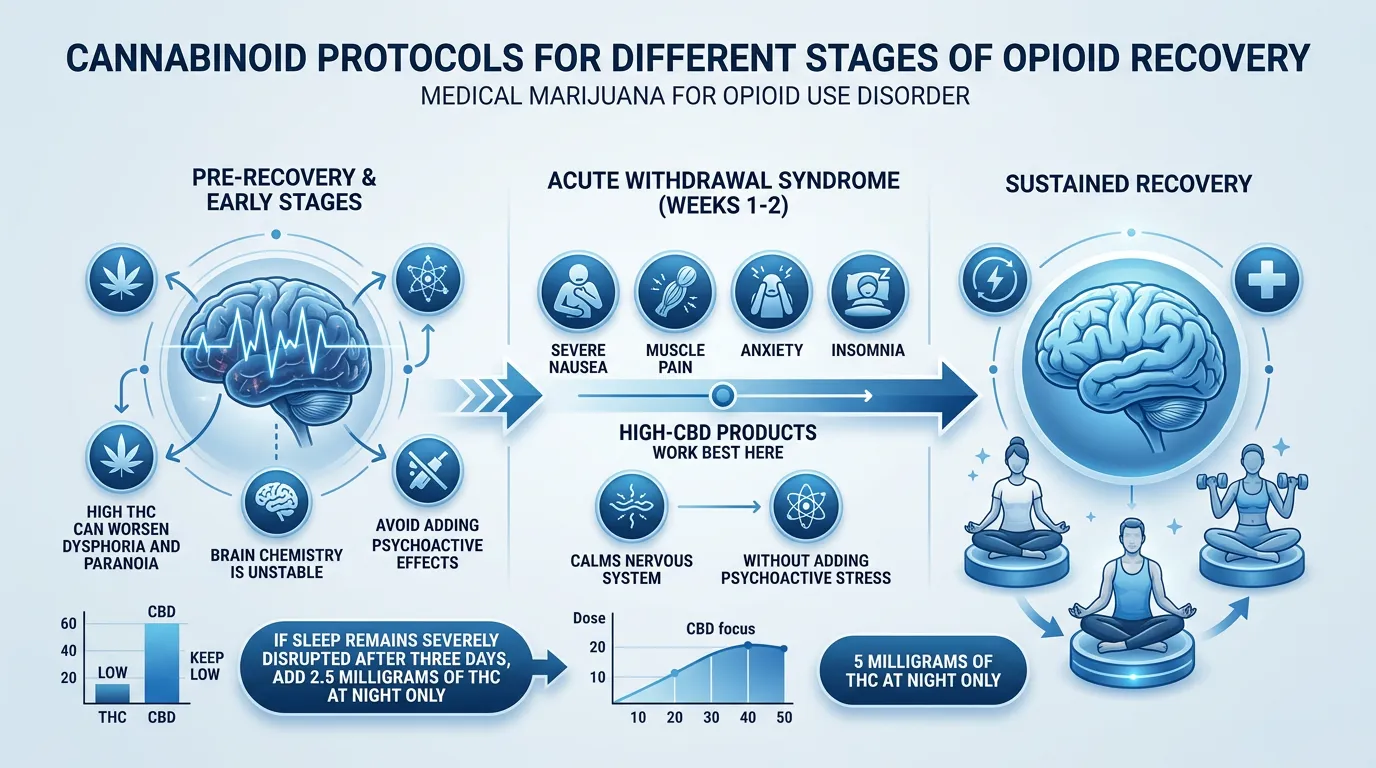
Acute Withdrawal Phase: Days 1-7
The first week is brutal. Your body screams for opioids. According to Medline Plus, acute withdrawal brings severe nausea, muscle pain, anxiety, and insomnia. High-CBD products work best here. They calm your nervous system without adding psychoactive stress.
Start with a 20:1 CBD to THC ratio. This means 20 milligrams of CBD for every 1 milligram of THC. Take 10 to 20 milligrams of CBD three times daily. Space doses evenly throughout the day. Morning, afternoon, and evening work well for most people.
Avoid high-THC products during acute withdrawal. THC can worsen dysphoria and paranoia. Your brain chemistry is already unstable. Adding strong psychoactive effects makes things worse. If sleep remains severely disrupted after three days, add 2.5 milligrams of THC at night only.
Use sublingual tinctures for precise dosing. They absorb quickly under your tongue. Effects start within 15 to 30 minutes. This consistency helps you manage symptoms as they spike. Skip smoking during this phase. Respiratory irritation compounds physical discomfort.
Post-Acute Withdrawal Syndrome: Weeks 2-12
Weeks two through twelve bring different challenges. Physical symptoms ease. Mental symptoms intensify. Depression, anhedonia, and persistent anxiety dominate this phase. Your brain is relearning how to produce pleasure naturally.

Balanced CBD to THC ratios help here. Try 2:1 or 1:1 products. This means equal or near-equal amounts of both cannabinoids. The combination addresses mood and motivation better than CBD alone. Start with 10 milligrams of each cannabinoid twice daily.
Terpene profiles matter significantly now. Look for products containing:
-
Myrcene and linalool for sedation and muscle relaxation
-
Limonene for mood elevation and stress relief
-
Pinene for focus and mental clarity
These terpenes work with cannabinoids to target specific symptoms. Ask your dispensary staff for lab reports. They show exact terpene content. Choose products based on your dominant symptoms each week.
Long-Term Recovery and Relapse Prevention
After three months, your focus shifts to maintenance. Cravings still appear. Stress triggers remain powerful. Microdosing THC becomes your primary tool. Take 1 to 5 milligrams of THC for stress management. Combine this with ongoing CBD for baseline anxiety and pain.
This low-dose approach prevents tolerance buildup. You maintain therapeutic benefits without escalating doses. Take CBD at 10 to 20 milligrams twice daily as your foundation. Add microdosed THC only when cravings or stress spike.
Always work with your MAT prescriber and addiction treatment team. Cannabis should complement your recovery plan. It doesn’t replace therapy, support groups, or medication-assisted treatment. Coordinate all cannabis use with your healthcare providers. They can adjust your protocol as your recovery progresses.
Track your symptoms daily. Note which products help most. Adjust ratios and doses based on real results. Recovery isn’t linear. Your cannabinoid protocol shouldn’t be either.
Combining Medical Marijuana with Medication-Assisted Treatment: Safety and Protocols
Medical marijuana for opioid use disorder often works alongside medication-assisted treatment (MAT). Understanding how cannabis interacts with MAT medications helps you make safer choices. Each MAT drug has a different safety profile when combined with cannabis.
Cannabis and Buprenorphine (Suboxone)
Buprenorphine is the safest MAT option to combine with cannabis. No direct pharmacological interaction exists between cannabinoids and buprenorphine. This makes it the most compatible MAT-cannabis combination available.
Patients on buprenorphine report cannabis helps with residual symptoms. These include anxiety, insomnia, and pain that MAT alone doesn’t fully address. Cannabis doesn’t interfere with buprenorphine’s efficacy in preventing opioid cravings.
Research from Lake et al confirms that cannabis use during buprenorphine treatment doesn’t increase relapse risk. In fact, it may improve treatment retention rates. Many patients find the combination helps them stay engaged in recovery programs.
Cannabis and Methadone
Methadone requires more caution when combined with cannabis. Both substances undergo liver metabolism via CYP450 enzymes. This creates a theoretical interaction risk, though it’s rarely clinically significant.
Start with very low cannabis doses if you’re on methadone. Monitor yourself carefully for increased sedation or respiratory depression. These effects can compound when both substances are present in your system.
Most patients tolerate the combination well at low doses. However, high-THC products or large amounts of cannabis can amplify methadone’s sedating effects. Always inform your methadone clinic about your cannabis use.
Cannabis and Naltrexone
Naltrexone blocks opioid receptors but doesn’t interact with cannabinoid receptors. This means cannabis can be used safely with naltrexone for symptom management. The two systems operate independently in your brain.
Cannabis helps manage withdrawal symptoms and cravings without interfering with naltrexone’s mechanism. Many addiction specialists now support supervised cannabis integration in recovery plans. The Cannabis Evidence Project confirms this approach doesn’t increase relapse risk.
Always disclose cannabis use to your MAT prescriber. Open communication ensures your treatment plan addresses all aspects of your recovery. Medical marijuana and MAT protocols work best when coordinated by your healthcare team.
Medical Marijuana for Opioid Use Disorder: Risks, Side Effects, and Who Should Not Use Cannabis in Recovery
Medical marijuana for opioid use disorder carries real risks that every patient must understand before starting treatment. Cannabis is not a risk-free intervention. The decision to use it in recovery requires careful consideration of your individual risk factors, medical history, and treatment goals.
Cannabis Use Disorder Risk in Recovering Opioid Users
People with opioid use disorder face higher baseline risk for cannabis use disorder. Research by Socías et al found that rates of problematic cannabis use are 2-3 times higher in this population compared to the general public. This elevated risk stems from shared genetic vulnerabilities and overlapping brain reward pathways.
Daily high-THC cannabis use can create dependence patterns similar to other substances. You may need higher doses over time to achieve the same effect. Withdrawal symptoms include irritability, sleep problems, and increased cravings when you stop using cannabis.
The risk increases with:
-
History of multiple substance use disorders
-
Early age of first cannabis use (before age 18)
-
Daily or near-daily cannabis consumption
-
Use of high-potency THC products (concentrates, edibles over 10mg)
-
Co-occurring mental health conditions like depression or anxiety
Cognitive and Motivational Effects During Early Recovery
Daily high-THC cannabis use can produce what clinicians call amotivational syndrome. This condition involves reduced drive, difficulty initiating tasks, and emotional blunting. These effects directly interfere with recovery work and therapy engagement.
Cognitive impairment from regular THC use affects:
-
Short-term memory and recall during counseling sessions
-
Ability to learn and practice new coping skills
-
Executive function needed for relapse prevention planning
-
Emotional processing required for trauma work in PTSD treatment
Cannabis should not replace evidence-based addiction treatment. It works best as an adjunct to counseling, peer support, and medication-assisted treatment when appropriate. Your primary treatment should remain behavioral therapy and, if indicated, medications like buprenorphine or naltrexone.
Contraindications and High-Risk Populations
Certain groups should avoid THC-dominant products or use them only under close psychiatric supervision. Individuals with co-occurring psychotic disorders, bipolar disorder, or severe depression face heightened risks. THC can trigger manic episodes, worsen psychotic symptoms, or deepen depressive states in vulnerable individuals.
Pregnant or breastfeeding individuals in recovery should not use cannabis. THC crosses the placenta and enters breast milk. Fetal and infant exposure carries neurodevelopmental risks including attention problems, learning difficulties, and behavioral issues later in childhood.
Adolescents and young adults under 25 should pursue conventional opioid use disorder treatment first. Cannabis use during brain development carries lasting cognitive and addiction risks. The prefrontal cortex continues developing until age 25. Early cannabis exposure can alter this critical maturation process.
Common side effects include increased heart rate, dry mouth, dizziness, and short-term memory impairment. These effects are manageable with proper dosing and product selection. Start with low-THC or CBD-dominant products. Work closely with your healthcare provider to monitor your response and adjust your treatment plan as needed.
Conclusion
Medical marijuana for opioid use disorder offers real hope in America’s addiction crisis. The research shows cannabis can reduce opioid use and ease withdrawal symptoms. It helps manage pain and mental health conditions that drive relapse. Population studies suggest it may lower overdose deaths.
But cannabis isn’t a cure-all. It works best as part of complete treatment. That means counseling, peer support, and sometimes medication-assisted treatment. You need medical guidance to use it safely.
More states now recognize opioid use disorder as a qualifying condition. This makes legal access easier than ever before. You can get a medical marijuana card for opioid addiction through licensed providers who understand recovery.
If you’re considering medical marijuana for opioid use disorder as part of your recovery plan, start with a proper evaluation. Leafy Rx connects you with licensed physicians who specialize in addiction medicine and cannabis certification. The process is 100% online, confidential, and backed by our money-back guarantee. Take the first step toward legal, medically supervised cannabis use in your recovery process.
Find out if you qualify for a medical marijuana card in your state. Connect with a licensed medical marijuana doctor online and get started from home. Get your medical card online within minutes without leaving home or missing work with LeafyRx.







 Ask ChatGPT
  Ask Claude
  Ask Perplexity