


Do you want a free medical marijuana card IL? Here’s the truth: Illinois does not give free cards to all patients. However, qualifying terminal patients can receive a free Terminal Illness Registry Card. However, the state provides some of the lowest costs in the nation. That’s far less than most states charge.
This guide shows you precisely how to minimize your expenses. You’ll learn which patients qualify for state discount programs. We break down every fee you’ll pay in 2026. You’ll see the step-by-step process to get certified quickly. We also cover all qualifying conditions and how telehealth evaluations work.
Most people overpay because they don’t know about reduced-fee options. Illinois offers specific programs for veterans and those receiving government assistance. You can fill out the form on the Illinois online registry. Eligible patients can also complete their physician evaluation through telehealth when available. Learn more about the Illinois medical marijuana card online process before you apply.
Let’s start with the real costs and how to get your free medical marijuana card il at the lowest possible price.
Quick Answer: Can You Get a Free Medical Marijuana Card IL?
-
Can you get a completely free medical marijuana card in Illinois? Some qualifying terminal patients can receive a Registry ID card without a state registration fee. For other patients, the state charges a registration fee, and the physician evaluation may also cost money.
-
How much does an Illinois medical marijuana card cost? Standard registration fees are $50 for one year, $100 for two years, or $125 for three years. Some patients qualify for reduced fees under Illinois rules.
-
Who can get a reduced registration fee? Illinois gives lower fees to patients who meet certain rules. Some patients who get public benefits can get reduced fees. Required proof may apply.
-
Can I get my Illinois medical marijuana evaluation online? Yes. LeafyRX offers online evaluations with licensed Illinois physicians. Your physician must complete the required certification before you finish your state application.
-
How long does it take to get an Illinois medical marijuana card? After your physician gives you the certification, you complete the Illinois registry application. You also finish all required steps. Your registry card shows up in your patient account after approval.
Free Medical Marijuana Card in Illinois
Some eligible patients can receive a medical cannabis registry card without a state registration fee. For other patients, Illinois charges a registration fee based on the registration period they choose. The standard fees are $50 for one year, $100 for two years, or $125 for three years.
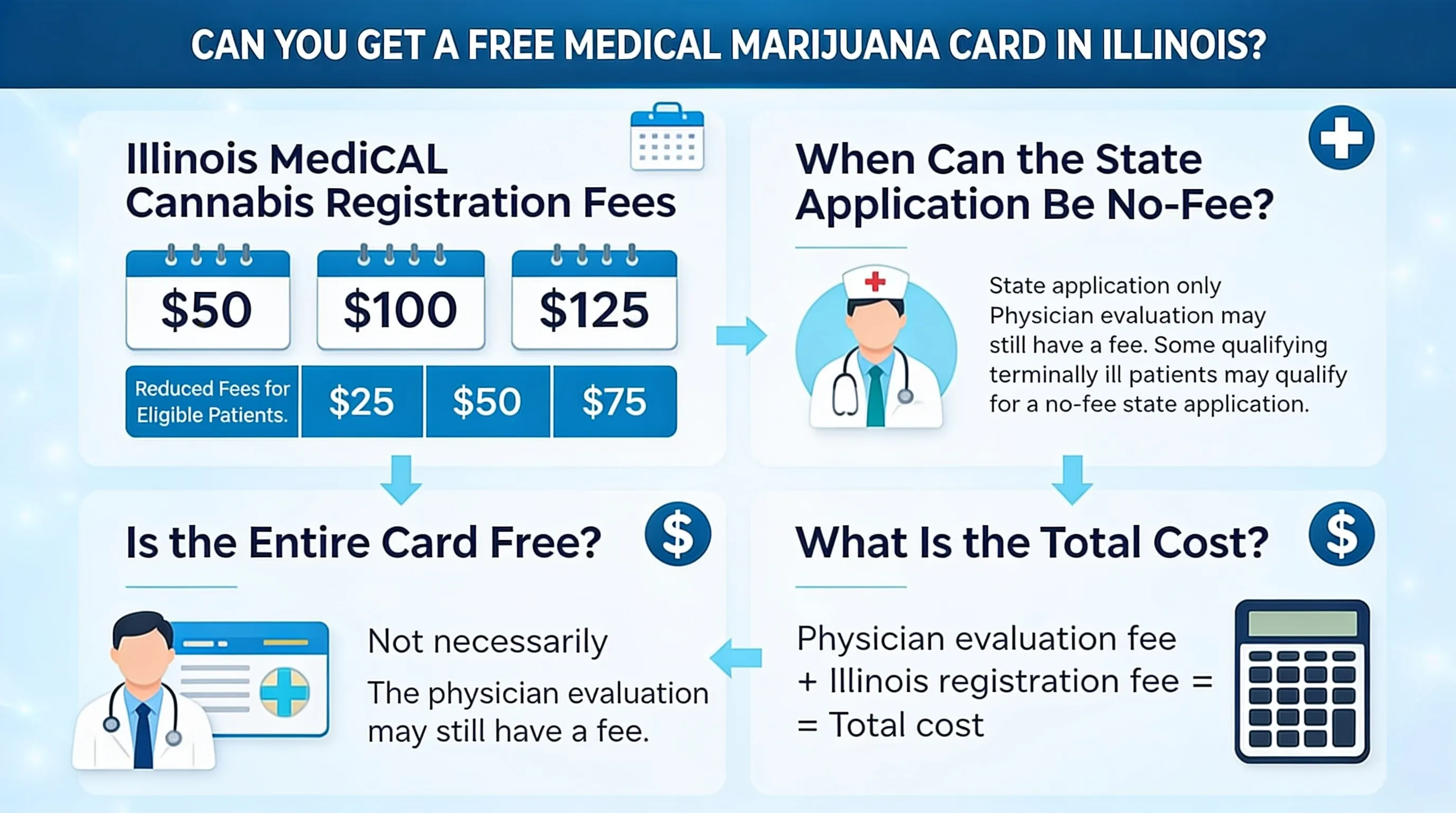
Your total cost depends on the physician evaluation fee and the state registration fee that applies to you. Some eligible patients may qualify for reduced or no-fee state registration, but the physician evaluation may still have a cost.
What ‘Free’ Actually Means in Illinois
When people search for a free medical marijuana card Illinois, they usually mean low-cost options. Illinois offers a free Terminal Illness Registry Card to qualifying patients diagnosed with six months or less to live. Other patients may qualify for reduced registration fees under state rules.
However, Illinois does offer savings compared to other states. The Illinois medical marijuana card process costs a fraction of what you’d pay in New York or Pennsylvania. Illinois keeps costs accessible for patients who need relief.
Some telehealth providers offer money-back guarantees. LeafyRX offers an approved-or-your-money-back guarantee for eligible evaluations. Check the current terms before booking.
Lowest Possible Cost Breakdown
Here’s what you’ll spend to get a low cost medical marijuana card Illinois:
-
Physician evaluation: The fee varies by provider. LeafyRX offers Illinois online evaluations starting at $49.
-
State registration: Standard fees are $50 for one year, $100 for two years, or $125 for three years. Reduced or no-fee options may apply to eligible patients.
-
Total cost: Your total depends on the physician evaluation fee and the state registration option that applies to you.
Traditional in-person clinics charge $150 to $300 for evaluations. Online services cut this cost dramatically. You save time and money by completing everything from home. The evaluation takes about 30 minutes via phone or video call.
Illinois offers one-, two-, and three-year registration terms. Your renewal or extension requirements depend on the term you choose.
Who Qualifies for Reduced Fees
Eligible patients may qualify for reduced Illinois registration fees. Reduced fees are $25 for one year, $50 for two years, or $75 for three years. Patients must provide the required proof of eligibility when applying.
To claim the discount, submit documentation with your application. Veterans and patients who receive qualifying public benefits may qualify for reduced fees. The state requires proof of eligibility for the category you select. The state reviews these documents before approving your reduced fee.
Understanding the medical marijuana card benefits in Illinois helps you see the value. Medical cannabis and adult-use cannabis have different tax rates in Illinois. Medical cannabis is subject to a 1% state Retailers’ Occupation Tax, while adult-use cannabis can face higher state and local taxes.
Illinois also allows higher possession limits for medical patients. You can possess 2.5 ounces every 14 days. Recreational users face stricter limits. Medical patients also access higher-potency products not available to recreational buyers.
Step-by-Step Process to Get an Illinois Medical Marijuana Card
Getting your Illinois medical marijuana card is simpler than you think. The state offers one of the most convinent processes in the country. You can complete everything in as little as 48 hours. Here’s how to do it.
Scheduling Your Physician Evaluation
First, verify you have a qualifying medical condition. Illinois lists 56 qualifying medical conditions for the card. These include chronic pain, PTSD, cancer, and epilepsy. Multiple sclerosis, migraines, and other conditions also qualify. The state maintains one of the most inclusive lists in the nation.
Next, schedule an evaluation with a licensed Illinois health care professional who can certify patients for the program. Telehealth may be available when permitted by the program and the provider. Telehealth can make the evaluation more convenient. Services like LeafyRX connects eligible Illinois patients with licensed doctors for online evaluations. You don’t need to leave your home.
The evaluation itself is straightforward. The physician reviews your condition, medical history, and symptoms. They determine if you qualify for medical cannabis treatment. Most appointments take 15 to 30 minutes. You’ll discuss your symptoms and how cannabis might help manage them.
If the physician determines that you qualify, the physician submits your certification to the state system. This document is what you need to complete your state application. Keep it safe. You’ll upload it to the Illinois Department of Public Health portal in the next step.
Completing the State Application
You get your physician certification. Then register online at the Illinois Department of Public Health medical cannabis patient portal. The website is mcpp.illinois.gov. You’ll need several items ready before you start.
Gather these documents:
-
Physician certification: Your Illinois health care provider must fill out your medical cannabis form. They do this through the state system.
-
Proof of identity: You need a valid government-issued photo ID for your patient application.
-
Patient information: Fill in your personal details in the Illinois medical cannabis registry application.
-
Supporting documents: Upload any documents required for your specific application or reduced-fee category.
-
Registration fee: Pay the state fee for your term choice. Your fee depends on your group.
The application walks you through each step. You’ll create an account first. Then upload your physician certification and ID documents. Double-check everything before submitting.
Illinois cuts registration fees for some patients. You may qualify if you get SNAP, Medicaid, WIC, LIHEAP, or TANF. Patients experiencing homelessness may also qualify for a reduced fee. You must provide the required proof of eligibility when applying.
Understanding medical marijuana card costs across different states helps you check the affordability of Illinois card.
Receiving Your Patient ID Card
IDPH notifies you after your application gets approved. Your medical cannabis card becomes active online. You can then download or print the card from your patient account. The process of online medical marijuana card through telehealth platforms can show you how modern technology speeds up the process.
Once you have your card, visit any licensed Illinois dispensary. Bring your card and a valid ID. Dispensary staff will help you choose products that match your condition. Start with low doses and increase gradually as needed.
Costs and Fees: Complete Breakdown for 2026
Understanding the total cost of getting a medical marijuana card in Illinois helps you budget and plan. Your total cost has two main parts: the physician evaluation and the Illinois state registration fee. LeafyRX offers online evaluations starting at $49, while the state fee depends on your registration term and eligibility.
The total first-year cost depends on two main components. You pay for the physician evaluation first. Then you pay the state registration fee. You need both to get your card.
Physician Evaluation Pricing
Physician evaluation fees vary widely across Illinois. Traditional in-person cannabis clinics charge $150 to $300 for an evaluation. These clinics often require appointments weeks in advance. You also need to travel to their office.
Telehealth services offer a faster and cheaper option. Physician evaluation fees vary by provider. The evaluation happens by phone or video call. Most appointments take under 30 minutes.
A qualified health care professional must complete the required certification. Telehealth availability depends on the program rules and provider. Telehealth saves you time and money without sacrificing quality.
State Registration Fee
According to the Illinois Department of Public Health, the standard registration fee is $50 for one year, $100 for two years, or $125 for three years. Eligible patients may qualify for reduced or no-fee registration options.
SNAP recipients and SSI beneficiaries also qualify for the 50% reduction. You need to provide proof of enrollment when you apply. The reduced fee drops to $5 with proper documentation.
The state fee is paid directly to the Illinois Department of Public Health. You submit payment when you register online after receiving your physician certification. Most applicants receive their card within 30 days of registration.
Annual Renewal Costs
Illinois does not require every medical cannabis patient to renew their card every year. Patients who choose a one- or two-year registration term can extend their card when the term ends. The existing health care professional certification remains valid for three years. A new certification is not required for these extensions.
The extension fee depends on the registration term you choose. IDPH lists a $50 fee for a one-year extension, $100 for two years, and $125 for three years. Reduced-fee options are also available to eligible patients.
If you choose a three-year registration, you must get a new health care professional certification when your certification expires.
IDPH moves eligible one- and two-year applications to Pending Extension 60 days before expiration, giving patients time to complete the extension.
For detailed comparisons of medical marijuana card costs across different providers and states, check current pricing options.
Long-Term Savings on Dispensary Purchases
Medical cardholders pay significantly lower cannabis taxes than recreational buyers. Medical cannabis is subject to a 1% state Retailers’ Occupation Tax. Adult-use cannabis also faces a state cannabis purchaser excise tax of 10%, 20%, or 25%, depending on the product and THC level, plus applicable sales and local taxes.
Medical patients also have higher possession limits. You can legally possess up to 2.5 ounces of medical cannabis during a 14-day period, subject to program rules and any applicable allotment limits. This can reduce the number of trips you need to make to a dispensary.
Some dispensaries offer medical-only products with higher potency. These products are not available to recreational buyers.
If you cannot visit a dispensary yourself, a registered caregiver can purchase medical cannabis on your behalf when allowed by the program and with the required documentation.
This fixes the abruptness without adding unnecessary content. The caregiver point now also has a clear connection to the preceding dispensary discussion.
Eligibility and Qualifying Conditions in Illinois
Illinois currently lists 56 qualifying debilitating conditions for the Medical Cannabis Patient Program. Chronic pain is the most common qualifying condition. Cancer, epilepsy, multiple sclerosis, PTSD, HIV/AIDS, glaucoma, Crohn’s disease, ALS, Parkinson’s disease, and terminal illness all qualify. According to the Illinois Department of Public Health, Illinois residents can petition the state to add debilitating medical conditions to the approved list. Patients must have a qualifying condition on the current state list to participate in the medical cannabis program.
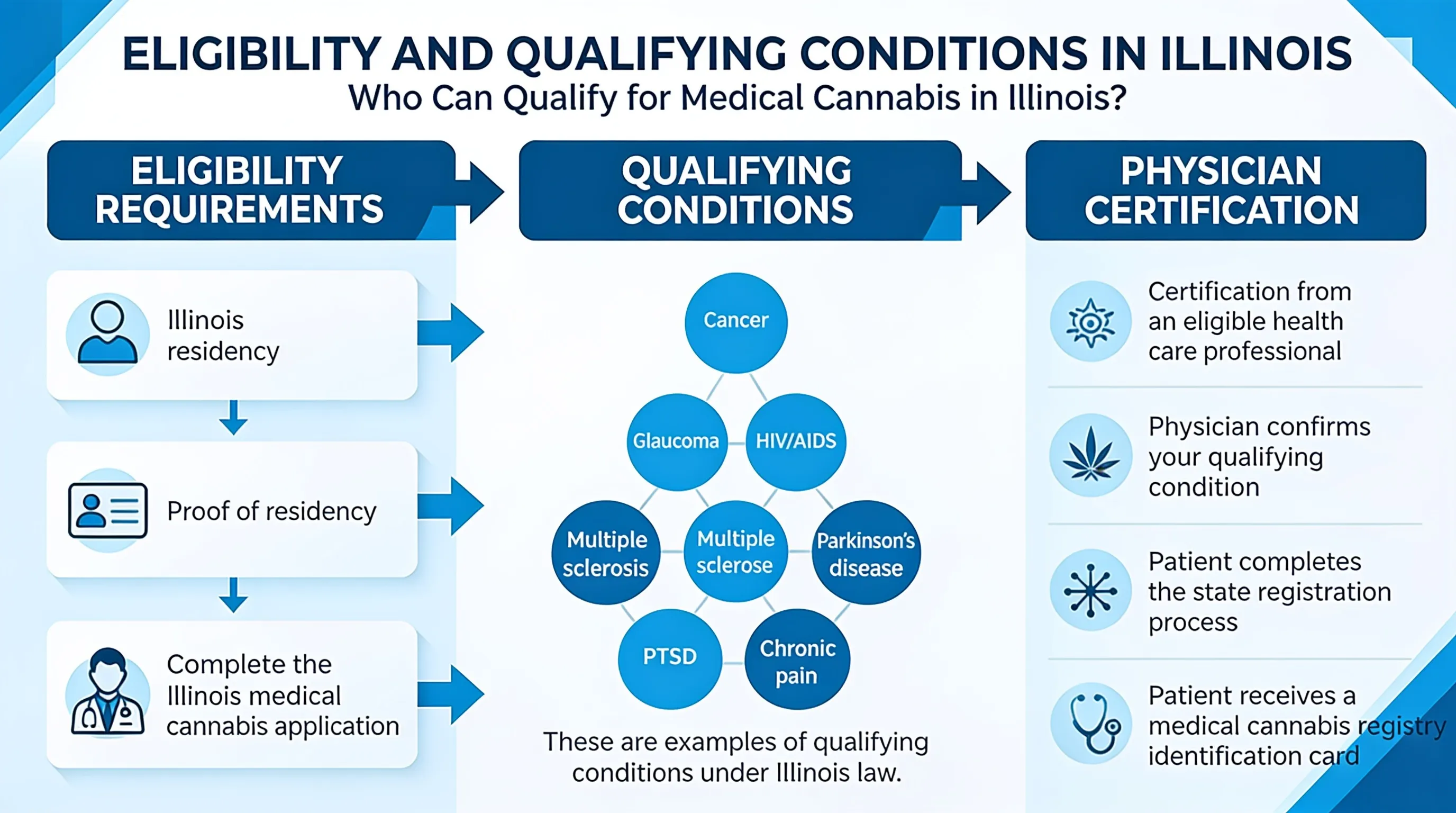
Terminal illness is a qualifying condition in Illinois. Patients diagnosed with six months or less to live can qualify for the Terminal Illness Registry Card. This provision helps patients facing end-of-life care access relief quickly.
List of Common Qualifying Conditions
Illinois recognizes these specific qualifying conditions:
-
Chronic or severe pain
-
Cancer (including cancer-related nausea, pain, and wasting syndrome)
-
Epilepsy and seizure disorders
-
Multiple sclerosis and muscle spasticity
-
HIV/AIDS and associated cachexia
-
Glaucoma
-
Post-traumatic stress disorder (PTSD)
-
Crohn’s disease and inflammatory bowel disease
-
Amyotrophic lateral sclerosis (ALS)
-
Parkinson’s disease
-
Huntington’s disease
-
Lupus
-
Spinal cord injury with spasticity
-
Fibromyalgia
-
Rheumatoid arthritis
-
Neuropathy
-
Sickle cell anemia
-
Tourette syndrome
-
Autism spectrum disorder
-
Chronic migraines
You may find more conditions on the list, as the Illinois Department of Public Health (IDPH) updated its list on August 14, 2026. Beyond this list, physicians can certify any debilitating condition. This flexibility helps patients with rare or complex conditions access treatment. Your doctor makes the final determination based on your medical history and symptoms.
Documentation Requirements
Medical records showing prior diagnosis or treatment strengthen your application. That said, telehealth physicians can evaluate your condition based on your reported symptoms and medical history during the consultation. You do not need prior cannabis use to qualify.
Bring any relevant medical records to your evaluation. Lab results, imaging reports, prescription histories, and diagnosis letters all help. These documents support your physician’s certification. Your health care professional determines whether you meet the certification requirements based on your medical evaluation and the information you provide.
Telehealth services often cost less than in-person clinics. The state application fee adds to your total cost. Budget for both the physician evaluation and state registration when planning your application.
How Physicians Verify Eligibility
Physicians verify eligibility through a medical consultation. They review your symptoms, medical history, and any documentation you provide. The doctor assesses whether cannabis treatment is appropriate for your condition. This evaluation can happen in person or via telehealth video call.
Minors under 18 can qualify with parental consent. They require two physician certifications instead of one. This extra step protects young patients and ensures appropriate medical oversight. Parents or legal guardians must participate in the application process. Illinois medical marijuana laws cover this in detail.
Conclusion
A Free Medical Marijuana Card IL is not available to everyone. However, qualifying terminal patients can receive a free Terminal Illness Registry Card, and other eligible patients may qualify for reduced registration fees. Physician evaluation costs vary by provider.
Illinois taxes medical cannabis purchases at a different rate than adult-use purchases. Medical patients may also purchase up to 2.5 ounces during a 14-day period, subject to program rules. Registered patients also receive protections provided by Illinois medical cannabis law.
The step-by-step process is simple. Check whether you have one of Illinois’s 56 qualifying debilitating conditions. Schedule a telehealth medical marijuana evaluation illinois with a licensed physician. Get your certification and submit your application to the state. After approval, you can access your medical cannabis card through your Illinois patient account.
LeafyRX connects eligible Illinois patients with licensed doctors for online medical cannabis evaluations. Over 100,000 patients trust our platform nationwide. We offer a money-back guarantee if you don’t get approved. Start your evaluation today and get legal access to medical cannabis.







 Ask ChatGPT
  Ask Claude
  Ask Perplexity