

Introduction: Understanding Medical Marijuana Qualifying Conditions
If you are exploring cannabis as a treatment option, understanding medical marijuana qualifying conditions is the essential first step. In the United States, each state that has legalized medical cannabis maintains its own approved list of health conditions that make a patient eligible for a medical marijuana card. These lists range from just a few narrow conditions in restrictive, CBD-only programs to dozens of recognized diagnoses in comprehensive programs. Knowing exactly which medical marijuana qualifying conditions apply in your state determines whether you can legally access cannabis-based treatment and how to begin the application process.
The National Conference of State Legislatures tracks cannabis legislation across all 50 states and confirms that the majority of U.S. states now permit some form of medical cannabis use. However, as the CDC notes in its cannabis overview, state laws govern medical use entirely independently of federal policy, which means your eligibility depends entirely on where you live.
This guide replicates the full state-by-state format of the source data so you can jump directly to your state and review its exact qualifying condition list. We have also included contextual notes, authentic external resources, and guidance on how to take the next step toward getting your medical card.
What Are Medical Marijuana Qualifying Conditions?
Medical marijuana qualifying conditions are officially approved diagnoses that entitle a patient to apply for a state-issued medical marijuana card. A licensed physician must evaluate the patient and certify that they have one of these conditions before the patient can register with their state health department. According to the Drug Policy Alliance, these programs exist to ensure that medical cannabis is distributed through a regulated, physician-supervised pathway rather than through unregulated channels.
Even in states where adult-use cannabis is legal, maintaining a valid medical card still provides meaningful advantages. Medical patients are often exempt from certain sales taxes, can purchase higher quantities, and gain access to products with higher potency limits. For patients with serious chronic or terminal illnesses, these distinctions can make a significant practical difference.
Not sure if your condition qualifies? Use the LeafyRX state guide to check your eligibility and connect with a licensed doctor online in minutes. Approval is guaranteed or your money back.
Medical Marijuana Qualifying Conditions by State
The following is a full state-by-state breakdown of qualifying health conditions. Data is sourced from the Compassionate Certification Centers qualifying conditions reference. Always verify current conditions directly with your state health department, as programs are updated regularly.
Alabama
Alabama legalized medical cannabis on May 17, 2021. Flower, vape products, and edibles are prohibited; permitted forms include oral tablets, capsules, tinctures, gels, oils, topicals, patches, nebulizers, and inhalers. For full program details, visit the Alabama Medical Cannabis Commission.
Qualifying health conditions for Alabama’s medical marijuana program include:
-
Cancer-related weight loss, chronic pain, nausea or vomiting, or Cachexia/Wasting Syndrome
-
Post-Traumatic Stress Disorder (PTSD)
-
Depression
-
Crohn’s Disease
-
Epilepsy
-
Autism Spectrum Disorder
-
Chronic or intractable pain not effectively treated with opioids, or for which opioid therapy is inadvisable
-
Sickle Cell Anemia
-
HIV/AIDS-related nausea or weight loss
-
Panic disorder
-
Parkinson’s disease
-
Persistent nausea not alleviated by more common treatments and not caused by pregnancy or marijuana use
-
Spasticity related to a spinal cord injury, MS, ALS, or another motor neuron disease
-
A terminal illness
-
Tourette’s Syndrome
Alaska
Alaska has allowed medical cannabis since 1998 and adult-use cannabis since 2014. Program details are managed by the Alaska Marijuana Control Office.
Qualifying health conditions for Alaska’s medical marijuana program include:
-
Cachexia or Wasting Syndrome
-
Cancer
-
Chronic pain
-
Glaucoma
-
HIV or AIDS
-
Multiple sclerosis
-
Nausea
-
Persistent Muscle Spasms
-
Seizures
Arizona
Arizona legalized medical cannabis in 2010 and adult-use cannabis in 2020. The program is administered by the Arizona Department of Health Services.
Qualifying health conditions for Arizona’s medical marijuana program include:
-
Alzheimer’s disease
-
Amyotrophic Lateral Sclerosis (ALS/Lou Gehrig’s Disease)
-
Cachexia or Wasting Syndrome
-
Cancer
-
Chronic pain
-
Crohn’s disease
-
Glaucoma
-
Hepatitis C
-
HIV or AIDS
-
Nausea
-
Persistent muscle spasms
-
PTSD
-
Seizures
Arkansas
Voters in Arkansas approved medical marijuana laws in 2016. The state opened its first dispensary application round in August 2017.
Qualifying health conditions for Arkansas’s medical marijuana program include:
-
Amyotrophic Lateral Sclerosis (ALS/Lou Gehrig’s Disease)
-
Alzheimer’s disease
-
Cachexia or Wasting Syndrome
-
Cancer
-
Chronic or debilitating disease
-
Crohn’s disease
-
Fibromyalgia
-
Glaucoma
-
Hepatitis C
-
HIV/AIDS
-
Intractable pain
-
Multiple sclerosis
-
Peripheral neuropathy
-
PTSD
-
Seizures
-
Severe arthritis
-
Severe nausea
-
Severe and persistent muscle spasms
-
Tourette’s syndrome
-
Ulcerative colitis
-
Any medical condition or its treatment approved by the Department of Health
California
California was the first state to legalize medical cannabis through a ballot vote in 1996 and legalized adult-use cannabis in 2016. The program is overseen by the California Department of Cannabis Control.
Qualifying health conditions for California’s medical marijuana program include:
-
Anorexia
-
Arthritis
-
Cachexia or Wasting Syndrome
-
Cancer
-
Chronic Pain
-
HIV/AIDS
-
Glaucoma
-
Migraine
-
Persistent Muscle Spasms
-
Severe Nausea
-
Seizures
-
Any debilitating illness where medical use of marijuana has been deemed appropriate and recommended by a physician
Colorado
Colorado launched its medical marijuana program in 2000 and adult-use cannabis in 2012. Program information is available through the Colorado Department of Public Health and Environment.
Qualifying health conditions for Colorado’s medical marijuana program include:
-
An Autism Spectrum Disorder
-
Any condition for which a physician would prescribe an opioid
-
Cachexia or Wasting Syndrome
-
Cancer
-
Chronic pain
-
Chronic nervous system disorders
-
Glaucoma
-
HIV/AIDS
-
Nausea
-
Persistent Muscle Spasms
-
Post-Traumatic Stress Disorder (PTSD)
-
Seizures
Connecticut
Connecticut signed its medical marijuana program into law in 2012 and expanded to adult use as of July 1, 2021.
Qualifying health conditions for Connecticut’s medical marijuana program include:
-
Amyotrophic Lateral Sclerosis (ALS/Lou Gehrig’s Disease)
-
Cachexia or Wasting Syndrome
-
Cancer
-
Cerebral Palsy
-
Chronic Neuropathic Pain Associated with Degenerative Spinal Disorders
-
Chronic Pain of at least six months duration associated with a specified underlying chronic condition refractory to other treatment intervention
-
Chronic Pancreatitis
-
Complex regional pain syndrome
-
Crohn’s disease
-
Cystic Fibrosis
-
Ehlers-Danlos Syndrome Associated with Chronic Pain
-
Epilepsy
-
Glaucoma
-
HIV or AIDS
-
Hydrocephalus with Intractable Headache
-
Interstitial Cystitis
-
Intractable Neuropathic Pain Unresponsive to Standard Medical Treatments
-
Intractable spasticity
-
Intractable Headache Syndromes
-
Irreversible Spinal Cord Injury with Objective Neurological Indication of Intractable Spasticity
-
MALS Syndrome (Median Arcuate Ligament Syndrome)
-
Movement disorders associated with Huntington Disease
-
Multiple Sclerosis
-
Muscular Dystrophy
-
Neuropathic Facial Pain
-
Osteogenesis Imperfecta
-
Parkinson’s Disease
-
Post Herpetic Neuralgia
-
Post-surgical back pain with chronic radiculopathy
-
Post Laminectomy Syndrome
-
Post-Traumatic Stress Disorder (PTSD)
-
Severe psoriasis and psoriatic arthritis
-
Severe Rheumatoid Arthritis
-
Sickle cell disease
-
Spasticity or Neuropathic Pain Associated with Fibromyalgia
-
Terminal Illness Requiring End-Of-Life Care
-
Tourette Syndrome
-
Ulcerative colitis
-
Uncontrolled Intractable Seizure Disorder
-
Vulvodynia and Vulvar Burning
-
Other medical conditions may be approved by the Department of Consumer Protection
Delaware
Delaware passed the Delaware Medical Marijuana Act in May 2011 and decriminalized cannabis in December 2015.
Qualifying health conditions for Delaware’s medical marijuana program include:
-
Autism with self-injurious or aggressive behavior
-
Alzheimer’s disease
-
Amyotrophic Lateral Sclerosis (ALS/Lou Gehrig’s Disease)
-
Cachexia or Wasting Syndrome
-
Cancer
-
Chronic Debilitating Migraines
-
Chronic pain
-
Decompensated Cirrhosis
-
Glaucoma
-
HIV/AIDS
-
Intractable epilepsy
-
Multiple Sclerosis
-
Nausea
-
Post-traumatic Stress Disorder (PTSD)
-
Seizures
-
Severe and persistent muscle spasms
-
Terminal Illness
Florida
Florida’s Compassionate Medical Cannabis Act has been in effect since 2015. The program is managed by the Florida Department of Health Office of Medical Marijuana Use.
Qualifying health conditions for Florida’s medical marijuana program include:
-
Amyotrophic Lateral Sclerosis (ALS/Lou Gehrig’s Disease)
-
Cancer
-
Crohn’s disease
-
Chronic nonmalignant pain
-
Epilepsy
-
Glaucoma
-
HIV/AIDS
-
Multiple sclerosis
-
Muscle spasms
-
Parkinson’s disease
-
PTSD
-
Seizures
-
Terminal illness (patients diagnosed with no more than 12 months to live)
-
Other debilitating medical conditions comparable to those enumerated
Georgia
Georgia has had a medical cannabis program since it signed the “Haleigh’s Hope Act” on April 16, 2015. Georgia’s program is limited to low-THC cannabis oil.
Qualifying health conditions for Georgia’s medical marijuana program include:
-
AIDS
-
Alzheimer’s disease
-
Amyotrophic Lateral Sclerosis (ALS/Lou Gehrig’s Disease)
-
Autism
-
Cancer
-
Crohn’s disease
-
Epidermolysis Bullosa
-
Hospice care patients
-
Intractable pain
-
Mitochondrial disease
-
Multiple sclerosis
-
Parkinson’s disease
-
Post-Traumatic Stress Disorder (PTSD)
-
Severe or end-stage Peripheral neuropathy
-
Seizure disorder
-
Sickle cell disease
-
Tourette’s syndrome
Hawaii
Hawaii was the first state to legalize medical cannabis through an act of the state legislature (rather than a ballot initiative) in 2000. It officially decriminalized cannabis in 2020. Details are available through the Hawaii Department of Health Medical Cannabis Registry.
Qualifying health conditions for Hawaii’s medical marijuana program include:
-
Amyotrophic Lateral Sclerosis (ALS/Lou Gehrig’s Disease)
-
Cachexia or Wasting Syndrome
-
Cancer
-
Chronic pain
-
Crohn’s disease
-
Epilepsy
-
Glaucoma
-
HIV or AIDS
-
Lupus
-
Multiple sclerosis
-
Nausea
-
Persistent muscle spasms
-
Post-traumatic stress disorder (PTSD)
-
Rheumatoid arthritis
-
Seizures
Illinois
Illinois launched its medical marijuana program in 2013 and fully legalized adult-use cannabis in May 2019. The program is overseen by the Illinois Department of Public Health.
Qualifying health conditions for Illinois’ medical marijuana program include:
-
Autism
-
Alzheimer’s disease
-
Amyotrophic Lateral Sclerosis (ALS/Lou Gehrig’s Disease)
-
Anorexia Nervosa
-
Arnold Chiari malformation
-
Cachexia/Wasting syndrome
-
Cancer
-
Causalgia
-
Chronic Inflammatory Demyelinating Polyneuropathy
-
Complex regional pain syndrome type 2 (CRPS)
-
Crohn’s Disease
-
Dystonia
-
Ehlers-Danlos Syndrome
-
Fibromyalgia
-
Fibrous dysplasia
-
Glaucoma
-
Hepatitis C
-
HIV/AIDS
-
Hydrocephalus
-
Hydromyelia
-
Interstitial Cystitis
-
Irritable Bowel Syndrome (IBS)
-
Lupus
-
Migraines
-
Multiple Sclerosis
-
Muscular Dystrophy
-
Myasthenia Gravis
-
Myoclonus
-
Nail-patella syndrome
-
Neurofibromatosis
-
Neuropathy
-
Osteoarthritis
-
Parkinson’s disease
-
Polycystic Kidney Disease (PKD)
-
Post-traumatic stress disorder (PTSD)
-
Reflex Sympathetic Dystrophy (RSD)
-
Residual limb pain
-
Rheumatoid Arthritis
-
Seizures
-
Sjogren’s syndrome
-
Spinal cord disease
-
Spinocerebellar Ataxia (SCA)
-
Superior Canal Dehiscence Syndrome
-
Syringomyelia
-
Tarlov cysts
-
Tourette’s syndrome
-
Traumatic brain injury and post-concussion syndrome
-
Ulcerative Colitis
Indiana
Indiana’s medical CBD program was signed into law in 2018. It is limited to CBD products only and covers a very narrow range of conditions.
Qualifying health conditions for Indiana’s Medical CBD program include:
-
Severe epilepsy resistant to other treatments
-
Dravet syndrome
-
Lennox-Gastaut syndrome
Iowa
Starting in December 2018, patients in Iowa with one of the following conditions and the proper physician recommendations can use certain CBD extracts.
Qualifying health conditions for Iowa’s medical CBD program include:
-
AIDS/HIV
-
Amyotrophic Lateral Sclerosis (ALS/Lou Gehrig’s Disease)
-
Cancer
-
Cancer-related chronic pain, nausea, or cachexia
-
Corticobasal Degeneration
-
Crohn’s disease
-
Multiple sclerosis
-
Parkinson’s disease
-
Post-traumatic Stress Disorder
-
Intractable epilepsy
-
Seizures
-
Severe, intractable autism with self-injurious or aggressive behaviors
-
Terminal illness
-
Ulcerative Colitis
-
Untreatable pain
Kentucky
Kentucky has a narrow CBD-only medical cannabis program. Coverage is limited to a single qualifying condition.
Qualifying health conditions for Kentucky’s medical CBD program include:
- Intractable epilepsy
Louisiana
Louisiana’s Therapeutic Marijuana Act approved vaporization via inhaler in 2019 and expanded to allow smoking starting January 1, 2022.
Qualifying health conditions for Louisiana’s medical marijuana program include:
-
Autism Spectrum disorders
-
Cachexia or Wasting Syndrome
-
Cancer
-
Crohn’s disease
-
Epilepsy
-
Glaucoma
-
HIV/AIDS
-
Intractable Pain
-
Muscular dystrophy
-
Multiple sclerosis
-
Parkinson’s disease
-
Post-traumatic Stress Disorder (PTSD)
-
Seizure disorders/spasticity
-
Severe muscle spasms
Maine
Medical cannabis has been legal in Maine since 1999. Voters approved adult-use cannabis in 2016.
Qualifying health conditions for Maine’s medical marijuana program include:
-
Alzheimer’s disease
-
Amyotrophic Lateral Sclerosis (ALS/Lou Gehrig’s Disease)
-
Cachexia or wasting syndrome
-
Cancer
-
Chronic pain
-
Crohn’s disease
-
Epilepsy
-
Glaucoma
-
Hepatitis C
-
HIV or AIDS
-
Huntington’s disease
-
Inflammatory bowel disease
-
Multiple Sclerosis
-
Nausea
-
Nail-patella syndrome
-
Parkinson’s disease
-
Post-traumatic stress disorder (PTSD)
Maryland
Maryland decriminalized and legalized medical cannabis in 2014.
Qualifying health conditions for Maryland’s medical marijuana program include:
-
Cachexia or Wasting Syndrome
-
Anorexia
-
Chronic Pain
-
Glaucoma
-
Nausea
-
Post-Traumatic Stress Disorder
-
Seizures
-
Severe or persistent muscle spasms
-
A chronic medical condition that is severe and for which other treatments have been ineffective
Massachusetts
Massachusetts launched its medical cannabis program in 2013 and legalized adult-use cannabis in 2016. The program is regulated by the Cannabis Control Commission.
Qualifying health conditions for Massachusetts’ medical marijuana program include:
-
Amyotrophic Lateral Sclerosis (ALS)
-
Anxiety
-
Cachexia or Wasting Syndrome
-
Cancer
-
Crohn’s disease
-
Glaucoma
-
HIV or AIDS
-
Hepatitis C
-
Multiple Sclerosis
-
Parkinson’s disease
-
Post-Traumatic Stress Disorder (PTSD)
-
Other conditions as determined in writing by a qualifying patient’s physician
Michigan
Michigan has had a medical marijuana program since 2008 and legalized adult-use cannabis in 2018.
Qualifying health conditions for Michigan’s medical marijuana program include:
-
Autism
-
Alzheimer’s disease
-
Amyotrophic Lateral Sclerosis (ALS/Lou Gehrig’s Disease)
-
Arthritis
-
Cachexia or wasting syndrome
-
Cancer
-
Cerebral Palsy
-
Chronic pain
-
Colitis
-
Crohn’s disease
-
Glaucoma
-
HIV or AIDS
-
Hepatitis C
-
Inflammatory Bowel Disease (IBD)
-
Nail-patella
-
Nausea
-
Obsessive-Compulsive Disorder (OCD)
-
Parkinson’s Disease
-
Post-traumatic stress disorder (PTSD)
-
Rheumatoid Arthritis
-
Seizures
-
Severe and persistent muscle spasms
-
Spinal cord injury
-
Tourette’s Disease
-
Ulcerative Colitis
Minnesota
Medical cannabis has been legal in Minnesota since 2014. The program was revised to allow smoking of cannabis effective March 1, 2022.
Qualifying health conditions for Minnesota’s medical marijuana program include:
-
Alzheimer’s Disease
-
Amyotrophic Lateral Sclerosis (ALS/Lou Gehrig’s Disease)
-
Autism
-
Cancer
-
Chronic Motor or Vocal Tic Disorder
-
Chronic Pain
-
Crohn’s disease
-
Epilepsy
-
Glaucoma
-
HIV/AIDS
-
Inflammatory Bowel Disease (IBD)
-
Intractable pain
-
Multiple Sclerosis
-
Obstructive Sleep Apnea
-
Post-traumatic stress disorder (PTSD)
-
Seizures
-
Severe and persistent muscle spasms
-
Sickle Cell Disease
-
Terminal illness
-
Tourette’s Syndrome
Mississippi
Mississippi launched a comprehensive medical marijuana program as of February 2, 2022, after years of decriminalization.
Qualifying health conditions for Mississippi’s medical marijuana program include:
-
Alzheimer’s Disease
-
Amyotrophic Lateral Sclerosis (ALS/Lou Gehrig’s Disease)
-
Autism
-
Cachexia or Wasting Syndrome
-
Cancer
-
Crohn’s Disease
-
Chronic Pain
-
Dementia
-
Diabetic/Peripheral Neuropathy
-
Glaucoma
-
HIV/AIDS
-
Hepatitis
-
Huntington’s Disease
-
Multiple Sclerosis
-
Muscular Dystrophy
-
Pain refractory to appropriate opioid management
-
Parkinson’s Disease
-
Post-Traumatic Stress Disorder (PTSD)
-
Seizures
-
Severe and persistent muscle spasms
-
Severe or intractable nausea
-
Spastic Quadriplegia
-
Spinal cord disease or severe injury
-
Sickle-Cell Anemia
-
Ulcerative Colitis
Missouri
Missouri decriminalized cannabis in 2014, legalized medical cannabis in 2018, and the medical program launched in October 2020.
Qualifying health conditions for Missouri’s medical marijuana program include:
-
A chronic medical condition normally treated with prescription medications that could lead to physical or psychological dependence
-
Alzheimer’s Disease
-
Amyotrophic Lateral Sclerosis (ALS/Lou Gehrig’s Disease)
-
Autism
-
Cachexia or Wasting Syndrome
-
Cancer
-
Chronic Pain
-
Crohn’s disease
-
Debilitating psychiatric disorders
-
Epilepsy
-
Glaucoma
-
Hepatitis C
-
HIV/AIDS
-
Huntington’s Disease
-
Inflammatory Bowel Disease (IBD)
-
Intractable migraines unresponsive to other treatment
-
Multiple Sclerosis
-
Neuropathies
-
Parkinson’s Disease
-
Post-Traumatic Stress Disorder (PTSD)
-
Sickle Cell Anemia
-
Seizures
-
Severe, persistent muscle spasms
-
Terminal illness
-
Tourette’s Syndrome
Montana
Voters in Montana approved a new medical marijuana program in 2016. Adult-use cannabis became legal to purchase in licensed dispensaries as of January 1, 2022.
Qualifying health conditions for Montana’s medical marijuana program include:
-
A CNS disorder that results in muscle spasms or painful/chronic spasticity
-
Cachexia or Wasting Syndrome
-
Cancer
-
Chronic Inflammatory Demyelinating Polyneuropathy
-
Crohn’s Disease
-
Epilepsy or an Intractable Seizure Disorder
-
Glaucoma
-
HIV/AIDS
-
Hospice Care
-
Multiple Sclerosis
-
Post-Traumatic Stress Disorder (PTSD)
-
Severe nausea or pain
Nevada
Nevada has allowed patients to grow medical cannabis since 2000, opened legal sales in 2015, and legalized adult-use cannabis in July 2017. Program information is managed by the Nevada Department of Health and Human Services.
Qualifying health conditions for Nevada’s medical marijuana program include:
-
Anxiety
-
Anorexia Nervosa
-
Autism Spectrum Disorder
-
Autoimmune Disease
-
Cachexia or Wasting Syndrome
-
Cancer
-
Chronic Pain
-
Dependence upon or Addiction to Opioids
-
Epilepsy
-
Glaucoma
-
HIV/AIDS
-
Multiple Sclerosis
-
Muscle Spasms
-
Nausea
-
Neuropathy
-
Post-Traumatic Stress Disorder (PTSD)
-
Seizures
New Hampshire
New Hampshire signed its medical marijuana program into law in 2013 and decriminalized small amounts of cannabis in 2017.
Qualifying health conditions for New Hampshire’s medical marijuana program include:
-
Amyotrophic Lateral Sclerosis (ALS/Lou Gehrig’s Disease)
-
Alzheimer’s disease
-
Cachexia or Wasting Syndrome
-
Cancer
-
Chemotherapy-induced anorexia
-
Chronic Pain that has not responded to previously prescribed medication
-
Chronic pancreatitis
-
Crohn’s disease
-
Ehlers-Danlos syndrome
-
Elevated intraocular pressure
-
Epilepsy
-
Glaucoma
-
Hepatitis C
-
HIV/AIDS
-
Lupus
-
Moderate to severe vomiting
-
Multiple Sclerosis
-
Muscular Dystrophy
-
Nausea
-
Parkinson’s disease
-
Persistent muscle spasms
-
Post-Traumatic Stress Disorder (PTSD)
-
Seizures
-
Spinal cord injury or disease
-
Terminal Illness
-
Traumatic brain injury
-
Ulcerative Colitis
New Jersey
Medicinal cannabis has been legal in New Jersey since 2010. The Garden State officially legalized adult-use cannabis in February 2021.
Qualifying health conditions for New Jersey’s medical marijuana program include:
-
Amyotrophic Lateral Sclerosis (ALS/Lou Gehrig’s Disease)
-
Anxiety
-
Cachexia or Wasting Syndrome
-
Cancer
-
Chronic Pain
-
Crohn’s disease
-
Dysmenorrhea
-
Epilepsy
-
Glaucoma
-
HIV/AIDS
-
Inflammatory bowel disease (IBD)
-
Intractable skeletal and muscular spasticity
-
Migraines
-
Multiple Sclerosis
-
Muscular Dystrophy
-
Nausea
-
Opioid use disorder
-
Post-Traumatic Stress Disorder (PTSD)
-
Seizures
-
Tourette’s Syndrome
-
Any terminal illness if a doctor has determined the patient will die within a year
New Mexico
New Mexico has allowed medicinal cannabis since 2007 and legalized adult-use cannabis on June 29, 2021.
Qualifying health conditions for New Mexico’s medical marijuana program include:
-
Alzheimer’s Disease
-
Amyotrophic Lateral Sclerosis (ALS/Lou Gehrig’s Disease)
-
Anorexia
-
Autism Spectrum Disorder
-
Cachexia or Wasting Syndrome
-
Cancer
-
Chronic pain
-
Crohn’s disease
-
Damage to the Nervous Tissue of the Spinal Cord
-
Epilepsy
-
Friedreich’s Ataxia
-
Glaucoma
-
Hepatitis C
-
HIV/AIDS
-
Hospice patients
-
Huntington’s disease
-
Inclusion Body Myositis
-
Inflammatory Autoimmune-mediated Arthritis
-
Intractable nausea/vomiting
-
Lewy Body Disease
-
Multiple sclerosis
-
Obstructive Sleep Apnea
-
Opioid Use Disorder
-
Painful Peripheral Neuropathy
-
Parkinson’s disease
-
Post-traumatic Stress Disorder (PTSD)
-
Seizures
-
Spasmodic Torticollis (Cervical Dystonia)
-
Spinal Muscular Atrophy
-
Ulcerative Colitis
New York
As of January 24, 2022, New York dropped all qualifying conditions from its medical marijuana program. Licensed physicians and practitioners can now prescribe medical cannabis for any condition they believe is appropriate. New York also permanently waived the $50 patient application fee, expanded the type of practitioners who can certify patients, and allowed the sale of flower. Program details are managed by the New York Office of Cannabis Management.
North Carolina
North Carolina legalized CBD oil use in 2015. No physician recommendation is required to purchase CBD. A broader medical marijuana program has been under legislative discussion but no comprehensive law had been enacted at the time of this publication.
North Dakota
North Dakota legalized medical marijuana during the 2016 elections.
Qualifying health conditions for North Dakota’s medical marijuana program include:
-
Agitation from Alzheimer’s disease or related dementia
-
Amyotrophic lateral sclerosis (ALS/Lou Gehrig’s Disease)
-
Anorexia Nervosa
-
Anxiety Disorder
-
Autism Spectrum Disorder
-
Brain Injury
-
Bulimia Nervosa
-
Cachexia or Wasting syndrome
-
Cancer
-
Chronic or debilitating disease
-
Crohn’s disease
-
Ehlers-Danlos Syndrome
-
Endometriosis
-
Epilepsy
-
Fibromyalgia
-
Glaucoma
-
Hepatitis C
-
HIV/AIDS
-
Interstitial Cystitis
-
Intractable nausea
-
Neuropathy
-
Migraine
-
Multiple sclerosis
-
Post-traumatic stress disorder (PTSD)
-
Rheumatoid Arthritis
-
Seizures
-
Severe and persistent muscle spasms
-
Severe debilitating pain
-
Spinal stenosis
-
Tourette’s Syndrome
Ohio
Ohio decriminalized cannabis in 1975 and signed a medical marijuana bill in 2016. Dispensaries were permitted to open in late 2018. For current program information, visit the Ohio Medical Marijuana Control Program.
Qualifying health conditions for Ohio’s medical marijuana program include:
-
Alzheimer’s disease
-
Amyotrophic lateral sclerosis (ALS/Lou Gehrig’s Disease)
-
Cachexia or Wasting Syndrome
-
Cancer
-
Chronic traumatic encephalopathy
-
Crohn’s disease
-
Epilepsy
-
Fibromyalgia
-
Glaucoma
-
Hepatitis C
-
HIV/AIDS
-
Huntington’s Disease
-
Inflammatory bowel disease
-
Multiple Sclerosis
-
Pain that is either chronic and severe or intractable
-
Parkinson’s disease
-
Post-traumatic stress disorder (PTSD)
-
Seizures
-
Sickle cell anemia
-
Spasticity
-
Spinal cord disease or injury
-
Terminal Illness
-
Tourette’s syndrome
-
Traumatic brain injury
-
Ulcerative colitis
Oklahoma
Oklahoma’s medical marijuana program took effect in 2018 and does not maintain a fixed list of qualifying conditions. A licensed physician’s recommendation is the sole requirement. The following are common conditions for which patients receive recommendations.
Common qualifying conditions in Oklahoma’s medical marijuana program include:
-
Anxiety Disorders
-
Body Aches
-
Cachexia or Wasting Syndrome
-
Cancer
-
Depression
-
Epilepsy
-
Glaucoma
-
HIV/AIDS
-
Inflammation
-
Loss of appetite
-
Migraines
-
Muscle pain
-
Nausea
-
Neuropathic pain disorders
-
Seizures
Oregon
Oregon legalized medical cannabis through a ballot vote in 1998 and adult-use cannabis in 2014.
Qualifying health conditions for Oregon’s medical marijuana program include:
-
Alzheimer’s disease
-
Cachexia or Wasting Syndrome
-
Cancer
-
Chronic pain
-
Glaucoma
-
HIV or AIDS
-
Nausea
-
Persistent muscle spasms
-
Post-traumatic Stress Disorder (PTSD)
-
Seizures
-
Other conditions subject to approval
Pennsylvania
Pennsylvania legalized medical cannabis in spring 2016. The Pennsylvania Medical Marijuana Program officially launched in 2018. For current program details, visit the Pennsylvania Department of Health Medical Marijuana Program.
Qualifying health conditions for Pennsylvania’s medical marijuana program include:
-
Amyotrophic Lateral Sclerosis (ALS/Lou Gehrig’s Disease)
-
Anxiety Disorders
-
Autism
-
Cancer
-
Crohn’s disease
-
Damage to the nervous tissue of the Central Nervous System (brain-spinal cord)
-
Dyskinetic and spastic movement disorders
-
Epilepsy
-
Glaucoma
-
HIV/AIDS
-
Huntington’s disease
-
Inflammatory bowel disease (IBD)
-
Intractable seizures
-
Intractable spasticity
-
Multiple Sclerosis
-
Neurodegenerative Diseases
-
Neuropathies
-
Opioid use disorder
-
Parkinson’s disease
-
Post-Traumatic Stress Disorder (PTSD)
-
Severe chronic or intractable pain
-
Sickle Cell Anemia
-
Terminal illness
-
Tourette’s Syndrome
Rhode Island
Rhode Island’s medical cannabis laws went into effect in 2006, and the state decriminalized cannabis in 2013.
Qualifying health conditions for Rhode Island’s medical marijuana program include:
-
Alzheimer’s Disease
-
Cachexia or Wasting Syndrome
-
Cancer
-
Chronic pain
-
Crohn’s disease
-
Epilepsy
-
Glaucoma
-
Hepatitis C
-
HIV/AIDS
-
Multiple Sclerosis
-
Nausea
-
Persistent muscle spasms
-
Post-traumatic stress disorder
-
Seizures
-
Other conditions subject to approval
South Carolina
South Carolina’s Senate approved a Medical Marijuana Legalization Bill in February 2022. The legislation was sent to the House for consideration. The conditions listed below reflect the proposed bill.
Proposed qualifying health conditions for South Carolina’s medical marijuana program include:
-
A condition causing a person to be homebound that includes severe or persistent nausea
-
A chronic medical condition causing severe and persistent muscle spasms
-
Autism
-
Cachexia or Wasting Syndrome
-
Cancer
-
Crohn’s Disease
-
Chronic medical condition for which an opioid is or could be prescribed based on standards of care
-
Multiple Sclerosis
-
Neurological disease or disorder (including epilepsy)
-
Post-Traumatic Stress Disorder
-
Sickle Cell Anemia
-
Terminal Illness
-
Ulcerative Colitis
South Dakota
South Dakota legalized medicinal cannabis in 2020, and its program became operational on July 1, 2021.
Qualifying health conditions for South Dakota’s medical marijuana program include:
-
Amyotrophic Lateral Sclerosis (ALS/Lou Gehrig’s Disease)
-
Cachexia or Wasting Syndrome
-
Cancer
-
Chronic Pain
-
Crohn’s Disease
-
Epilepsy
-
Glaucoma
-
HIV/AIDS
-
Multiple Sclerosis
-
Nausea or severe vomiting
-
Post-Traumatic Stress Disorder (PTSD)
-
Seizures
Tennessee
Tennessee’s medical cannabis bill permits the use of CBD oil only. The following conditions are covered under Tennessee’s limited CBD program.
Qualifying health conditions for Tennessee’s medical CBD program include:
-
Alzheimer’s Disease
-
Amyotrophic Lateral Sclerosis (ALS/Lou Gehrig’s Disease)
-
Cancer and related conditions
-
Crohn’s Disease
-
Epilepsy
-
HIV/AIDS
-
Inflammatory Bowel Disease (IBD)
-
Multiple Sclerosis
-
Parkinson’s Disease
-
Seizures
-
Sickle Cell Disease
-
Ulcerative Colitis
Texas
Texas issued its first medical marijuana licenses in September 2017 and expanded its limited Compassionate Use Program in 2019 and 2021.
Qualifying health conditions for Texas’s medical marijuana program include:
-
Amyotrophic Lateral Sclerosis (ALS/Lou Gehrig’s Disease)
-
An incurable neurodegenerative disease
-
Autism
-
Epilepsy
-
Multiple Sclerosis
-
Post-Traumatic Stress Disorder
-
Seizures
-
Spasticity
-
Terminal Cancer
Utah
Utah passed the Utah Medical Cannabis Act and launched its program in December 2018.
Qualifying health conditions for Utah’s medical marijuana program include:
-
Alzheimer’s Disease
-
Amyotrophic Lateral Sclerosis (ALS/Lou Gehrig’s Disease)
-
Autism
-
Cachexia or Wasting Syndrome
-
Cancer
-
Chronic Pain
-
Crohn’s Disease
-
Epilepsy
-
HIV/AIDS
-
Hospice Patient
-
Multiple Sclerosis
-
Nausea
-
Persistent and debilitating muscle spasms
-
Post-Traumatic Stress Disorder (PTSD)
-
Rare condition or disease affecting fewer than 200,000 individuals in the U.S. that is not adequately managed despite treatment with conventional medications or physical interventions
-
Seizures
-
Terminal Illness
-
Ulcerative Colitis
Vermont
Vermont legalized medical cannabis in 2004 and adult-use cannabis in 2018.
Qualifying health conditions for Vermont’s medical marijuana program include:
-
Cachexia or wasting syndrome
-
Cancer
-
Crohn’s disease
-
Epilepsy
-
Glaucoma
-
HIV/AIDS
-
Multiple Sclerosis
-
Parkinson’s disease
-
Post-Traumatic Stress Disorder (PTSD)
-
Seizures
-
Severe or chronic pain
-
Severe nausea
Virginia
Virginia legalized both medicinal and adult-use cannabis in April 2021. As of July 1, 2021, any licensed Virginia physician or nurse practitioner can recommend medical cannabis for any condition they deem appropriate.
Qualifying health conditions for Virginia’s medical marijuana program include, but are not limited to:
-
Alzheimer’s Disease
-
Amyotrophic Lateral Sclerosis (ALS/Lou Gehrig’s Disease)
-
Anxiety
-
Autism
-
Cachexia or Wasting Syndrome
-
Cancer
-
Chronic Pain
-
Crohn’s Disease
-
Epilepsy
-
Fibromyalgia
-
Hepatitis C
-
Huntington’s Disease
-
Inflammatory Bowel Disease (IBD)
-
Multiple Sclerosis (MS)
-
Parkinson’s Disease
-
Post-Traumatic Stress Disorder (PTSD)
-
Seizures
-
Sickle Cell Anemia
-
Tourette’s Syndrome
Washington
Washington legalized medical cannabis through a ballot vote in 1998 and adult-use cannabis in 2012.
Qualifying health conditions for Washington’s medical marijuana program include:
-
Anorexia Nervosa
-
Appetite Loss
-
Cachexia or Wasting Syndrome
-
Cancer
-
Chronic renal failure requiring hemodialysis
-
Crohn’s disease
-
Epilepsy
-
Glaucoma
-
Hepatitis C
-
HIV/AIDS
-
Intractable pain
-
Multiple Sclerosis
-
Nausea
-
Persistent muscle spasms and/or spasticity
-
Post-Traumatic Stress Disorder (PTSD)
-
Seizures
-
Traumatic brain injury
-
Any terminal or debilitating condition
West Virginia
West Virginia legalized medical marijuana in 2017 when it signed bill SB 386 into law.
Qualifying health conditions for West Virginia’s medical marijuana program include:
-
Amyotrophic lateral sclerosis (ALS/Lou Gehrig’s Disease)
-
Cancer
-
Crohn’s disease
-
Epilepsy
-
HIV/AIDS
-
Huntington’s disease
-
Intractable seizures
-
Intractable Spasticity
-
Multiple sclerosis
-
Neuropathy
-
Parkinson’s disease
-
Post-Traumatic Stress Disorder (PTSD)
-
Severe chronic or intractable pain
-
Spinal cord damage
-
Sickle cell anemia
-
Terminal illness
Wisconsin
Wisconsin signed a CBD-only medical cannabis program into law in 2014.
Qualifying health conditions for Wisconsin’s medical CBD program include:
- Any medical condition for which a patient receives proper physician recommendations
Wyoming
Wyoming signed a CBD-only medical cannabis law in 2015.
Qualifying health conditions for Wyoming’s medical CBD program include:
- Intractable epilepsy
Washington, D.C.
Washington, D.C. passed medical cannabis legislation in 2010 and adult-use cannabis in 2014. Patients may receive a medical marijuana recommendation for any condition that a treating physician determines would benefit from cannabis use.
Why Getting a Medical Card Still Matters in Adult-Use States
As the Marijuana Policy Project highlights, the growth of recreational cannabis laws has led some patients to forgo their medical card. However, this approach can mean giving up significant benefits. Medical cardholders typically qualify for lower state excise taxes, higher possession and purchase limits, and access to products with greater potency than what recreational shelves are allowed to carry.
Research published by the Journal of Studies on Alcohol and Drugs has explored patterns of medical versus recreational cannabis use and consistently found that medical patients have distinct clinical needs that benefit from physician oversight. Working with a licensed physician ensures your treatment is personalized, monitored, and optimized for your specific condition.
Additionally, as noted by the American Cancer Society in its resource on cannabis and cancer treatment, the involvement of a healthcare provider is important for patients managing complex conditions, because cannabis can interact with certain medications and its dosing varies considerably by condition and individual response.
Ready to get your card? Learn how to get your medical marijuana card online through LeafyRX and complete the entire process from home in minutes. Over 100,000 patients approved. Guaranteed approval or your money back.
How to Get Your Medical Marijuana Card Online
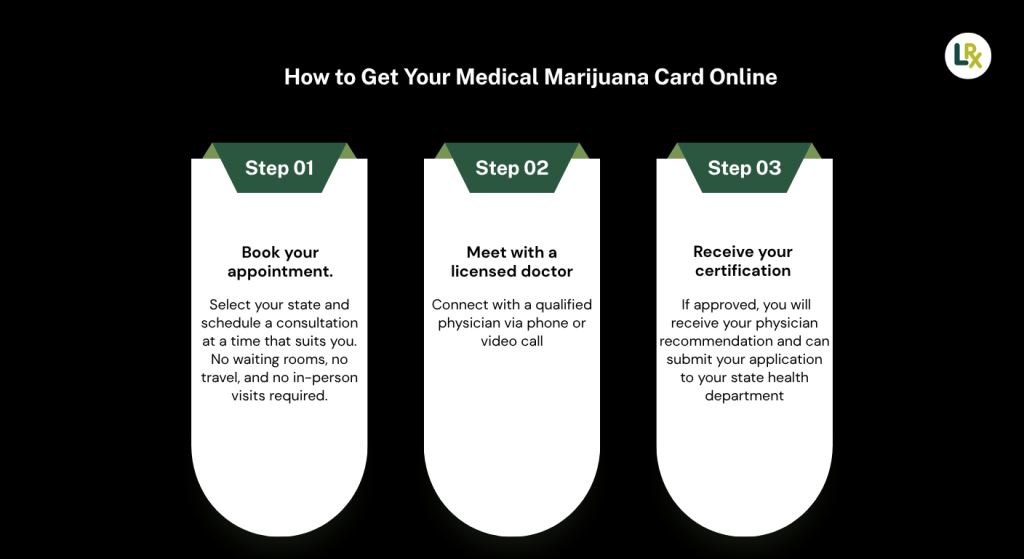
Once you have confirmed that your health condition appears on your state’s qualifying list, the process of applying for a medical card has never been more accessible. LeafyRX connects patients with board-certified, licensed physicians across the United States through a streamlined three-step telehealth process.
Step 1: Book your appointment. Select your state and schedule a consultation at a time that suits you. No waiting rooms, no travel, and no in-person visits required.
Step 2: Meet with a licensed doctor. Connect with a qualified physician via phone or video call. The doctor reviews your medical history, discusses your symptoms, and determines whether medical cannabis is an appropriate option for you.
Step 3: Receive your certification. If approved, you will receive your physician recommendation and can submit your application to your state health department. In many states, a digital card is issued the same day.
LeafyRX is fully HIPAA-compliant, offers some of the lowest certification costs in the country, and backs every consultation with a money-back approval guarantee. Whether you are a first-time applicant or renewing an existing card, the platform makes the process fast, private, and affordable. Visit LeafyRX to check your state and get started today.







 Ask ChatGPT
  Ask Claude
  Ask Perplexity