

Medical marijuana card reciprocity shows if your home state’s card works when you travel. It tells you which states accept your card. Some states allow out-of-state patients to purchase and possess medical cannabis. Others require you to apply for a temporary card or don’t recognize outside credentials at all. The rules change often, and confusion about which states accept your card can leave you without access to your medicine or facing legal trouble.
This guide shows what reciprocity means under state law. It lists which states accept out-of-state cards. You’ll learn what papers you need to stay safe. You’ll also learn about the limits of reciprocity. This includes why your card won’t protect you on federal property or with TSA. You’ll see how to verify current rules before you travel or relocate in 2027.
What Is Medical Marijuana Card Reciprocity?

Medical marijuana card reciprocity lets certified patients buy cannabis. They can own it in states that accept their home state’s program. This means you can access dispensaries outside your home state without obtaining a new card, though the rules vary widely by location.
Reciprocity agreements are voluntary arrangements between states. Not all medical cannabis programs offer this benefit. Some states ask you to get a temp visitor card first. Others want you to sign up before you buy. Some states do not accept your card at all.
Legal Definition and Framework
Your home state’s medical card gives you rights in other states. These rights are limited under reciprocity rules. Bring your valid medical card and government-issued ID. Sometimes you also need your original doctor’s note.
These agreements only cover medical programs. Your medical card does not work at shops for adult use. Reciprocity rules block this access. This holds true even in states that allow adult use. Visitors face different purchase and possession limits than residents. Your health condition must match the state’s approved list.
State legislatures can modify or end reciprocity agreements at any time. What works when traveling with an out-of-state medical card this month might change by next quarter. Checking current status before each trip protects you from legal problems.
How Reciprocity Differs from Full Legalization
Reciprocity does not mean cannabis is legal everywhere you go. Federal law bans cannabis possession and transport. State reciprocity cannot remove these federal risks. Rules change based on what each state does. Some states offer full reciprocity. Others require you to register for a short time. Some states do not recognize your card at all.
For example, Michigan recognizes out-of-state medical cards with certain restrictions, while California does not accept cards from other states at all. Know these rules to plan safe, legal travel. Your medical cannabis card works in some states.
What Medical Marijuana Card Reciprocity Means Under State Law
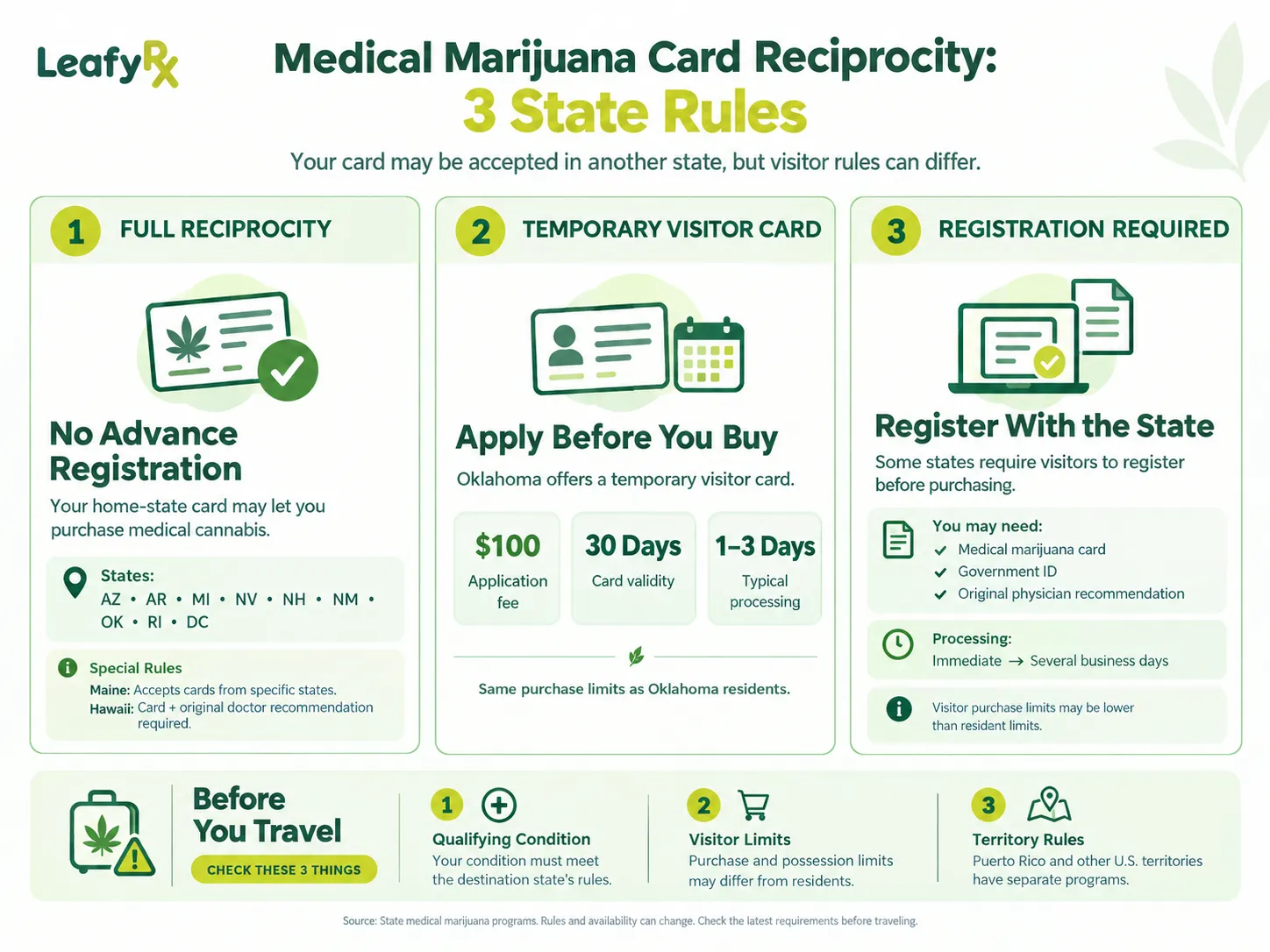
State laws use three main types of reciprocity. Each type has different rules for documents, registration, and purchase limits.
Full Reciprocity States
Nine states and DC allow visiting patients to buy medical cannabis. Your home state card works in these places. These states are: Arizona, Arkansas, Michigan, Nevada, New Hampshire, New Mexico, Oklahoma, Rhode Island, and Washington, DC. No advance registration is required.
Maine also allows full reciprocity, but it has a specific list of states it accepts. Check that your home state is on Maine’s approved list before you travel.
Hawaii allows reciprocity too. However, patients must carry both their valid medical card and original doctor recommendation. Visitor purchase limits may also be different from resident limits. Some states set lower daily or monthly limits for visitors.
Your home state’s qualifying condition must also match the medical conditions allowed in the state you visit. For example, a card issued for anxiety may not be accepted in a state where anxiety is not a qualifying condition.
Temporary Visitor Card States
Oklahoma has an easy temporary card system for out-of-state patients. You can apply online and may receive approval within days. The temporary card costs $100 and is valid for 30 days. You can renew it if you need to stay longer.
During its validity period, the temporary card works like a resident card. Patients can visit dispensaries and follow the same possession limits as Oklahoma residents.
Registration Required States
Some states ask visitors to sign up with the health department. You must do this before you buy medical cannabis. You may need to submit your home state medical card, government-issued ID, and proof of your qualifying condition through an online portal.
Processing times vary. Some applications are approved right away, while others may take several business days. Apply early to avoid delays during your trip.
When traveling, always carry these three documents:
-
Your valid medical marijuana card
-
A government-issued ID
-
Your original physician recommendation
Dispensaries may check your card by looking at it or checking the state database. Missing documents may cause your purchase to be denied.
Puerto Rico and other U.S. territories have their own medical cannabis programs. Their reciprocity rules may be different from those in mainland states. Contact the territory’s health department before traveling to confirm the current visitor requirements.
| State Type | Registration Required | Processing Time | Visitor Purchase Limits |
|---|---|---|---|
| Full Reciprocity (AZ, AR, MI, NV, NH, NM, OK, RI, DC) | No | Immediate | Varies by state, often lower than resident limits |
| Temporary Card (OK) | Yes, online application | 1-3 days | Same as resident limits |
| Advance Registration (HI, ME) | Yes, state portal | Immediate to 5 days | State-specific daily limits |
LeafyRx connects you with licensed healthcare providers for secure online evaluations, helping you obtain your state-approved medical marijuana certification from home.
What Medical Marijuana Card Reciprocity Does Not Cover?
Even when states accept your medical marijuana card, federal law still sets limits. No state agreement can change federal law. Knowing these rules can help you avoid serious legal problems.
Federal Law Restrictions and Interstate Transport
Cannabis is still illegal under federal law. It is listed as a Schedule I controlled substance. This means carrying cannabis across state lines is a federal crime, even if both states allow medical marijuana reciprocity.
Never take cannabis from your home state to another state that accepts your card. Buy your medicine only after you arrive at your destination. Federal drug trafficking penalties can apply no matter your medical status or state laws.
TSA and Airport Guidelines
Under TSA’s medical marijuana policy, security officers focus on aviation safety, not enforcing drug laws. However, if they find cannabis during screening, they must refer the matter to local law enforcement.
What happens next depends on local airport rules and state laws. Some airports in legal states may let you dispose of cannabis without a penalty, while others may involve the police. Flying with cannabis always carries some risk, even in states where it is legal.
Hotel and Accommodation Policies
Hotels, vacation rentals, and other places to stay can set their own cannabis rules. These rules are separate from state law. Many hotels ban cannabis use in their rooms. This ban covers vaping and edibles. It applies even in states with legal medical marijuana.
Check the property’s rules before booking. Breaking hotel rules may lead to eviction, loss of your deposit, or cleaning fees. Smoking bans often apply to all substances, not only tobacco.
Federal Property and National Parks
Federal property follows federal law. This makes cannabis possession illegal, even if your medical card is accepted by the state. National parks fall under this rule. Military bases fall under this rule. Federal courthouses fall under this rule. Post offices fall under this rule. Federally subsidized housing falls under this rule.
Rangers and federal officers can arrest and prosecute people for cannabis possession on federal land. Before traveling with your medical card, check state-specific rules to understand restrictions beyond reciprocity.
Public cannabis use is also illegal in most states, including for medical patients. Driving under the influence laws also apply to medical cannabis users. If cannabis impairs your driving, officers can charge you with DUI. Having a medical card does not protect you from these charges.
How to Check Medical Marijuana Card Reciprocity?

Laws change often, so you need to verify reciprocity status within 30 days of travel. Visit the destination state’s health department website first. Check the cannabis agency website for new rules.
Official State Resources and Verification
Each state runs its own cannabis agency. That agency posts reciprocity rules and needs. Out-of-state patients must meet specific criteria before purchasing medical cannabis in the state.
Some states require advance online registration before you can visit dispensaries. For example, Hawaii’s Medical Cannabis Registry requires out-of-state patients to complete an online application and pay a fee before making purchases.
Check if your home state’s qualifying condition matches the visiting state’s approved conditions. States with stricter eligibility requirements may ask for documentation of your diagnosis.
Required Documentation for Out-of-State Purchases
Always carry your valid medical marijuana card, government-issued ID, and original physician recommendation when traveling. Keep these documents together and easily accessible.
Bring proof of your qualifying condition if the destination state has more limited approved conditions than your home state. This documentation protects you if questions arise about your eligibility.
Keep all purchase receipts. Stay within the visiting state’s possession limits. Out-of-state patients have different limits than residents. These limits often differ from what resident cardholders can purchase.
Dispensary Verification Process
Dispensaries check your card’s validity using state databases. They also inspect your physical card to confirm it is real. They’ll check expiration dates and confirm your identity matches the card information.
Contact dispensaries directly before visiting to confirm they accept out-of-state cards. Not all dispensaries in reciprocal states choose to serve out-of-state patients, even when state law allows it.
Store staff may ask additional questions about your home state’s program or your qualifying condition. Answer honestly and provide requested documentation to complete your purchase.
Medical Marijuana Card Reciprocity When Visiting vs. Becoming a Resident
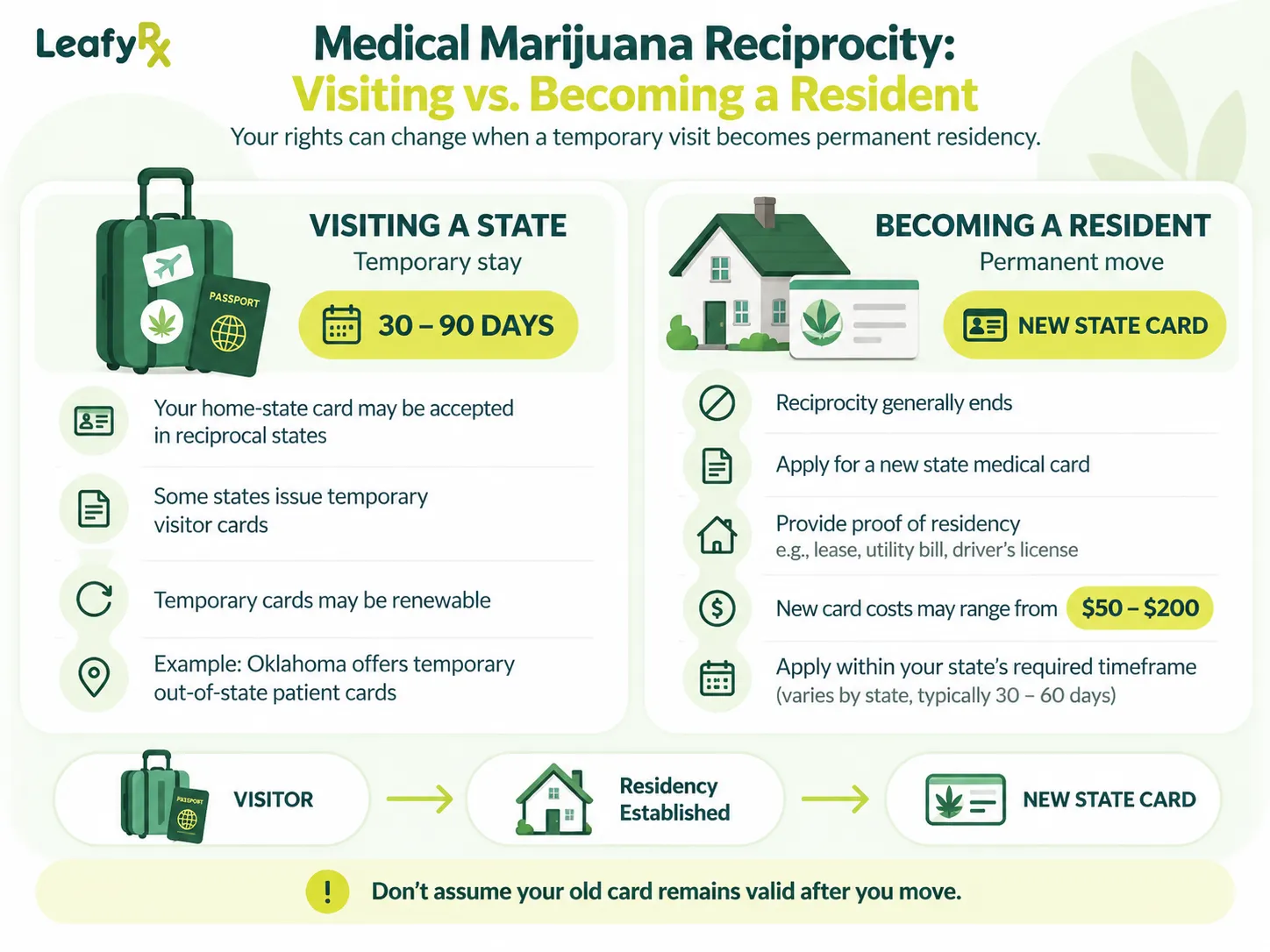
Medical marijuana card reciprocity works one way if you visit a state. It works a different way if you move there for good. Understanding these distinctions helps you stay compliant with local laws and maintain access to your medication.
Temporary Visitor Status and Time Limits
Most states define visitors as people staying less than 30 to 90 days. During this period, your home state medical card may allow you to purchase cannabis in reciprocal states without additional registration.
Temporary visitor cards typically remain valid for 30 to 90 days and may be renewable in some states. Oklahoma, for example, offers a straightforward online application for temporary cards that out-of-state patients can complete before arrival.
Once you exceed the visitor timeframe, states generally require you to obtain local residency documentation and apply for a new medical card.
Establishing Residency Requirements
When you establish permanent residency in a new state, reciprocity protections end. According to the CDC state cannabis laws overview, each state sets its own residency verification standards and medical cannabis program requirements.
New residents usually must obtain a medical card from their new state within 30 to 60 days of establishing residency. States require proof such as utility bills, lease agreements, or a driver’s license showing your new address.
Continuing to use your old state card after becoming a resident violates most state programs and can result in legal issues or denied dispensary access.
Obtaining a New State Medical Card
Applying for a new state medical card involves getting a physician evaluation that confirms your qualifying condition under local laws. Some states now offer telemedicine options that let you complete this process remotely after relocation.
Cost for new state medical cards ranges from $50 to $200 depending on state requirements, application fees, and whether you need a new physician consultation. Processing times vary from immediate approval to several weeks.
Plan ahead by researching your new state’s application process, gathering required documents, and scheduling medical evaluations before your current card expires or residency deadline passes.
Medical Marijuana Card Reciprocity: What to Do Before You Travel

Proper preparation prevents legal problems when crossing state lines with a medical cannabis card. Missing a critical step can leave you without access to medication or facing possession charges in an unfamiliar state.
Pre-Travel Checklist and Documentation
Check your medical card expiration date at least 30 days before departure. Many states won’t accept cards that expire during your visit, and renewing takes time.
Research your destination state’s possession limits before you leave. Some states allow out-of-state patients to possess only half the amount permitted for residents. Purchase limits at dispensaries may also differ.
Review the destination state’s approved product types and consumption laws. A state that accepts your card might prohibit certain forms like edibles or concentrates. Public consumption remains illegal almost everywhere, even with a valid medical card.
Gather all required documentation. You should carry your valid medical marijuana card, government-issued ID, and your original physician recommendation. Some states require proof that your qualifying condition matches their approved list.
Never purchase cannabis in your home state with plans to transport it. Buy only after arriving in the reciprocal state, and keep products in their original dispensary packaging with labels intact.
States Without Reciprocity and Alternative Options
Twenty states currently don’t recognize out-of-state medical cards. These are California, Colorado, Connecticut, Delaware, Florida, Illinois, Maryland, Massachusetts, Minnesota, Missouri, Montana, New Jersey, New York, North Dakota, Ohio, Pennsylvania, Utah, Vermont, Virginia, and West Virginia.
Several non-reciprocal states offer alternatives. If you’re 21 or older, you can purchase cannabis recreationally in these states. California, Colorado, Connecticut, Illinois, Maryland, Massachusetts, Minnesota, Missouri, Montana, New Jersey, New York, and Vermont allow adult-use sales. Adult-use programs don’t require medical registration but may charge higher taxes.
Oklahoma stands out for offering the easiest temporary card process. Out-of-state patients can apply online and receive approval within days, making it practical for planned visits.
Common Reciprocity Mistakes to Avoid
Don’t assume recreational states automatically accept medical cards. Colorado and California require separate medical registration even though they have adult-use programs. The processes and benefits differ between medical and recreational access.
Many visitors purchase more than the state’s possession limit for out-of-state patients. This turns legal possession into a criminal offense instantly. Verify the specific limit for visitors, not just the resident limit.
Letting your medical card expire before or during travel is a costly mistake. An expired card provides no legal protection, even in reciprocal states. Dispensaries will refuse service, and law enforcement won’t recognize it.
Failing to carry proper documentation causes problems at dispensaries and during traffic stops. Keep your medical card, ID, and physician recommendation together and accessible. Some patients photograph these documents as backup, though physical copies remain the legal standard.
Conclusion
Medical marijuana card reciprocity opens doors for patients who need access to their medicine while traveling, but success depends on preparation. Each state sets its own rules for out-of-state cardholders, from automatic acceptance to temporary registration requirements to no recognition at all. Before you travel, verify the current reciprocity status of your destination, check your card’s expiration date, and understand the possession limits that apply to visitors.
If you’re planning to travel or need to establish medical cannabis access in your home state, start by getting a valid medical marijuana card. Carry your certification, government-issued ID, and physician recommendation whenever you visit dispensaries in reciprocal states. Purchase your medicine only after arriving in the destination state, and keep products in their original packaging. Never transport cannabis across state lines, even between states that both recognize your card.
LeafyRx connects you with licensed healthcare providers for secure online evaluations, helping you obtain your state-approved medical marijuana certification from home. Get legal access to medical cannabis in your state and reciprocal destinations with a simple, confidential process.






 Ask ChatGPT
 Ask Claude
 Ask Perplexity