


If you are wondering whether your health condition qualifies for a medical marijuana card, the answer depends on which state you live in. Every state with a medical cannabis program maintains its own approved list of qualifying conditions, and these lists vary dramatically across the country. A condition that qualifies for a medical marijuana card in one state may not be recognized in another. Some states use open physician discretion where nearly any condition can qualify with the right documentation. Others maintain strict, narrowly defined lists. Knowing exactly where your state stands is the single most important step before you begin the process. This complete state-by-state guide answers the question once and for all, covering every active medical marijuana program, every qualifying condition list, what a medical marijuana card actually gives you, what it costs, and how to get approved online in minutes.
What a Medical Marijuana Card Actually Is
A medical marijuana card, also called a patient ID card or MMJ card, is an official state-issued document that gives legal authorization for qualified patients to purchase, possess, and use cannabis for medical purposes. This certification serves as your legal protection and gateway to accessing medical-grade cannabis products from licensed dispensaries. It is issued after a licensed physician confirms that you have a health condition that qualifies under your state’s medical marijuana program.
Unlike recreational cannabis users, who are simply buying a legal consumer product, medical cardholders are recognized as patients under state law. This distinction matters in several practical ways. It affects how much you can purchase, what products you can access, how much you pay in taxes, and the legal protections available to you. The qualifying conditions vary by state but often include chronic pain, anxiety, PTSD, epilepsy, cancer, and other serious health conditions, and that a physician reviews your medical history to determine eligibility before any certification is issued.
The Two Ways States Define Medical Marijuana Card Eligibility
Understanding how your state defines eligibility is the foundation of knowing whether you qualify. There are two broad approaches.
The first is a fixed qualifying condition list. These states publish a specific list of diagnoses and symptoms that qualify a patient for a medical marijuana card. If your condition appears on the list, a licensed physician can certify you. If it does not, the physician generally cannot certify you regardless of clinical opinion. States with fixed lists range from narrow programs covering 10 to 15 conditions, like Alaska, Vermont, and Wyoming, to expansive programs listing 40 or more conditions, like Illinois, Connecticut, and North Dakota.
The second approach is physician discretion. States like New York, Washington D.C., and Wisconsin allow licensed physicians to certify any condition they believe would benefit from medical cannabis. There is no fixed list to satisfy. This makes these states the most accessible for patients whose conditions fall outside the mainstream qualifying lists. California, Massachusetts, Maryland, Oregon, and several others take a hybrid approach: they maintain a list of named conditions but also include language allowing physicians to certify additional conditions not explicitly named, effectively extending their programs beyond the published list.
According to the National Conference of State Legislatures state medical cannabis laws tracker, medical cannabis is now legal in the majority of U.S. states. The legislative momentum behind these programs continues to expand, with states regularly adding conditions to their qualifying lists through annual legislative sessions and regulatory updates.
The 10 Conditions Recognized Across Nearly Every State
Before reviewing the full state-by-state table, it helps to identify the conditions that have near-universal acceptance. These appear on qualifying lists in the overwhelming majority of active medical marijuana programs and represent the strongest intersection of patient demand, medical research, and legislative consensus. As documented in the LeafyRX qualifying conditions guide, the following ten conditions are recognized across the widest range of state programs:
-
Chronic pain: The most common qualifying condition in the country, covering persistent pain not adequately managed by other treatments.
-
Cancer and cancer-related symptoms: Including chemotherapy-induced nausea, cachexia and wasting syndrome, and cancer-associated pain.
-
Epilepsy and seizure disorders: One of the most consistently recognized conditions and a primary driver of early cannabis legalization advocacy.
-
PTSD: Now accepted in the vast majority of states with active programs.
-
Multiple sclerosis: Recognized for its association with muscle spasticity, nerve damage, and chronic pain.
-
HIV/AIDS: A foundational qualifying condition in virtually every program.
-
ALS: Universally recognized due to its severe and progressive neurological nature.
-
Crohn’s disease and inflammatory bowel conditions: Accepted in most states based on growing evidence for cannabis in managing gastrointestinal symptoms.
-
Glaucoma: One of the original qualifying conditions, included in nearly every program since the earliest medical cannabis laws.
-
Severe nausea and persistent muscle spasms: Recognized as symptom-based qualifiers independent of the underlying diagnosis in many states.
Medical Marijuana Card Qualifying Conditions: Complete State-by-State Table 2026
The table below covers every active state medical marijuana program. Find your state to confirm whether your condition is currently recognized.
| State | Qualifying Conditions |
|---|---|
| Alabama | Cancer-related weight loss, Chronic pain, Nausea/vomiting, Cachexia/wasting syndrome, PTSD, Depression, Crohn’s disease, Epilepsy, Autism spectrum disorder, HIV/AIDS-related weight loss/nausea, Panic disorder, Parkinson’s disease |
| Alaska | Cachexia/wasting syndrome, Cancer, Chronic pain, Glaucoma, HIV/AIDS, Multiple sclerosis, Nausea, Persistent muscle spasms, Seizures |
| Arizona | Alzheimer’s disease, ALS, Cachexia/wasting syndrome, Cancer, Chronic pain, Crohn’s disease, Glaucoma, Hepatitis C, HIV/AIDS, Nausea, Persistent muscle spasms, PTSD, Seizures |
| Arkansas | Crohn’s disease, Severe nausea, Peripheral neuropathy, Glaucoma, Cancer, PTSD, Hepatitis C, HIV/AIDS, Fibromyalgia, Ulcerative colitis, Alzheimer’s disease, ALS, Cachexia/wasting syndrome, Tourette’s syndrome, Severe and persistent muscle spasms, Intractable pain (pain failing to respond to ordinary treatment for over 6 months), Severe arthritis, Seizures/epilepsy |
| California | Anorexia, Arthritis, Cachexia/wasting syndrome, Cancer, Chronic pain, HIV/AIDS, Glaucoma, Migraines, Persistent muscle spasms, Severe nausea, Seizures, Any debilitating illness where physician determines medical use is appropriate |
| Colorado | Autism spectrum disorder, Any condition for which a physician would prescribe an opioid, Cachexia/wasting syndrome, Cancer, Chronic pain, Chronic nervous system disorders, Glaucoma, HIV/AIDS, Nausea, Persistent muscle spasms, PTSD, Seizures |
| Connecticut | ALS, Cachexia/wasting syndrome, Cancer, Cerebral palsy, Chronic neuropathic pain associated with degenerative spinal disorders, Chronic pain of at least 6 months associated with a specified underlying chronic condition refractory to other treatment, Chronic pancreatitis, Complex regional pain syndrome, Crohn’s disease, Cystic fibrosis, Ehlers-Danlos syndrome associated with chronic pain, Epilepsy, Glaucoma, HIV/AIDS, Hydrocephalus with intractable headache, Interstitial cystitis, Intractable neuropathic pain unresponsive to standard medical treatments, Intractable spasticity, Intractable headache syndromes, Irreversible spinal cord injury with intractable spasticity, MALS Syndrome, Movement disorders associated with Huntington disease, Multiple sclerosis, Muscular dystrophy, Neuropathic facial pain, Osteogenesis imperfecta, Parkinson’s disease, Other conditions approved by the physician |
| Delaware | Autism with self-injurious or aggressive behavior, Alzheimer’s disease, ALS, Cachexia/wasting syndrome, Cancer, Chronic debilitating migraines, Chronic pain, Decompensated cirrhosis, Glaucoma, HIV/AIDS, Intractable epilepsy, Multiple sclerosis, Nausea, PTSD, Seizures, Severe and persistent muscle spasms, Terminal illness |
| Florida | ALS, Cancer, Crohn’s disease, Chronic nonmalignant pain, Epilepsy, Glaucoma, HIV/AIDS, Multiple sclerosis, Muscle spasms, Parkinson’s disease, PTSD, Seizures, Terminal illness, Other debilitating conditions comparable to those listed |
| Georgia | AIDS, Alzheimer’s disease, ALS, Autism, Cancer, Crohn’s disease, Epidermolysis bullosa, Hospice care patients, Intractable pain, Mitochondrial disease, Multiple sclerosis, Parkinson’s disease, PTSD, Severe or end-stage peripheral neuropathy, Seizure disorder, Sickle cell disease, Tourette’s syndrome |
| Hawaii | ALS, Cachexia/wasting syndrome, Cancer, Chronic pain, Crohn’s disease, Epilepsy, Glaucoma, HIV/AIDS, Lupus, Multiple sclerosis, Nausea, Persistent muscle spasms, PTSD, Rheumatoid arthritis, Seizures |
| Illinois | Autism, Alzheimer’s disease, ALS, Anorexia nervosa, Arnold Chiari malformation, Cachexia/wasting syndrome, Cancer, Causalgia, Chronic inflammatory demyelinating polyneuropathy, Complex regional pain syndrome type 2 (CRPS), Crohn’s disease, Dystonia, Ehlers-Danlos syndrome, Fibromyalgia, Fibrous dysplasia, Glaucoma, Hepatitis C, HIV/AIDS, Hydrocephalus, Hydromyelia, Interstitial cystitis, Irritable bowel syndrome (IBS), Lupus, Migraines, Multiple sclerosis, Muscular dystrophy, Myasthenia gravis, Myoclonus, Nail-patella syndrome, Neurofibromatosis, Neuropathy, Osteoarthritis, Parkinson’s disease, Polycystic kidney disease (PKD), PTSD, Reflex sympathetic dystrophy (RSD), Residual limb pain, Rheumatoid arthritis, Seizures, Sjogren’s syndrome, Spinal cord disease, Spinocerebellar ataxia (SCA), Superior canal dehiscence syndrome, Syringomyelia, Tarlov cysts, Tourette’s syndrome, Traumatic brain injury and post-concussion syndrome, Ulcerative colitis |
| Iowa | AIDS/HIV, ALS, Cancer, Cancer-related chronic pain/nausea/cachexia, Corticobasal degeneration, Crohn’s disease, Multiple sclerosis, Parkinson’s disease, PTSD, Intractable epilepsy, Seizures, Severe intractable autism, Terminal illness, Ulcerative colitis, Untreatable pain |
| Louisiana | Autism spectrum disorders, Cachexia/wasting syndrome, Cancer, Crohn’s disease, Epilepsy, Glaucoma, HIV/AIDS, Intractable pain, Muscular dystrophy, Multiple sclerosis, Parkinson’s disease, PTSD, Seizure disorders, Spasticity, Severe muscle spasms |
| Maine | Alzheimer’s disease, ALS, Cachexia/wasting syndrome, Cancer, Chronic pain, Crohn’s disease, Epilepsy, Glaucoma, Hepatitis C, HIV/AIDS, Huntington’s disease, Inflammatory bowel disease, Multiple sclerosis, Nausea, Nail-patella syndrome, Parkinson’s disease, PTSD |
| Maryland | Cachexia/wasting syndrome, Anorexia, Chronic pain, Glaucoma, Nausea, PTSD, Seizures, Severe or persistent muscle spasms, Any chronic severe condition for which other treatments have been ineffective |
| Massachusetts | ALS, Anxiety, Cachexia/wasting syndrome, Cancer, Crohn’s disease, Glaucoma, HIV/AIDS, Hepatitis C, Multiple sclerosis, Parkinson’s disease, PTSD, Other conditions as determined by a qualifying practitioner |
| Michigan | Autism, Alzheimer’s disease, ALS, Arthritis, Cachexia/wasting syndrome, Cancer, Cerebral palsy, Chronic pain, Colitis, Crohn’s disease, Glaucoma, HIV/AIDS, Hepatitis C, Inflammatory bowel disease, Multiple sclerosis, Nausea, OCD, Parkinson’s disease, PTSD, Rheumatoid arthritis, Seizures, Severe and persistent muscle spasms, Spinal cord injury, Tourette’s disease, Ulcerative colitis |
| Minnesota | Alzheimer’s disease, ALS, Autism, Cancer, Chronic motor or vocal tic disorder, Chronic pain, Crohn’s disease, Epilepsy, Glaucoma, HIV/AIDS, Inflammatory bowel disease, Intractable pain, Multiple sclerosis, Obstructive sleep apnea, PTSD, Seizures, Severe and persistent muscle spasms, Sickle cell disease, Terminal illness, Tourette’s syndrome |
| Mississippi | Alzheimer’s disease, ALS, Autism, Cachexia/wasting syndrome, Cancer, Crohn’s disease, Chronic pain, Dementia, Diabetic or peripheral neuropathy, Glaucoma, HIV/AIDS, Hepatitis, Huntington’s disease, Multiple sclerosis, Muscular dystrophy, Pain refractory to appropriate opioid management, Parkinson’s disease, PTSD, Seizures, Severe and persistent muscle spasms, Severe or intractable nausea, Spastic quadriplegia, Spinal cord disease or severe injury, Sickle cell anemia, Ulcerative colitis |
| Missouri | Any chronic condition normally treated with opioid-risk medications, Alzheimer’s disease, ALS, Autism, Cachexia/wasting syndrome, Cancer, Chronic pain, Crohn’s disease, Debilitating psychiatric disorders, Epilepsy, Glaucoma, Hepatitis C, HIV/AIDS, Huntington’s disease, Inflammatory bowel disease, Intractable migraines, Multiple sclerosis, Neuropathies, Parkinson’s disease, PTSD, Sickle cell anemia, Seizures, Severe persistent muscle spasms, Terminal illness, Tourette’s syndrome |
| Montana | CNS disorder resulting in muscle spasms or painful or chronic spasticity, Cachexia/wasting syndrome, Cancer, Chronic inflammatory demyelinating polyneuropathy, Crohn’s disease, Epilepsy or an intractable seizure disorder, Glaucoma, HIV/AIDS, Hospice care, Multiple sclerosis, PTSD, Severe nausea or pain |
| Nevada | Anxiety, Anorexia nervosa, Autism spectrum disorder, Autoimmune disease, Cachexia/wasting syndrome, Cancer, Chronic pain, Opioid dependence or addiction, Epilepsy, Glaucoma, HIV/AIDS, Multiple sclerosis, Muscle spasms, Nausea, Neuropathy, PTSD, Seizures |
| New Hampshire | ALS, Alzheimer’s disease, Cachexia/wasting syndrome, Cancer, Chemotherapy-induced anorexia, Chronic pain that has not responded to previously prescribed medication, Chronic pancreatitis, Crohn’s disease, Ehlers-Danlos syndrome, Elevated intraocular pressure, Epilepsy, Glaucoma, Hepatitis C, HIV/AIDS, Lupus, Moderate to severe vomiting, Multiple sclerosis, Muscular dystrophy, Nausea, Parkinson’s disease, Persistent muscle spasms, PTSD, Seizures, Spinal cord injury or disease, Terminal illness, Traumatic brain injury, Ulcerative colitis |
| New Jersey | ALS, Anxiety, Cachexia/wasting syndrome, Cancer, Chronic pain, Crohn’s disease, Dysmenorrhea, Epilepsy, Glaucoma, HIV/AIDS, Inflammatory bowel disease, Intractable skeletal or muscular spasticity, Migraines, Multiple sclerosis, Muscular dystrophy, Nausea, Opioid use disorder, PTSD, Seizures, Tourette’s syndrome, Terminal illness |
| New Mexico | Alzheimer’s disease, ALS, Anorexia, Autism spectrum disorder, Cachexia/wasting syndrome, Cancer, Chronic pain, Crohn’s disease, Damage to the nervous tissue of the spinal cord, Epilepsy, Friedreich’s ataxia, Glaucoma, Hepatitis C, HIV/AIDS, Hospice patients, Huntington’s disease, Inclusion body myositis, Inflammatory autoimmune-mediated arthritis, Intractable nausea/vomiting, Lewy body disease, Multiple sclerosis, Obstructive sleep apnea, Opioid use disorder, Painful peripheral neuropathy, Parkinson’s disease, PTSD, Seizures, Spasmodic torticollis (cervical dystonia), Spinal muscular atrophy, Ulcerative colitis |
| New York | Any condition the physician determines benefits from cannabis (full physician discretion) |
| North Carolina | CBD oil only; no qualifying condition required for CBD purchases |
| North Dakota | Alzheimer’s disease agitation, ALS, Anorexia nervosa, Anxiety disorder, Autism spectrum disorder, Brain injury, Bulimia nervosa, Cachexia/wasting syndrome, Cancer, Chronic or debilitating disease, Crohn’s disease, Ehlers-Danlos syndrome, Endometriosis, Epilepsy, Fibromyalgia, Glaucoma, Hepatitis C, HIV/AIDS, Interstitial cystitis, Intractable nausea, Neuropathy, Migraines, Multiple sclerosis, PTSD, Rheumatoid arthritis, Seizures, Severe and persistent muscle spasms, Severe debilitating pain, Spinal stenosis, Tourette’s syndrome |
| Ohio | Alzheimer’s disease, ALS, Cachexia/wasting syndrome, Cancer, Chronic traumatic encephalopathy, Crohn’s disease, Epilepsy, Fibromyalgia, Glaucoma, Hepatitis C, HIV/AIDS, Huntington’s disease, Inflammatory bowel disease, Multiple sclerosis, Chronic severe or intractable pain, Parkinson’s disease, PTSD, Seizures, Sickle cell anemia, Spasticity, Spinal cord disease or injury, Terminal illness, Tourette’s syndrome, Traumatic brain injury, Ulcerative colitis |
| Oklahoma | Anxiety disorders, Body aches, Cachexia/wasting syndrome, Cancer, Depression, Epilepsy, Glaucoma, HIV/AIDS, Inflammation, Loss of appetite, Migraines, Muscle pain, Nausea, Neuropathic pain disorders, Seizures |
| Oregon | Alzheimer’s disease, Cachexia/wasting syndrome, Cancer, Chronic pain, Glaucoma, HIV/AIDS, Nausea, Persistent muscle spasms, PTSD, Seizures, Other conditions subject to approval |
| Pennsylvania | ALS, Anxiety disorders, Autism, Cancer, Crohn’s disease, Central nervous system tissue damage, Dyskinetic and spastic movement disorders, Epilepsy, Glaucoma, HIV/AIDS, Huntington’s disease, Inflammatory bowel disease, Intractable seizures, Intractable spasticity, Multiple sclerosis, Neurodegenerative diseases, Neuropathies, Opioid use disorder, Parkinson’s disease, PTSD, Severe chronic or intractable pain, Sickle cell anemia, Terminal illness, Tourette’s syndrome |
| Rhode Island | Alzheimer’s disease, Cachexia/wasting syndrome, Cancer, Chronic pain, Crohn’s disease, Epilepsy, Glaucoma, Hepatitis C, HIV/AIDS, Multiple sclerosis, Nausea, Persistent muscle spasms, PTSD, Seizures, Other conditions subject to approval |
| South Carolina | A condition causing a person to be homebound that includes severe or persistent nausea, A chronic medical condition causing severe and persistent muscle spasms, Autism, Cachexia/wasting syndrome, Cancer, Crohn’s disease, A chronic medical condition for which an opioid is or could be prescribed based on standards of care, Multiple sclerosis, Neurological disease or disorder including epilepsy, PTSD, Sickle cell anemia, Terminal illness, Ulcerative colitis |
| South Dakota | ALS, Cachexia/wasting syndrome, Cancer, Chronic pain, Crohn’s disease, Epilepsy, Glaucoma, HIV/AIDS, Multiple sclerosis, Nausea or severe vomiting, PTSD, Seizures |
| Tennessee | CBD oil only; no THC products permitted |
| Texas | Alzheimer’s disease, ALS, Cancer and related conditions, Crohn’s disease, Epilepsy, HIV/AIDS, Inflammatory bowel disease, Multiple sclerosis, Parkinson’s disease, Seizures, Sickle cell disease, Ulcerative colitis, Incurable neurodegenerative disease, Autism, PTSD, Spasticity, Terminal cancer |
| Utah | Alzheimer’s disease, ALS, Autism, Cachexia/wasting syndrome, Cancer, Chronic pain, Crohn’s disease, Epilepsy, HIV/AIDS, Hospice patients, Multiple sclerosis, Nausea, Persistent and debilitating muscle spasms, PTSD, Rare conditions affecting fewer than 200,000 U.S. patients, Seizures, Terminal illness, Ulcerative colitis |
| Vermont | Cachexia/wasting syndrome, Cancer, Crohn’s disease, Epilepsy, Glaucoma, HIV/AIDS, Multiple sclerosis, Parkinson’s disease, PTSD, Seizures, Severe or chronic pain, Severe nausea |
| Virginia | Alzheimer’s disease, ALS, Anxiety, Autism, Cachexia/wasting syndrome, Cancer, Chronic pain, Crohn’s disease, Epilepsy, Fibromyalgia, Hepatitis C, Huntington’s disease, Inflammatory bowel disease, Multiple sclerosis, Parkinson’s disease, PTSD, Seizures, Sickle cell anemia, Tourette’s syndrome |
| Washington State | Anorexia nervosa, Appetite loss, Cachexia/wasting syndrome, Cancer, Chronic renal failure requiring hemodialysis, Crohn’s disease, Epilepsy, Glaucoma, Hepatitis C, HIV/AIDS, Intractable pain, Multiple sclerosis, Nausea, Persistent muscle spasms or spasticity, PTSD, Seizures, Traumatic brain injury, Any terminal or debilitating condition |
| Washington D.C. | Any condition the physician determines benefits from cannabis (full physician discretion) |
| West Virginia | ALS, Cancer, Crohn’s disease, Epilepsy, HIV/AIDS, Huntington’s disease, Intractable seizures, Intractable spasticity, Multiple sclerosis, Neuropathy, Parkinson’s disease, PTSD, Severe chronic or intractable pain, Spinal cord damage, Sickle cell anemia, Terminal illness |
| Wisconsin | Any condition for which a patient receives proper physician recommendations (full physician discretion) |
| Wyoming | Intractable epilepsy only |
Found your state? Not sure if your specific condition qualifies? Book a free eligibility check with a LeafyRX licensed physician. The consultation is fully online, completed in under 30 minutes, and a board-certified doctor will confirm your eligibility against your state’s exact requirements. Approved or your money back.
What to Do if Your Condition Is Not Listed
If you reviewed the table and your specific diagnosis does not appear in your state’s list, do not assume you are ineligible. Several pathways remain open. First, look carefully at symptom-based criteria. Many state programs qualify patients based on symptoms rather than named diagnoses. Severe chronic pain, persistent nausea, severe and persistent muscle spasms, cachexia and wasting syndrome, and intractable pain are symptom categories that can apply to a wide range of underlying conditions. A patient with lupus, a rare autoimmune condition, or a complex pain disorder may qualify under chronic pain criteria even if their specific disease is not listed by name.
Second, check whether your state includes catch-all language. Terms such as other conditions subject to physician approval, any chronic or debilitating disease as determined by the treating physician, or conditions comparable to those enumerated give physicians meaningful flexibility. Even states with moderate lists often include this language, which extends the program well beyond the named conditions.
Third, consult a physician who specializes in medical cannabis certifications. A general practitioner who is unfamiliar with your state’s program may decline to certify even when a valid pathway exists. A physician experienced with the program, such as those available through LeafyRX, knows exactly what is and is not possible within your state’s rules and can advise on your specific situation before any fees are charged.
The Real Benefits of a Medical Marijuana Card
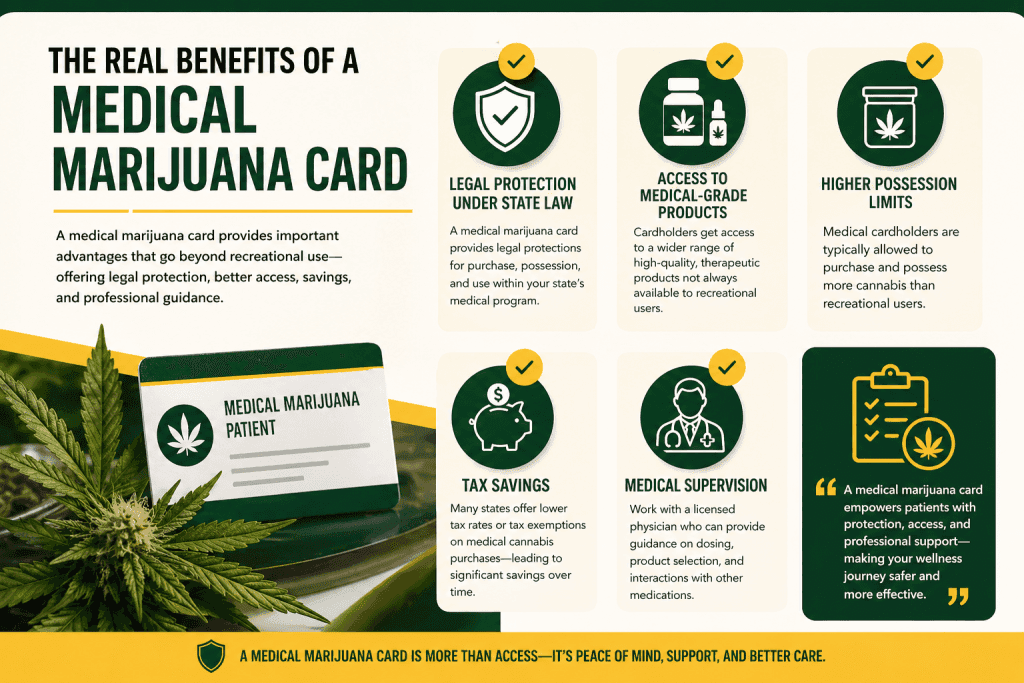
Understanding what a medical marijuana card actually provides helps clarify why obtaining one is worth the process, even in states where recreational cannabis is also legal. According to LeafyRX’s overview of medical marijuana card benefits, the following advantages are available to cardholders that recreational users do not receive.
Legal Protection Under State Law
A medical marijuana card establishes you as a state-recognized patient, providing legal protections for purchase, possession, and use within your state’s program. This reduces legal exposure compared to recreational use in states where recreational cannabis carries different possession limits or enforcement patterns.
Access to Medical-Grade Products
Medical dispensaries carry products specifically formulated for therapeutic use, including higher-potency formulations, specialized delivery methods such as tinctures, capsules, and topicals, and products with precise cannabinoid ratios developed for specific conditions. Recreational dispensaries may not carry the same range of medical-grade options.
Higher Possession Limits
Medical cardholders are typically permitted to purchase and possess larger quantities than recreational buyers in the same state. This matters for patients who use cannabis consistently as part of a treatment plan and need to maintain an adequate supply.
Tax Savings
In many states, medical cannabis purchases are taxed at a lower rate than recreational purchases, or are exempt from certain tax categories altogether. Depending on the state and a patient’s level of use, the annual tax savings from holding a medical card can be substantial.
Medical Supervision
Cardholders access cannabis under the supervision of a licensed physician who can advise on dosing, delivery methods, product selection, and potential interactions with other medications. This clinical oversight is not available to recreational consumers.
How LeafyRX Makes Getting Your Medical Marijuana Card Fast and Simple
Navigating state-specific eligibility requirements, finding a qualified physician, completing the certification, and submitting the state application is a multi-step process that many patients find overwhelming, particularly those already managing serious health conditions. LeafyRX was built specifically to remove these barriers.
LeafyRX connects patients directly with board-certified, licensed physicians available in all 50 states who conduct evaluations entirely by phone or video with no waiting room and no travel required. The entire evaluation typically takes under 30 minutes. A licensed physician reviews your medical history, evaluates your symptoms against your state’s specific qualifying criteria, and completes your legal certification if you qualify. LeafyRX then guides you through the next steps for your state’s registration process. The platform is HIPAA compliant and has helped more than 100,000 patients across the country access their certification. According to LeafyRX, all evaluations come with an approved or money-back guarantee, meaning there is no financial risk if you do not qualify.
Patient reviews consistently highlight the speed and simplicity of the process. One verified patient described completing the entire evaluation in under 30 minutes with a doctor who was respectful and did not rush anything. Another noted receiving their card emailed the same day. For patients in smaller towns or rural areas where in-person cannabis-certified physicians are scarce, the telehealth model eliminates what would otherwise be a significant logistical barrier to accessing care.
Ready to find out if you qualify? Start your LeafyRX evaluation today. Connect with a licensed board-certified doctor online in minutes from any device. No office visit, no waiting room, no guesswork. 100,000+ patients approved across all 50 states. Approved or your money back.







 Ask ChatGPT
  Ask Claude
  Ask Perplexity