
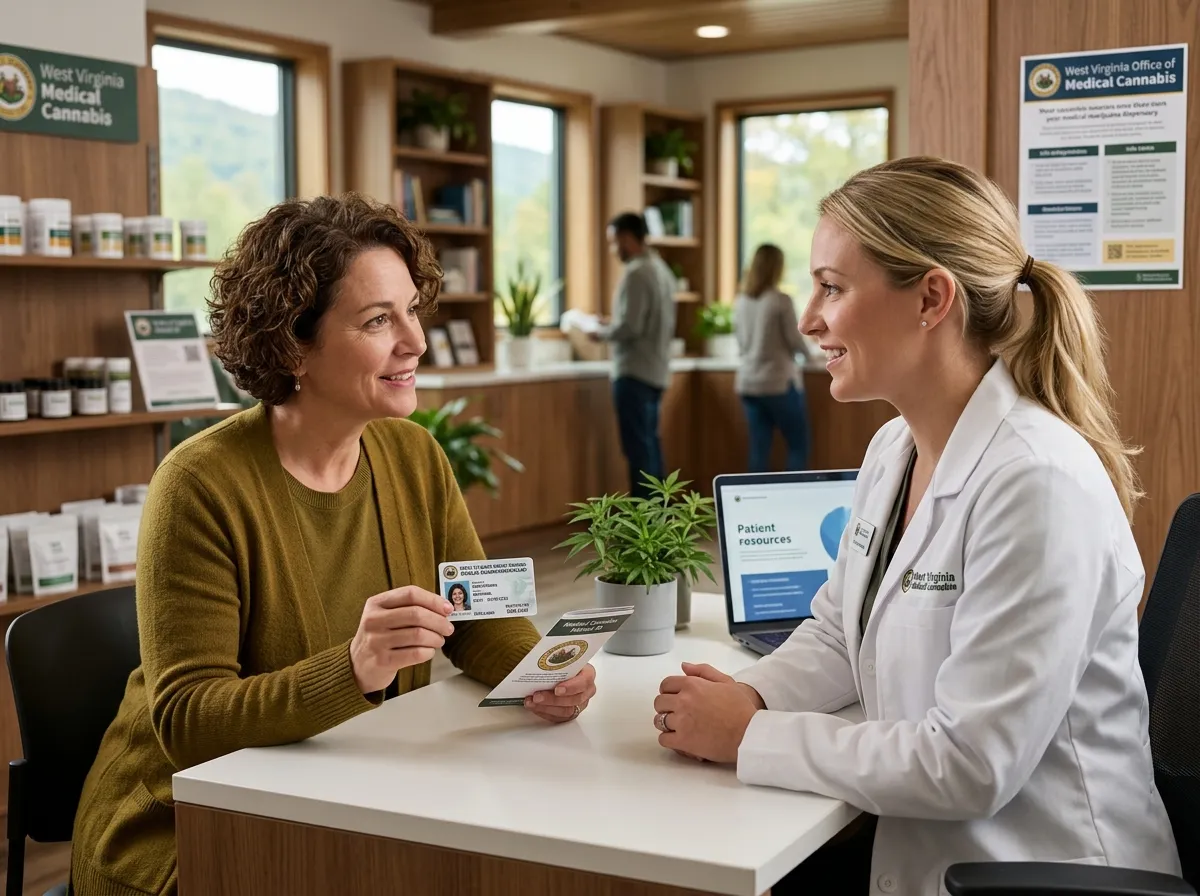

A West Virginia Medical Marijuana Card costs more than the state application fee, and many patients don’t learn that until they’re partway through. Few also know whether the card could put a job, a CDL, or a gun permit at risk. Many online pages skip the qualifying conditions list, give mixed payment instructions, or rely on old forms and fees.
This beginner guide shows you what to expect in 2027. You’ll learn who qualifies, how to apply online or in person, how long each stage takes, and what your first year may cost. It also explains how the card can affect work, driving, and firearms after approval. Rules change, so confirm current details with the West Virginia Office of Medical Cannabis (OMC) before you apply.
What Is a West Virginia Medical Marijuana Card?
A West Virginia Medical Marijuana Card is a state-issued patient ID from the Office of Medical Cannabis (OMC). It lets a certified patient buy medical cannabis from licensed West Virginia dispensaries.
A physician’s written certification is the medical recommendation. The state issues the card after you register.
| Item | Certification | Card |
|---|---|---|
| Who issues it | Physician | OMC |
| What it proves | Qualifying condition | Registered patient |
| Who needs it | Every applicant | Dispensary buyers |
The card suits patients with a qualifying condition, such as severe chronic pain or PTSD, who want legal access in the state. It isn’t a prescription and gives no protection under federal law. Anyone who wants to get a West Virginia medical card online should confirm the provider is OMC-registered.
-
Certifying physician: a doctor registered with the OMC to certify patients.
-
OMC patient portal: the state’s online account where you register.
-
Dispensary: a licensed store that sells medical cannabis to cardholders.
-
Patient registry: the state’s list of registered patients.
How the West Virginia Medical Marijuana Card Program Works in 2027

The West Virginia Medical Cannabis Act (Senate Bill 386, April 2017) created the program. It sits in Chapter 16A of state law.
According to the WV Bureau for Public Health, the Office of Medical Cannabis (OMC) runs the program. The OMC registers patients and approves each West Virginia Medical Marijuana Card. Physicians must register with the OMC to certify patients. Licensed dispensaries sell to cardholders.
The physician decides whether you have a qualifying condition. The state handles registration and issues the card. LeafyRX can help you find a certifying provider, but confirm that provider’s OMC registration.
Forms, certifier rules, and fees have changed over time, and older pages still rank. Before you apply for a West Virginia Medical Marijuana Card, check the OMC site and the page’s last-updated date.
Federal rescheduling would not automatically rewrite West Virginia’s program. State law would still govern until West Virginia changes it. Check the current federal status and note the date you checked.
Qualifying Conditions for a West Virginia Medical Marijuana Card
West Virginia law (Chapter 16A) lists the conditions that qualify. You need one to get a West Virginia Medical Marijuana Card.
| Condition group | Examples from state law |
|---|---|
| Cancer and blood disorders | Cancer, sickle cell anemia |
| Nerve and brain conditions | ALS, Parkinson’s disease, multiple sclerosis, epilepsy and intractable seizures, Huntington’s disease, neuropathies, spinal cord nerve damage with intractable spasticity |
| Immune and digestive conditions | HIV/AIDS, Crohn’s disease |
| Mental health | Post-traumatic stress disorder |
| Pain and end of life | Terminal illness, severe chronic or intractable pain |
The pain wording is narrow. The law covers severe chronic or intractable pain of neuropathic origin, or pain where conventional treatment and opioid therapy are contraindicated or ineffective. In plain terms, a physician looks for serious, long-lasting pain that standard care hasn’t eased, or where those treatments aren’t safe for you.
Anxiety alone isn’t on the list for a West Virginia Medical Marijuana Card. A patient with anxiety may still qualify through a listed condition, such as PTSD or a pain diagnosis. The physician decides, and approval is never guaranteed.
Medical records make your West Virginia Medical Marijuana Card visit faster. A diagnosis, treatment history, and past medications give the physician what they need. LeafyRX suggests gathering these first; it’s important to check whether your condition qualifies for a medical card before you book.
How to Apply for a West Virginia Medical Marijuana Card
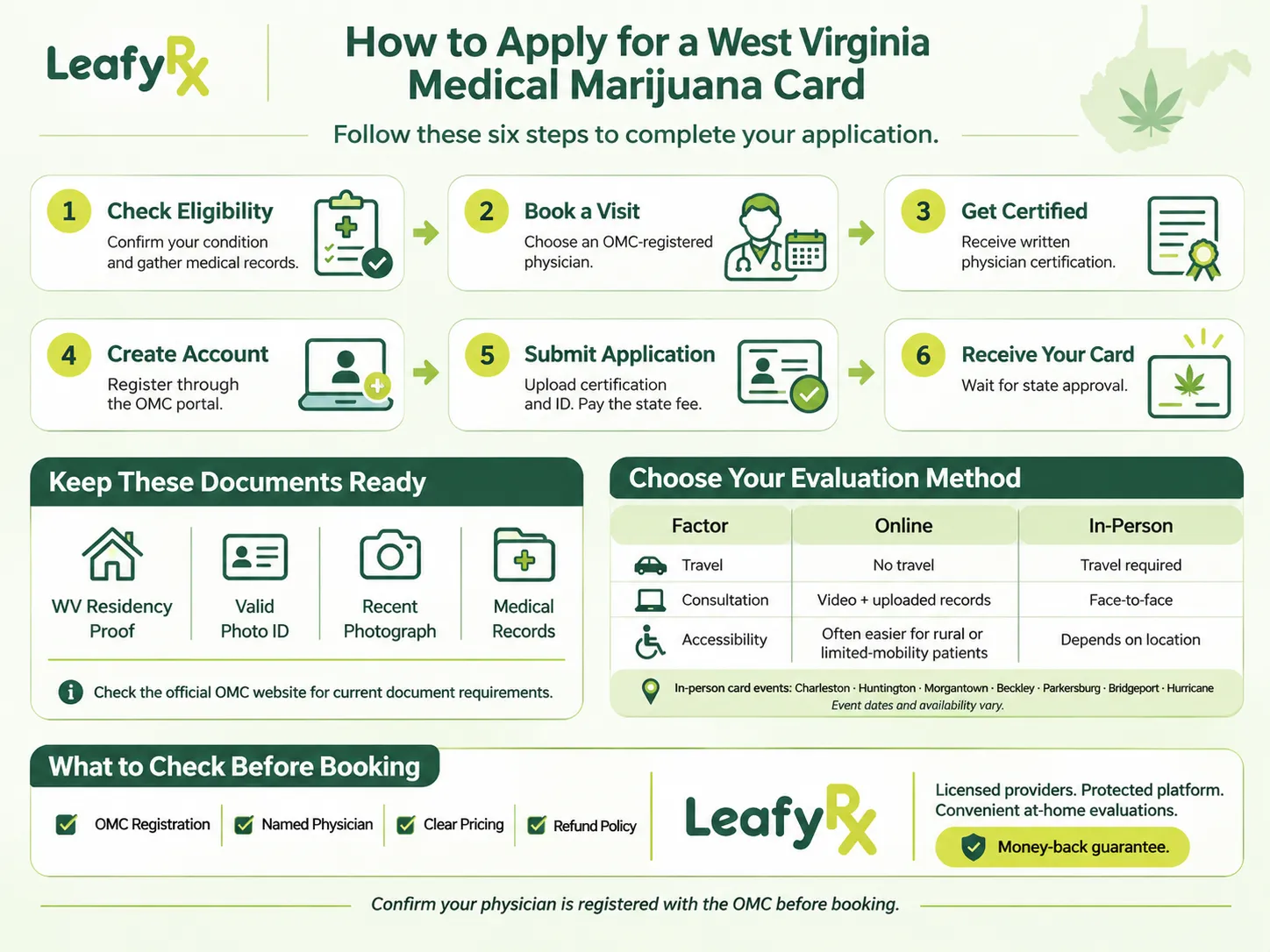
Applying for a West Virginia Medical Marijuana Card takes six steps. Follow them in order.
-
Confirm you have a qualifying condition and gather medical records.
-
Book a visit with an OMC-registered certifying physician.
-
Receive a written certification.
-
Create an account on the OMC registration portal.
-
Upload the certification and ID, then pay the state fee.
-
Wait for approval and receive your card.
Have these ready: proof of West Virginia residency, a valid photo ID, a recent photo, and records that document your diagnosis. Requirements change, so check the OMC site for the current list.
Online Evaluation vs. In-Person Visit
Either route can lead to a West Virginia Medical Marijuana Card. This step-by-step guide to getting a medical card online explains the remote option. Telehealth rules can change, so confirm the current West Virginia rule with the OMC before you book.
| Factor | Online | In person |
|---|---|---|
| Travel and wait time | No travel, often quick appointments | Drive to the visit, wait varies |
| Records and questions | Upload records, ask by video | Hand over records, talk face to face |
| Limited mobility or rural homes | Usually easier | Can be harder |
In-person card events happen in cities such as Charleston, Huntington, Morgantown, Beckley, Parkersburg, Bridgeport, and Hurricane. Dates change, so check a provider’s current schedule.
LeafyRx offers licensed providers, Secure and protected platform, quick evaluations from home, and a money-back guarantee. Confirm that your LeafyRx provider is registered with the OMC to certify in West Virginia before you pay. Then use this checklist on any provider you consider for your West Virginia Medical Marijuana Card:
-
OMC registration
-
A named physician
-
Clear pricing
-
A refund policy
West Virginia Medical Marijuana Card Timeline: Visit vs State Processing

Getting a West Virginia Medical Marijuana Card takes two stages. The physician visit can happen the same day or within a few days, depending on provider availability. State review takes longer. Competitor FAQs report roughly 30 to 60 days for approval. Check the OMC portal for current processing times.
| Stage | Who handles it | Typical time |
|---|---|---|
| Physician visit | Certifying physician | Same day to a few days |
| State review | Office of Medical Cannabis | Reported 30 to 60 days |
| Annual renewal | You, physician, and OMC | Start before expiration |
Your card is valid for one year, with annual physician recertification. For WV medical card renewal, book the recertification visit before the card expires, update your portal record, and pay the renewal fee. Set a calendar reminder 60 days before expiration. Don’t confuse this with the Virginia medical marijuana card process, which follows different rules.
If your application is denied or delayed, read the portal message first. Correct any missing documents, then contact the OMC. A West Virginia Medical Marijuana Card can’t be issued until the file is complete.
West Virginia Medical Marijuana Card Fees at a High Level
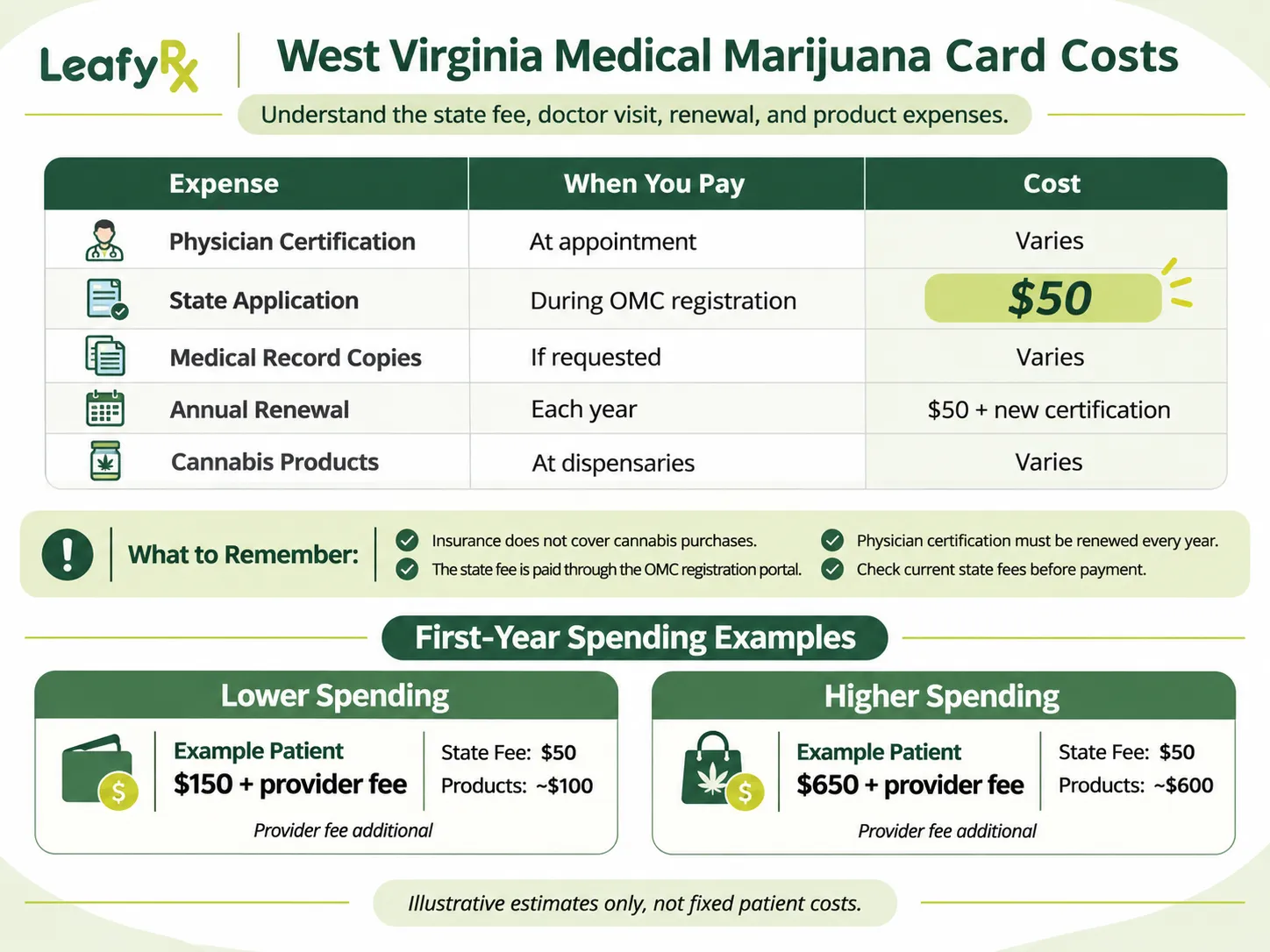
The state fee is only part of your first-year cost. A West Virginia Medical Marijuana Card also involves a physician visit and product spending. Insurance doesn’t cover cannabis, so you pay these costs yourself.
| Expense | When you pay | Typical range or fee |
|---|---|---|
| Certification visit | At your appointment | Varies by provider |
| State application fee | During OMC registration | $50 |
| Record copies (optional) | When you request them | Varies by provider |
| Renewal | Each year | $50, plus a new certification |
| Products | At dispensaries | Varies by purchase |
You pay the state fee through the OMC registration process. Follow the instructions in your own portal account. Confirm current fees on the OMC site before you pay.
Your West Virginia Medical Marijuana Card needs a renewed physician certification every year.
Example only: a low-spend patient might pay the provider fee, $50, and about $100 in products (estimate). A higher-spend patient might pay the provider fee, $50, and about $600 in products (estimate).
Using Your West Virginia Medical Marijuana Card After Approval
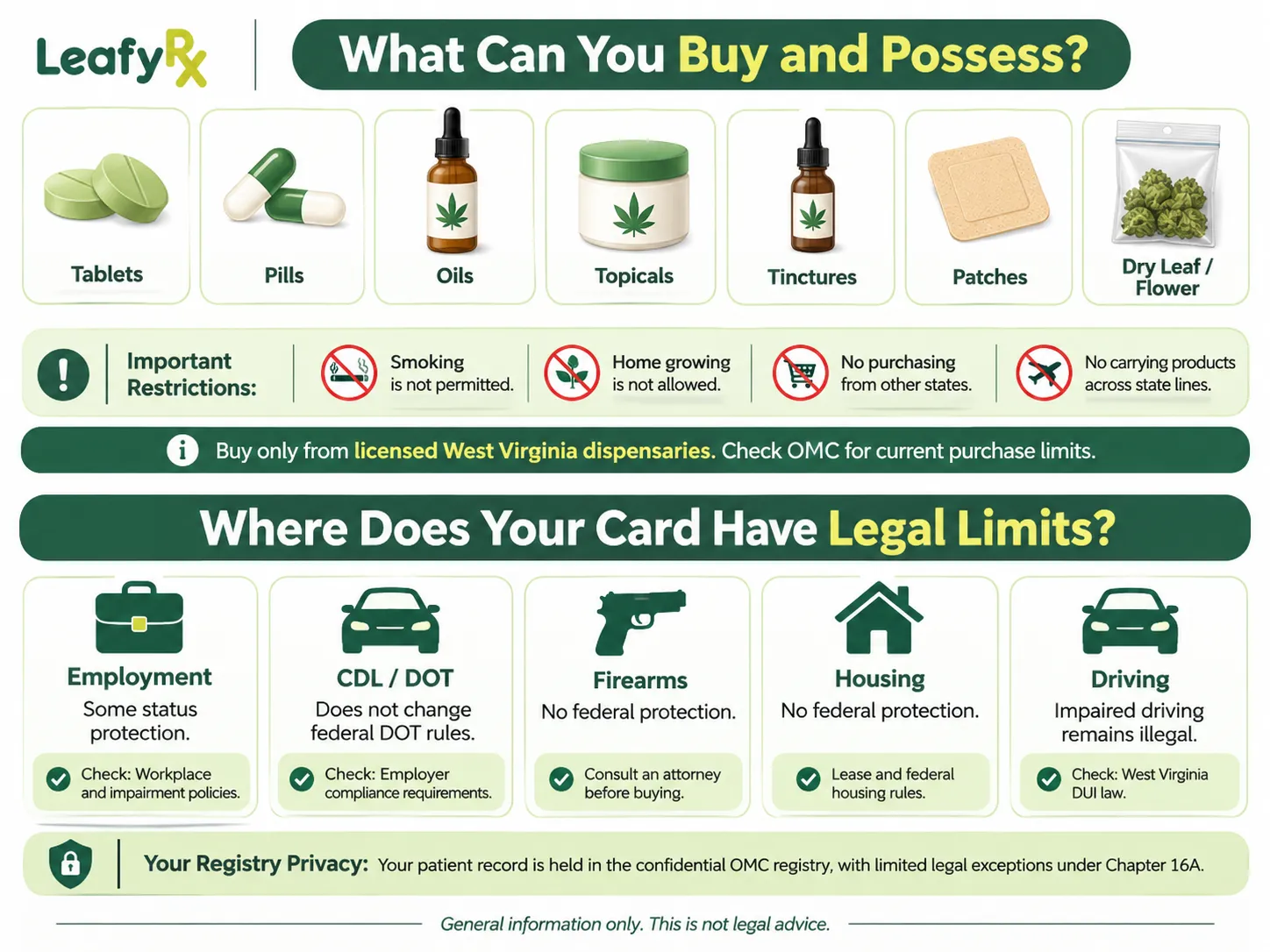
What You Can Buy and Possess?
Your West Virginia Medical Marijuana Card lets you buy pills, oils, topicals, tinctures, liquids, dermal patches, and dry leaf or plant flower for vaporization. Smoking is not permitted. Dispensary staff can explain each form. Ask your certifying physician what suits you.
Buy only from licensed West Virginia dispensaries, using your patient card. Limits are set by supply period, so check the Office of Medical Cannabis (OMC) for current limits and the product list.
Home growing is not allowed. You also can’t buy in other states or carry products across state lines.
Work, CDL, Firearms, Housing, and Driving
West Virginia law gives certified patients some protection from penalty solely for their status. Employers can still ban impairment and use at work, and can act under safety-sensitive or federal rules. A West Virginia Medical Marijuana Card won’t change a failed DOT drug test, because federal transportation rules still prohibit marijuana.
Federal law bars controlled substance users from buying or having firearms. The federal purchase form asks about marijuana use regardless of state law, so consult an attorney. Federally assisted housing and some landlords restrict use. West Virginia prohibits impaired driving, so cardholders can still face DUI charges.
| Situation | What the card does | What to check |
|---|---|---|
| Employer | Gives some status protection | Impairment and workplace-use rules |
| CDL | Doesn’t change DOT rules | Employer’s compliance contact |
| Firearm | Gives no federal protection | Attorney advice before buying |
| Housing | Gives no federal protection | Lease and federal assistance rules |
| Driving | Doesn’t allow impaired driving | West Virginia DUI law |
Your West Virginia Medical Marijuana Card record sits in the OMC patient registry. Chapter 16A of state law treats that registry as confidential, with limited exceptions.
This is general information, not legal advice.
Conclusion
Getting a West Virginia Medical Marijuana Card comes down to four steps. Confirm you have a qualifying condition, get certified by a physician registered with the Office of Medical Cannabis (OMC), apply through the OMC portal, and budget for your first-year costs. Then give the state time to process your application.
Know the limits before you apply. A state card doesn’t change federal rules on work, driving, housing, or firearms. If you hold a CDL, a gun permit, or a job with drug testing, check how the card could affect you before you commit.
Rules, fees, and forms change. The OMC website has the final word, so verify current details before you pay or submit anything.
Ready to start? Your certification visit comes first, and you can do it from home. Gather your ID and medical records, check your eligibility with LeafyRX, and book a quick online evaluation with a licensed provider. The visit is backed by a money-back guarantee, so you can take that first step with less risk.




 Ask ChatGPT
 Ask Claude
 Ask Perplexity