


An Arizona medical marijuana card gives you legal access to cannabis for medical use. It may also offer lower costs and higher purchase limits than recreational use. More than 200,000 Arizona residents use the state’s medical marijuana program. Telehealth evaluations have also made the approval process faster in 2027.
If you have chronic pain, PTSD, or another qualifying condition, you may want to know if you can qualify. You may also want to know how to apply and how much it costs.
This guide explains Arizona’s medical marijuana program from start to finish. You’ll learn which conditions qualify, how to apply, what documents you need, and how to use your card. We also cover costs, processing times, caregiver rules, and what to expect at dispensaries.
Arizona Medical Marijuana Card Process

Arizona’s medical marijuana program has benefits that are different from recreational access. Knowing these benefits can help you decide if a medical card fits your needs.
What Makes Arizona’s Program Different
Arizona’s medical marijuana program operates under the Arizona Medical Marijuana Act. It gives patients legal protections that recreational users do not have.
Medical cardholders can also choose a caregiver to buy and transport marijuana for them. This can help patients with mobility limits or minors who need access with parental consent.
Medical vs. Recreational Access Benefits
Medical patients can possess up to 2.5 ounces every 14 days. Recreational users can possess up to 1 ounce. The higher limit can help patients who use marijuana often to manage symptoms.
Medical purchases also have lower taxes at dispensaries. This can help offset the cost of getting a medical card over time. Medical patients may also get priority access during busy times at licensed dispensaries.
Quick Facts About the Application Process
The process takes about 10 business days after you submit your application through the state portal. Most patients receive approval via email, with physical cards arriving 2-3 weeks later.
Cards cost $150 for standard applications or $75 for SNAP recipients, plus physician evaluation fees ranging from $150 to $250. Cards remain valid for two years, making the annual cost $150-$200 when you factor in renewal.
Telehealth evaluations have made getting certified more convenient. You can complete your physician appointment from home, with same-day certifications available from most providers.
Who Needs an Arizona Medical Marijuana Card?
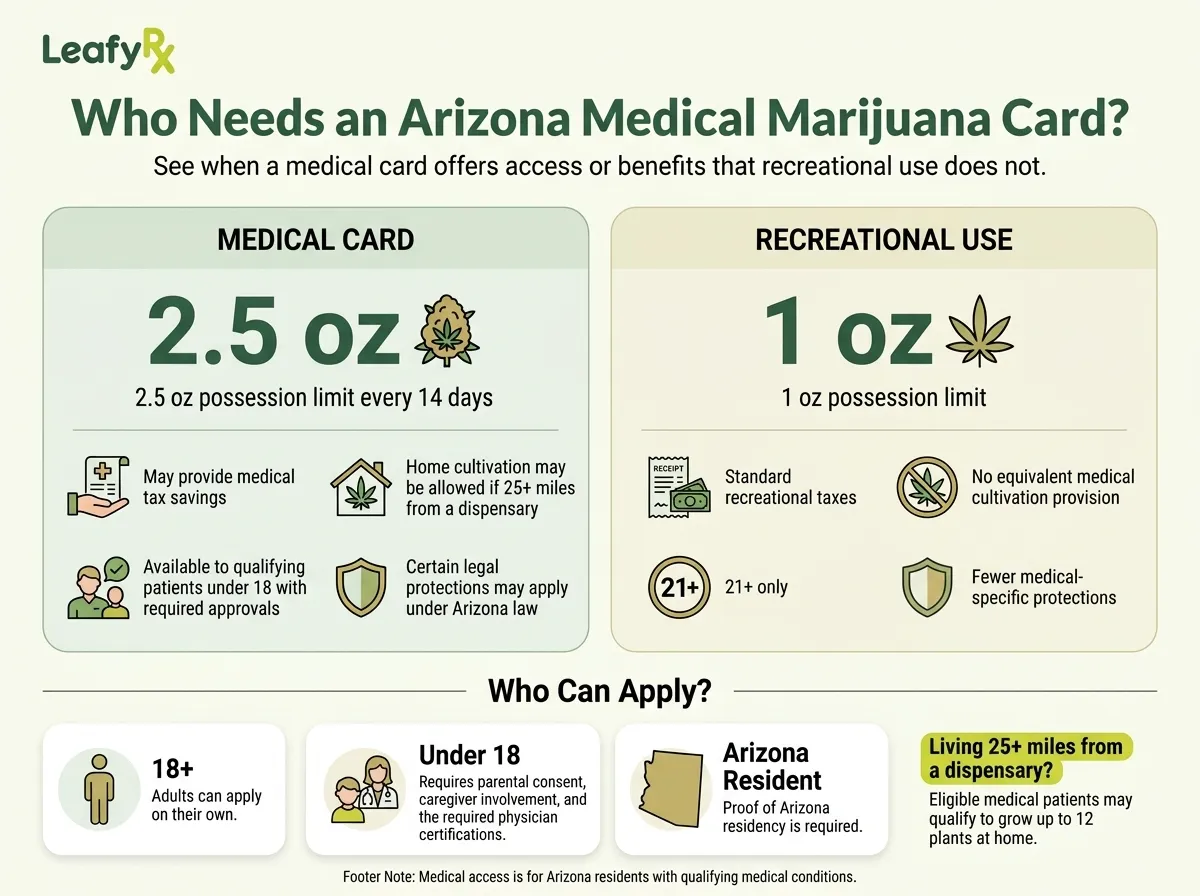
This guide is for Arizona residents with qualifying medical conditions who want legal access to medical marijuana. If you have chronic pain, PTSD, or another serious condition, knowing who can benefit from a medical card can help you decide if it is right for you.
Patients Who Benefit Most from Medical Cards
People who use marijuana often may benefit most from a medical card. Higher possession limits and tax savings can help cover the cost of the card over time.
According to ARCannabisClinic, medical cardholders can save on dispensary taxes. They can also have up to 2.5 ounces every 14 days, compared with the 1-ounce limit for recreational users. These benefits can make a medical card useful for regular users.
Patients who want to grow their own marijuana also need a medical card. If you live 25 or more miles from the nearest dispensary, you can apply to grow up to 12 plants at home.
When Medical Access Makes More Sense Than Recreational
Medical cards can offer workplace protections that recreational users do not have. Employers can still enforce drug-free workplace rules, but cardholders have certain legal protections under the Arizona Medical Marijuana Act.
Minors under 18 need a medical card to use marijuana with parental consent and a designated caregiver. Recreational marijuana is not available to anyone under 21, so a medical card is the only legal option for patients under 18.
Arizona Residency and Age Requirements
You must be an Arizona resident to apply for a medical card. Proof of residency may include a driver’s license, utility bill, or property deed dated within the last 90 days.
Out-of-state visitors cannot use their home state’s medical marijuana card in Arizona. If you need medical access while in Arizona, you must apply for an Arizona card. Services such as LeafyRX offer telehealth evaluations to make the process easier for new residents and qualifying patients.
Age rules depend on the patient. Adults 18 and older can apply on their own. Minors need two physician certifications and parental consent. Some patients also compare medical marijuana costs by state before deciding where to establish residency.
How the Arizona Medical Marijuana Card Program Works in 2027
Arizona’s medical marijuana program operates under the Arizona Medical Marijuana Act (AMMA), which voters approved in 2010. This law provides legal protections for qualified patients who use cannabis for medical purposes.
Arizona Medical Marijuana Act Overview
The AMMA established a framework that allows patients with debilitating conditions to access medical marijuana legally. The law protects patients from criminal prosecution when they follow program rules.
Licensed dispensaries throughout Arizona accept medical cards. Medical patients receive priority access during high-traffic periods, which means shorter wait times compared to recreational customers.
Role of the Arizona Department of Health Services
The Arizona Department of Health Services manages the patient registry, processes applications, and issues medical marijuana cards to approved patients. The department reviews applications within 10 business days and sends approval notifications via email.
Patients can designate caregivers who can purchase and transport medical marijuana on their behalf. This option helps minors and patients with mobility limitations access their medicine.
Patient Registry and Privacy Protections
The registry is accessible only to law enforcement verifying card validity during traffic stops or investigations.
Your medical records and personal health information remain confidential. Dispensaries verify your card status through the state system without accessing your medical details.
Arizona Medical Marijuana Card Qualifying Conditions

Arizona allows patients with certain medical conditions to join the state’s medical marijuana program. Knowing the qualifying conditions can help you see if you may be eligible for a medical card.
State-Approved Conditions List
The Arizona Department of Health Services approves medical marijuana cards for patients with cancer, glaucoma, HIV/AIDS, hepatitis C, ALS, Crohn’s disease, and Alzheimer’s disease. Cachexia, PTSD, severe nausea, seizures, including epilepsy, and severe or ongoing muscle spasms, including those caused by multiple sclerosis, also qualify. See the full list of qualifying conditions for a medical card.
Medical records can help during your doctor visit, but they are not always required. If you do not have a formal diagnosis, a doctor may diagnose a qualifying condition during your visit.
Chronic Pain as a Qualifying Condition
Chronic pain is the most common qualifying condition in Arizona. It accounts for about 60% of medical marijuana cardholders. This includes pain that lasts three months or longer and has not improved with standard treatments.
A doctor must confirm that you have a debilitating medical condition. They must also decide that the possible benefits of medical marijuana are greater than the risks for you. This review takes place during your evaluation, either in person or through telehealth.
Petition Process for Unlisted Conditions
If your condition is not on the approved list, you can ask the Arizona Department of Health Services to review it. This process lets you request that your condition be added to the approved list.
Approval is not automatic. The department reviews each request on its own. You will need documents from your doctor that explain why medical marijuana may help your condition and why other treatments have not provided enough relief.
How to Apply for an Arizona Medical Marijuana Card: Step-by-Step
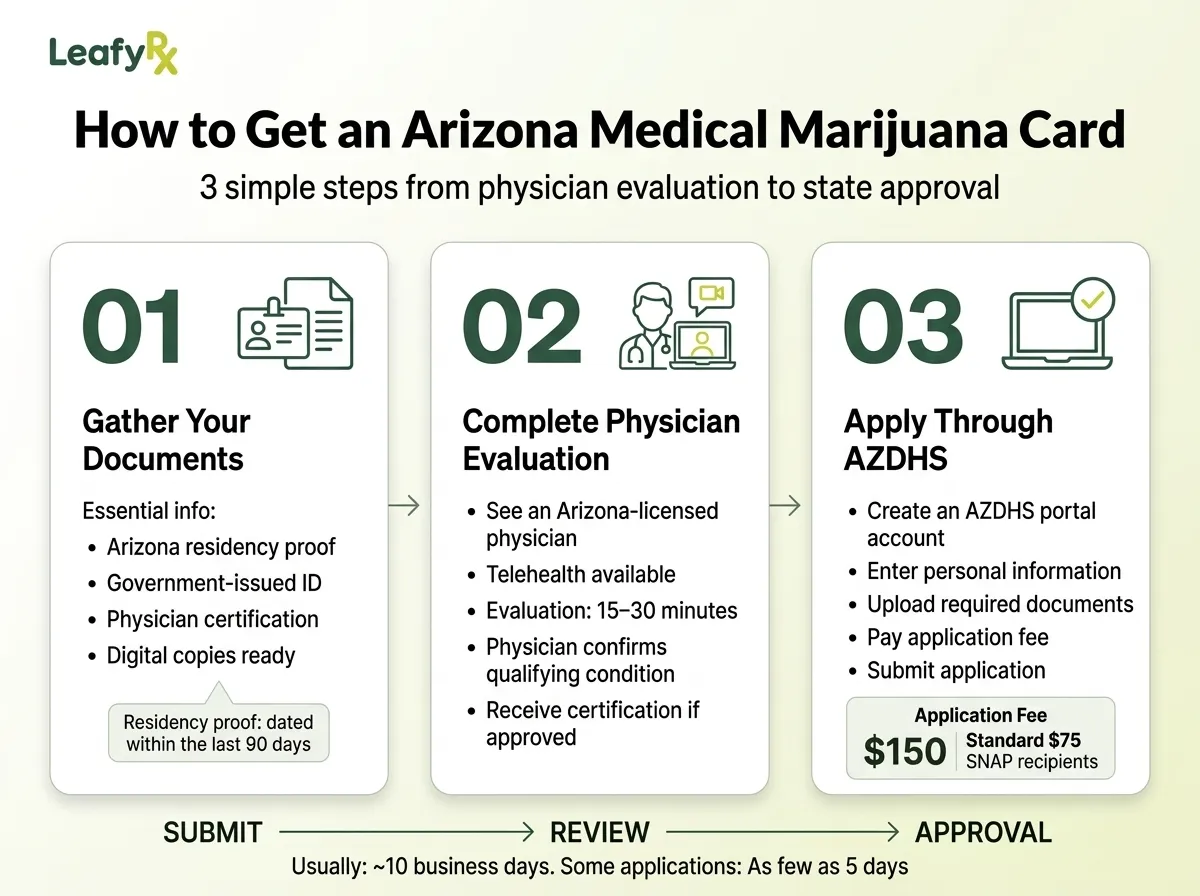
Getting an Arizona medical marijuana card is a simple process that you can complete mostly online. After you submit your application, it usually takes about 10 business days to process.
Required Documentation Checklist
Before you start, gather proof of Arizona residency. This may include a driver’s license, utility bill, or property deed dated within the last 90 days. You will also need proof of identity. You can use the same driver’s license or another government-issued ID.
Your doctor will provide a certification after your evaluation. Keep digital copies of all your documents ready to upload.
Physician Evaluation Process
Book an appointment with an Arizona-licensed doctor who provides medical marijuana certifications. Telehealth visits are convenient and let you complete the evaluation from home. They usually take 15 to 30 minutes.
During the evaluation, the doctor will confirm your qualifying condition and discuss whether medical marijuana may be right for you. If approved, you will receive your physician certification right away. You will need it to complete your state application.
Completing the AZDHS Online Application
Create an account on the Arizona Department of Health Services online portal. Complete the application with your personal details. Then upload your physician certification, proof of identity, and proof of Arizona residency.
Pay the application fee through the portal. Understanding medical card costs and fee structures helps you budget accordingly, as standard applications cost $150 while SNAP recipients pay $75.
Submit your completed application and watch for an email confirmation. Most applicants receive approval notifications within 10 business days, though some are approved in as few as 5 days.
Arizona Medical Marijuana Card Timeline and Fees
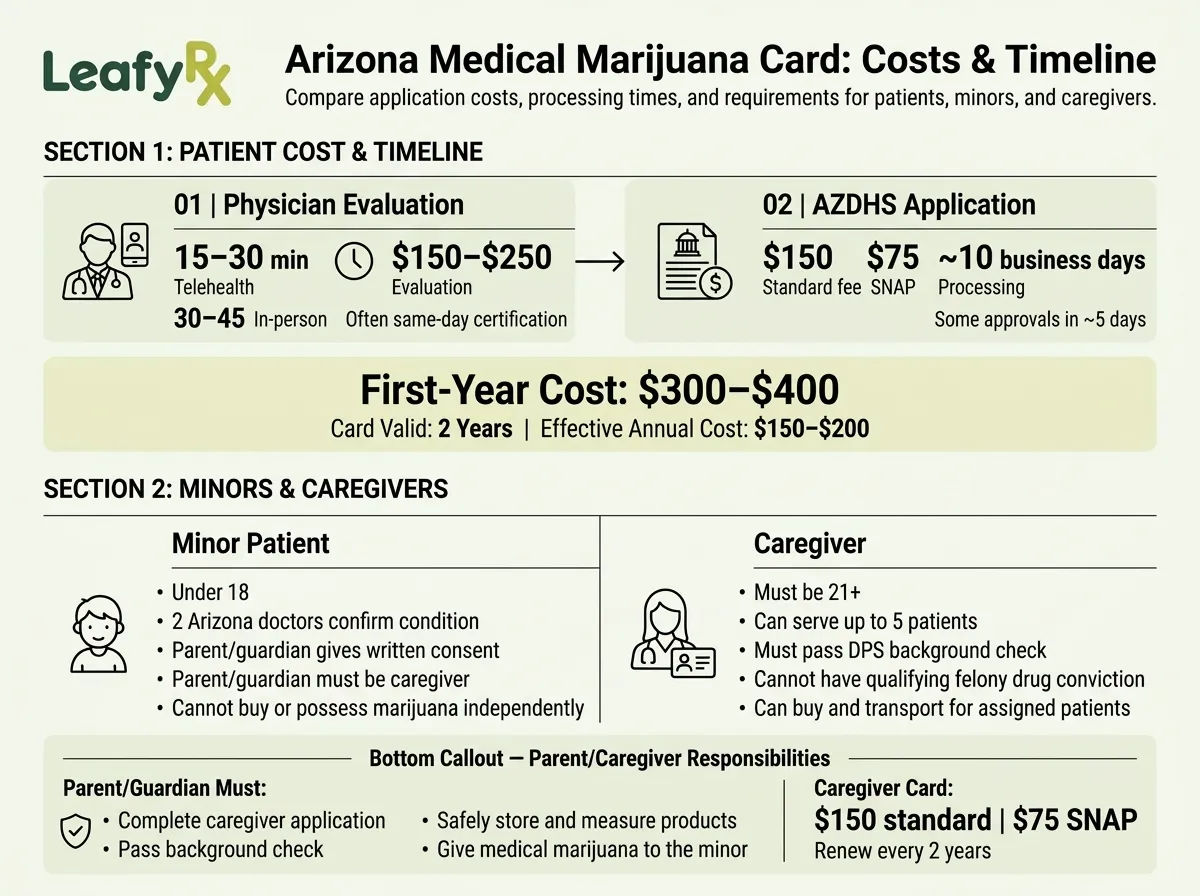
Understanding the full cost and timeline helps you plan your application without surprises. The process involves two distinct stages: your physician evaluation and state processing.
Physician Evaluation Costs and Timeframes
Telehealth evaluations typically take 15 to 30 minutes, while in-person consultations run 30 to 45 minutes. Most providers offer same-day certifications once you complete your appointment.
Evaluation costs range from $150 to $250 depending on which provider you choose. Online services like LeafyRx often provide competitive pricing with money-back guarantees if you don’t qualify.
State Application Fees and Processing Times
The state application fee is $150 for standard applications. Patients receiving SNAP benefits pay a reduced fee of $75.
After you submit your application to AZDHS, processing takes about 10 business days. Some applications get approved in as few as 5 days, though you should plan for the full timeline.
You’ll pay this fee directly through the AZDHS online portal when you submit your application.
Total Cost Breakdown for First-Time Applicants
Total first-year costs typically range from $300 to $400, combining both physician evaluation and state fees. Cards remain valid for two years, which makes the effective annual cost $150 to $200 per year.
Many patients offset these expenses through tax savings at dispensaries. Medical cardholders avoid the excise taxes that recreational users pay, which can add up quickly with regular purchases.
Arizona Medical Marijuana Card for Minors and Caregivers
Minors under 18 can get a medical marijuana card in Arizona, but they must meet extra safety rules. Two doctors must confirm the minor’s qualifying condition. This adds medical oversight and helps make sure medical marijuana is right for the child’s health needs.
Minor Patient Application Requirements
A parent or legal guardian must give written consent for the minor to join the program. Arizona law also requires a parent or guardian to be the minor’s caregiver. Minors cannot buy or possess medical marijuana on their own.
Both doctors must be licensed in Arizona and have a real doctor-patient relationship with the minor. The second doctor gives an independent review to confirm the diagnosis and treatment plan.
Caregiver Designation Process
Caregivers can help minors and adults who need help getting medical marijuana. Each caregiver can serve up to five patients. Caregivers must be at least 21 years old and cannot have felony drug convictions.
Caregivers must pass a background check through the Arizona Department of Public Safety. They get their own caregiver card, which allows them to buy and transport medical marijuana for their assigned patients.
Parental Consent and Responsibilities
Parents or legal guardians must complete the caregiver application and pass a background check to buy and give medical marijuana to their minor child. A caregiver card costs $150, or $75 for SNAP recipients.
The minor’s patient card and caregiver card must both be renewed every two years. Parents are responsible for safely storing, measuring, and giving all medical marijuana products.
Using Your Arizona Medical Marijuana Card for Buying, Travel, and Driving

Your approved medical card lets you buy medical marijuana from dispensaries and gives you legal protections. But you still need to follow Arizona’s rules.
Dispensary Access and Purchasing Guidelines
You can visit any licensed dispensary in Arizona after your card is approved. You can use your digital card right away. Your physical card should arrive by mail within 2–3 weeks.
Medical patients can have up to 2.5 ounces of usable marijuana every 14 days. Patients with certain conditions may qualify for higher limits with a doctor’s recommendation.
You cannot use medical marijuana in public places, on federal property, including national parks, in vehicles, or anywhere smoking is not allowed.
Travel Restrictions and Out-of-State Recognition
Arizona does not recognize medical marijuana cards from other states.
Federal law does not allow you to take marijuana across state lines, even if marijuana is legal in both states. You could face federal charges if you cross state lines with cannabis.
If you live 25 or more miles from the nearest dispensary, you may apply for a home cultivation authorization. This may allow you to grow up to 12 plants at home.
Employment Protections and Workplace Policies
Arizona law gives some job protections to medical marijuana cardholders. However, employers can still have drug-free workplace policies.
An employer may take action if marijuana use affects your job performance. These protections do not apply if you use or have marijuana at work or come to work impaired.
Driving Laws and Legal Limitations
You cannot use medical marijuana while driving or operating a vehicle. Driving while impaired by marijuana is illegal, even if you have a medical card.
During a traffic stop, law enforcement can check your card through the state registry. Having a medical card does not protect you from charges for impaired driving.
Conclusion
An Arizona medical marijuana card gives you legal protections, tax savings, and higher possession limits than recreational users. The process can take less than two weeks from start to finish. Telehealth visits also make it easier to get your physician certification from home.
Start by checking if you have a qualifying condition, such as chronic pain, PTSD, or another approved condition. Then schedule an evaluation with a licensed Arizona physician. Some providers may offer same-day certification.
After your physician approves you, submit your application through the Arizona Department of Health Services portal. Include the required documents and payment. You will usually receive a decision within 10 business days. Once approved, you can visit dispensaries using your digital card.
LeafyRx connects you with licensed healthcare providers for online evaluations. They offer same-day certifications and a money-back guarantee to make Arizona medical marijuana card process simple and stress-free.







 Ask ChatGPT
 Ask Claude
 Ask Perplexity