


If you’re considering medical marijuana in Louisiana, you probably have one pressing question: what are the consequences of getting a medical card in Louisiana? The answer is more complex than a simple yes or no. You gain legal protections to possess and use medical cannabis within state borders.
But you also face real limitations around employment, gun ownership, and federal law conflicts that many patients don’t expect.
Louisiana’s medical marijuana program has grown dramatically since its 2026 launch. Yet confusion still surrounds how holding a card affects your legal status, job security, firearm rights, and privacy. Many patients worry about stigma and whether their card information stays confidential. Others wonder if their health insurance will cover costs or if they’ll face discrimination at work.
This guide breaks down everything Louisiana residents need to know about the real-world consequences of getting a medical card in Louisiana.
You’ll learn about legal protections and limitations under state law. We’ll cover how medical card employment Louisiana rules work and what happens with Louisiana medical cannabis gun rights. You’ll also discover privacy safeguards, qualifying conditions, and practical tips for managing the program safely.
If you’re ready to get started, you can apply for a Louisiana medical marijuana card online in just a few simple steps. By the end, you’ll have a clear picture of what to expect before, during, and after getting your card.
Legal Protections and Limitations of a Louisiana Medical Marijuana Card: Understanding the Consequences of Getting a Medical Card in Louisiana
A Louisiana medical marijuana card gives you state-level legal protection from arrest and prosecution for possessing medical cannabis within program limits. This protection is real and meaningful. Without a card, possession of any amount of marijuana remains a criminal offense in Louisiana, even if you have a qualifying medical condition. The card changes your legal status completely.
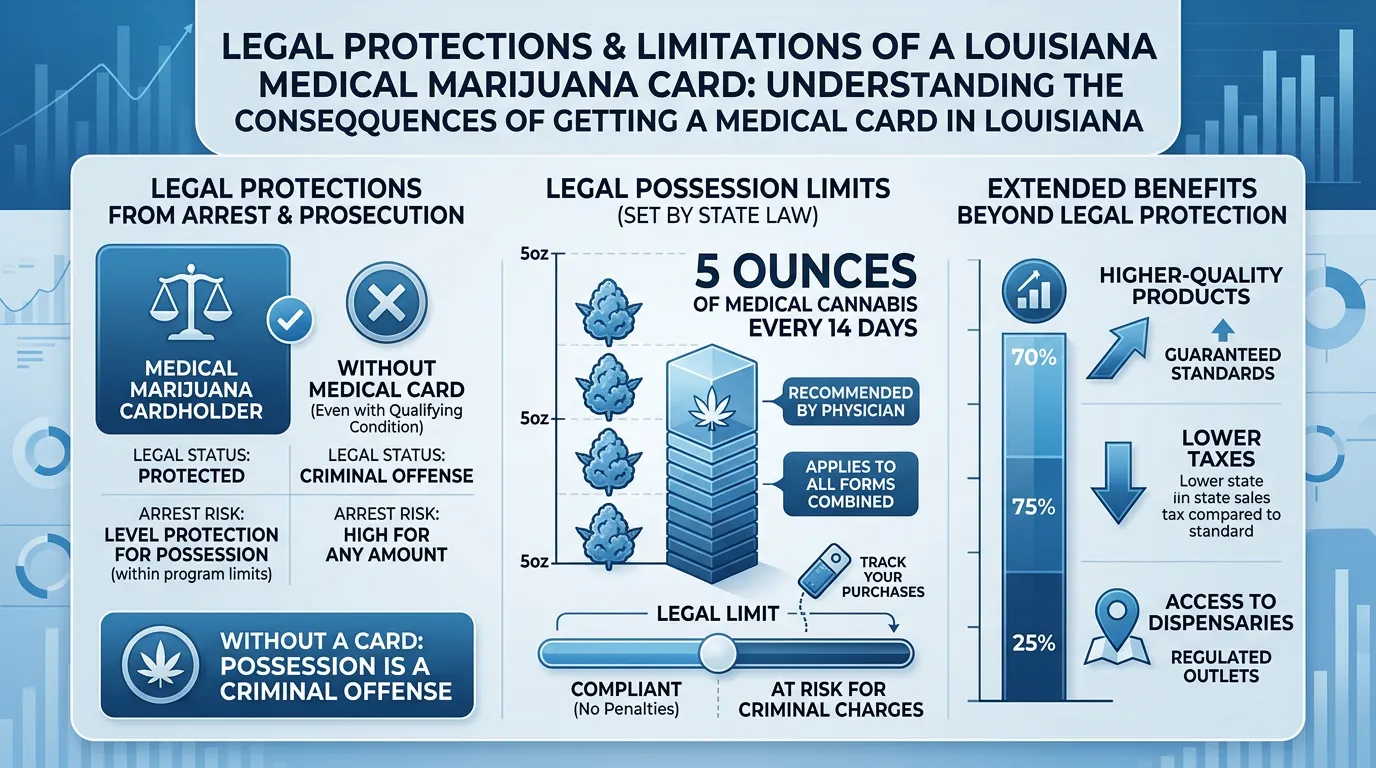
Your card allows you to possess up to 2.5 ounces of medical cannabis every 14 days as recommended by your physician. This limit is set by state law and applies to all forms of medical cannabis combined.
You won’t face criminal penalties as long as you stay within this amount and follow program rules. That said, the benefits of medical cards extend beyond just legal protection to include access to higher-quality products and lower taxes.
What Legal Protections Does Your Card Provide?
Your Louisiana medical marijuana card protects you from state-level criminal charges for possession, use, and purchase of medical cannabis.
Police cannot arrest you for having cannabis if you’re within your legal possession limit and can show your valid card. This protection applies during traffic stops, at home, and anywhere else in Louisiana.
The card also protects you from prosecution. District attorneys cannot charge you with marijuana possession crimes when you’re a registered patient following program rules. This legal shield is automatic once you receive your card and remains active as long as you renew on time.
Federal Law Conflicts and Schedule III Rescheduling
Federal law still classifies cannabis as a Schedule I controlled substance under the Controlled Substances Act. This creates a conflict between state and federal law that patients need to understand.
Federal agents can technically enforce federal drug laws even in states with legal medical programs, though this rarely happens to individual patients.
According to the Louisiana Department of Health guidelines, the December 2026 Executive Order directed the DEA to expedite rescheduling cannabis to Schedule III.
This change would formally recognize cannabis’s medical uses and ease research restrictions. It won’t make recreational use federally legal, but it represents the biggest shift in federal cannabis policy in decades.
Possession Limits and Where You Can Use Medical Cannabis
You can possess up to 2.5 ounces every 14 days based on your physician’s recommendation. This is your legal limit. Going over this amount puts you at risk for criminal charges even with a valid card. Track your purchases carefully to stay compliant.
You cannot use medical cannabis in public spaces, on federal property, in schools, or at most workplaces. Louisiana law prohibits smoking medical cannabis entirely. Only approved forms are legal:
-
Tinctures and oils taken orally or sublingually
-
Topical creams and patches applied to skin
-
Inhalers and metered-dose inhalers for respiratory delivery
-
Edibles and capsules for oral consumption
Your card does not protect you from DUI charges if you drive impaired. Louisiana law treats impaired driving the same whether you have a medical card or not. Plan alternative transportation when using cannabis.
Out-of-state medical cards are not recognized in Louisiana. You must be a Louisiana resident with a Louisiana-issued card to access the state’s medical cannabis program. Bringing cannabis across state lines remains a federal crime regardless of your medical status.
How a Medical Marijuana Card Affects Employment in Louisiana
Getting a medical marijuana card in Louisiana doesn’t protect your job. Louisiana law doesn’t require private employers to accommodate medical cannabis use. This means companies can keep zero-tolerance drug policies. They can refuse to hire you or fire you for testing positive.
Your valid medical card won’t change that.

Most Louisiana employers still test for THC. They treat medical users the same as recreational users. Even if you never use cannabis at work, a positive test can end your employment.
Private Employer Drug Testing Policies
Private companies in Louisiana set their own drug policies. Many maintain strict zero-tolerance rules. They can test job applicants and current employees. A positive THC result can disqualify you from hiring. It can also be grounds for termination.
Some progressive employers have started to distinguish between medical and recreational use. This remains uncommon in Louisiana. Most companies haven’t updated their policies. They treat all cannabis use the same way.
Federal Employees and Safety-Sensitive Positions
Federal jobs prohibit any cannabis use. This includes medical marijuana. DOT-regulated positions follow the same rule. Safety-sensitive roles like healthcare, law enforcement, and commercial driving typically ban cannabis entirely. These restrictions exist regardless of state medical programs.
If you work in one of these fields, your medical card offers no protection. Federal law still classifies cannabis as Schedule I. Employers in these sectors must comply with federal standards.
Workplace Accommodation and Discrimination Protections
Your medical card doesn’t create automatic workplace protections. Louisiana employment law doesn’t treat medical cannabis like prescription medication. Employers aren’t required to make accommodations. They can enforce drug-free workplace policies without exception.
Best practice is to discuss your medical cannabis use with HR before accepting a position. This matters especially if drug testing is required. Never use medical cannabis before or during work hours. Impairment-based termination is legally defensible regardless of your medical status.
Understanding how medical marijuana cards appear on background checks can help you prepare for employment discussions.
Medical Marijuana Cards and Gun Ownership Rights in Louisiana
Getting a medical card in Louisiana creates a complex legal situation with firearms. Federal law prohibits anyone who uses marijuana from purchasing or possessing firearms. This applies regardless of state medical programs.
Federal Form 4473 and Cannabis Use
ATF Form 4473 is required for all firearm purchases in the United States. The form asks if you are an unlawful user of controlled substances. Marijuana remains a Schedule I controlled substance under federal law.
Answering falsely on Form 4473 is a federal felony.
Louisiana State Law vs Federal Firearms Regulations
Louisiana does not maintain a registry linking medical marijuana patients to gun ownership databases. Your medical card information stays private under state law. However, federal law still applies to all firearm transactions.
The state cannot override federal firearms restrictions. This creates a legal gray area for Louisiana patients. State law protects your medical card privacy, but federal law governs gun purchases.
Practical Consequences for Gun Owners
Holding a Louisiana medical card does not automatically disqualify you from gun ownership. Active cannabis use does under federal law. If you already own firearms, obtaining a medical card does not require you to surrender them.
Purchasing new firearms becomes legally problematic once you start using medical cannabis. Some patients delay getting a medical card to maintain firearm purchase eligibility. Others suspend their card when they need to buy firearms. Before deciding whether qualifying conditions make a medical card worth pursuing, you must weigh these restrictions carefully.
The conflict between state medical programs and federal gun laws remains unresolved. Patients must make personal decisions based on their priorities. Legal counsel can help you understand your specific situation.
Privacy, Confidentiality, and Insurance Considerations
One of the most common concerns about getting a medical card in Louisiana is privacy.
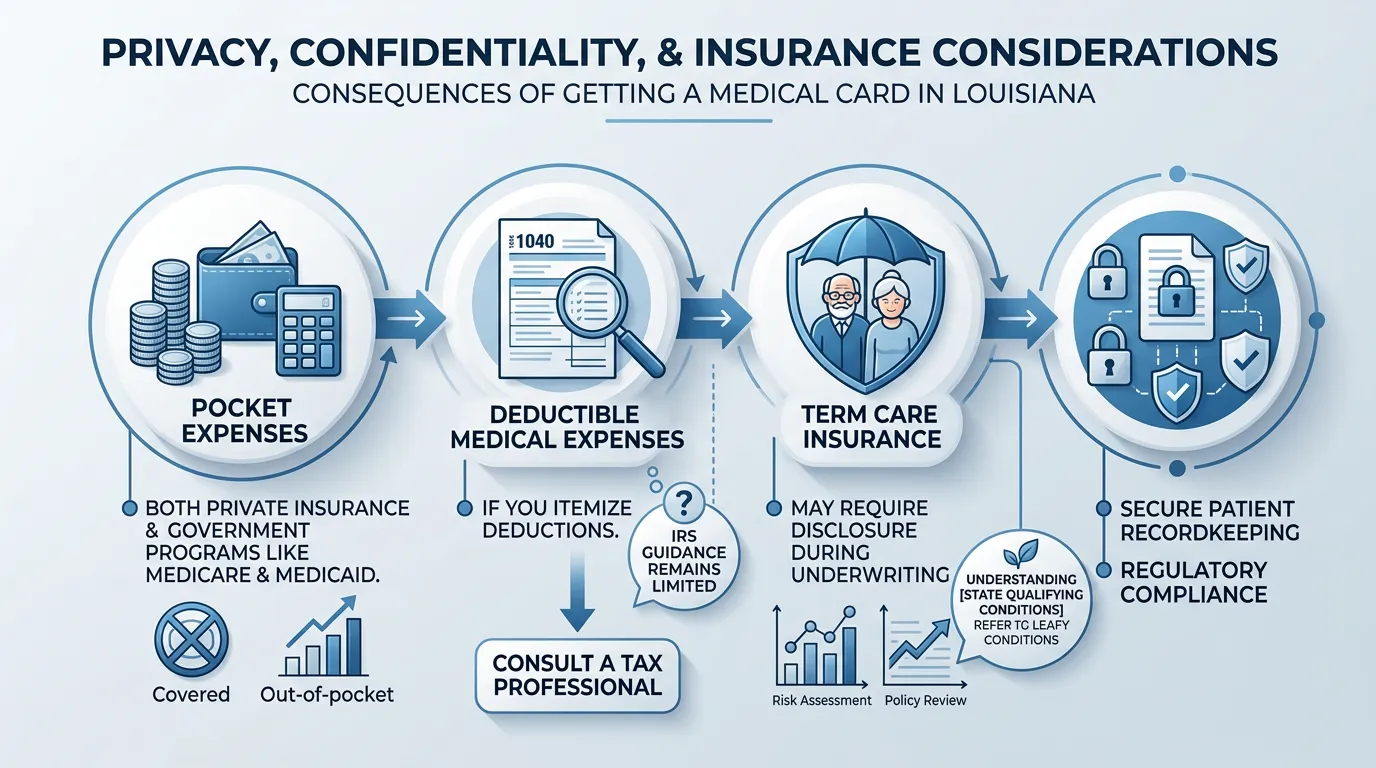
The good news is that Louisiana does not maintain a public registry of medical marijuana patients. Your information stays protected under both federal HIPAA patient privacy protections and state confidentiality laws.
This means your employer, landlord, or the general public cannot access your patient records.
How Louisiana Protects Patient Information
Only three parties have access to your patient records within the state system. These include you, your certifying physician, and the licensed dispensary where you purchase products.
Law enforcement cannot access the patient registry without a court order related to a specific investigation. This legal barrier protects patients from routine searches or fishing expeditions.
Your medical marijuana status does not appear on background checks. It also does not show up in employment screenings or housing applications. The state treats your patient information with the same confidentiality as any other medical record.
Health Insurance and Medical Marijuana Coverage
Health insurance does not cover medical marijuana costs. Cannabis remains federally illegal, which prevents insurance companies from covering it. All purchases are out-of-pocket expenses.
This applies to both private insurance and government programs like Medicare and Medicaid.
That said, medical marijuana expenses may qualify as tax-deductible medical expenses if you itemize deductions. IRS guidance on this remains limited. Consult a tax professional to understand how this applies to your situation.
Life Insurance and Disclosure Requirements
Life insurance applications typically ask about drug use. Failing to disclose medical marijuana use could void your policy if discovered later. Some life insurance companies treat medical marijuana users similarly to tobacco users. This means higher premiums. Others deny coverage entirely based on cannabis use.
Disability and long-term care insurance may also require disclosure during underwriting. Understanding state qualifying conditions helps you prepare for these conversations. Be honest on all insurance applications to avoid policy cancellation or claim denial down the road.
For a deeper look, see HIPAA patient privacy protections.
Qualifying Conditions and How to Get Your Louisiana Medical Card
Louisiana takes a flexible approach to medical marijuana access. The state uses a physician-discretion model. Doctors can recommend cannabis for any debilitating condition they believe will benefit from treatment.
Louisiana’s Broad Qualifying Condition Standard
This open standard gives physicians wide latitude. They can certify patients based on clinical judgment. Common qualifying conditions include chronic pain, cancer, seizure disorders, PTSD, Crohn’s disease, multiple sclerosis, and severe muscle spasms.
The physician-discretion model means you don’t need to match a rigid list. Your doctor evaluates your specific situation. If they believe cannabis will help, they can issue a recommendation.
Step-by-Step Process to Obtain Your Card
Getting your Louisiana medical card starts with a physician consultation. You need a Louisiana-licensed doctor registered with the state medical marijuana program. Telehealth evaluations through platforms like Leafy Rx make this simple.
You can complete the entire process online in under 30 minutes. Licensed Louisiana doctors review your condition via video or phone. Once approved, you receive a physician recommendation immediately.
That recommendation allows you to purchase from any licensed Louisiana dispensary.
No separate state registration card is required. Your physician’s certification is all you need to buy medical cannabis products.
Costs and Renewal Requirements
Louisiana doesn’t charge a state registration fee. Your only cost is the physician evaluation. Telehealth services typically charge $99 for evaluations.
Understanding card costs by state helps you budget for the process. Louisiana’s no-fee structure makes it one of the more affordable states.
Medical marijuana cards in Louisiana are valid for one year. You need annual renewal with a follow-up physician evaluation.
Patients save 10 to 15 percent on dispensary purchases compared to recreational buyers. Lower tax rates on medical products make the card cost recoup itself quickly.
Conclusion
Getting a medical card in Louisiana opens access to therapeutic relief. But it comes with trade-offs you need to understand. You gain legal protection for possession and use within state guidelines. You also get privacy safeguards that keep your patient status confidential.
However, you face potential employment challenges since Louisiana doesn’t require workplace accommodation. Gun ownership becomes complicated due to federal restrictions. Insurance coverage remains limited for medical marijuana products.
The consequences of getting a medical card in Louisiana depend on your personal situation. Weigh the medical benefits against workplace policies and federal limitations.
If you have a qualifying condition, Leafy Rx connects you with licensed Louisiana physicians for fast evaluations. Over 100,000 patients have been approved nationwide.
Get your medical card online today.






 Ask ChatGPT
  Ask Claude
  Ask Perplexity