
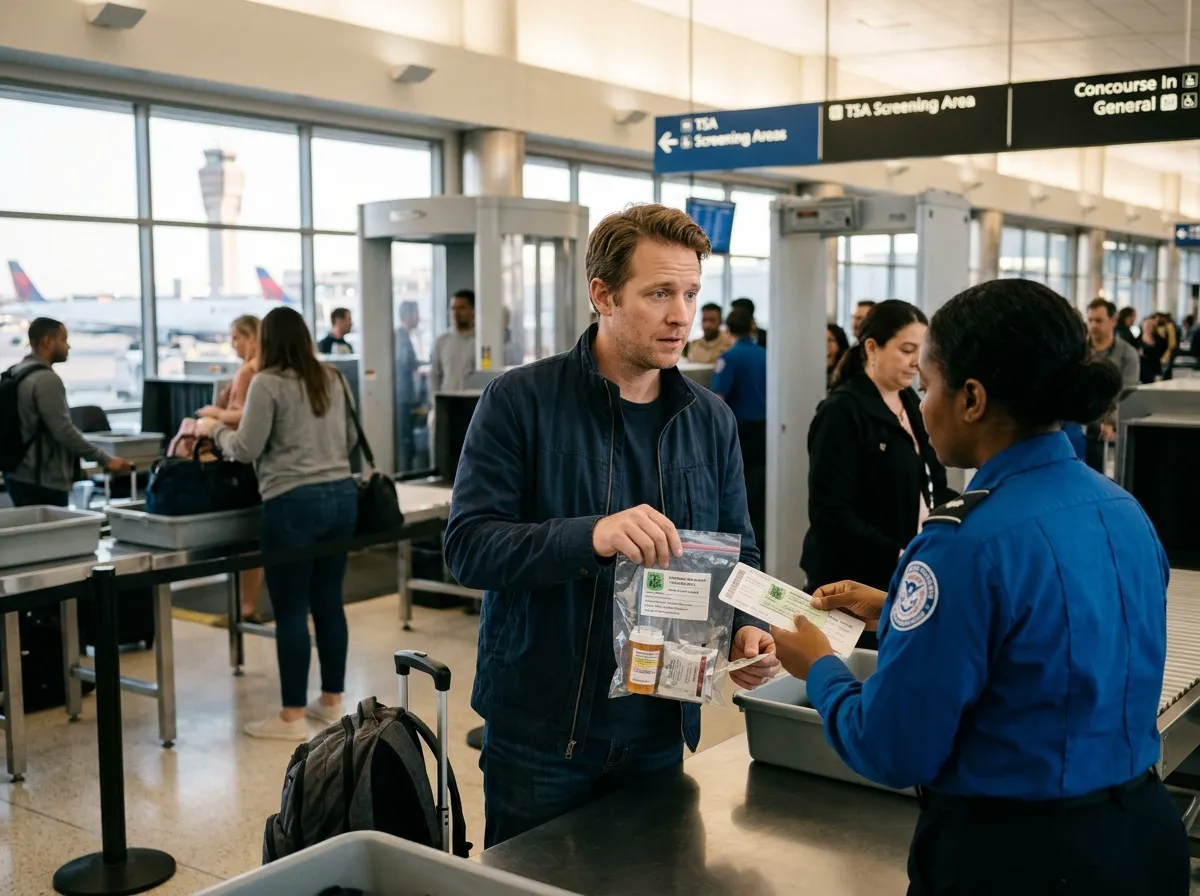

Flying with a medical marijuana card does not have to be a gamble when you plan ahead. Your card is valid in your state, but airports follow federal law. Cannabis is still illegal under that law, and a state card doesn’t change it. TSA officers screen for weapons and explosives, not drugs. They can still refer a suspected violation to local police.
News stories about the updated TSA guidance rarely spell out what’s allowed. Many travelers also assume that moving cannabis to Schedule III would change airport rules on its own. It wouldn’t. This guide helps you understand your risks, pack with fewer surprises, and plan trips that cross state lines. You’ll also learn how hemp and CBD products differ from marijuana.
What Patients Should Know Before Flying With a Medical Marijuana Card?
Your medical card is a state document, and airports follow federal rules. Federal law still treats cannabis as illegal, so your card doesn’t guarantee safe passage. Flying With a Medical Marijuana Card carries legal risk, even between two states with medical programs.
Security officers mainly look for threats, not drugs. They may still refer a cannabis find to local police. Rules differ by airport and state.
-
Check the laws at your departure, connecting, and arrival airports.
-
Ask your doctor about options that fit your travel plans.
-
Plan how you’ll manage symptoms if you leave your medicine at home.
A patient with chronic pain, for example, might find a local dispensary at the destination instead of packing product. Some states accept out-of-state cards, but others don’t. Get information about traveling with your MMJ card before you book.
Plan early, because Flying With a Medical Marijuana Card depends on rules that can change. Check current guidance before every trip.
What Your Medical Marijuana Card Does and Does Not Permit at the Airport?
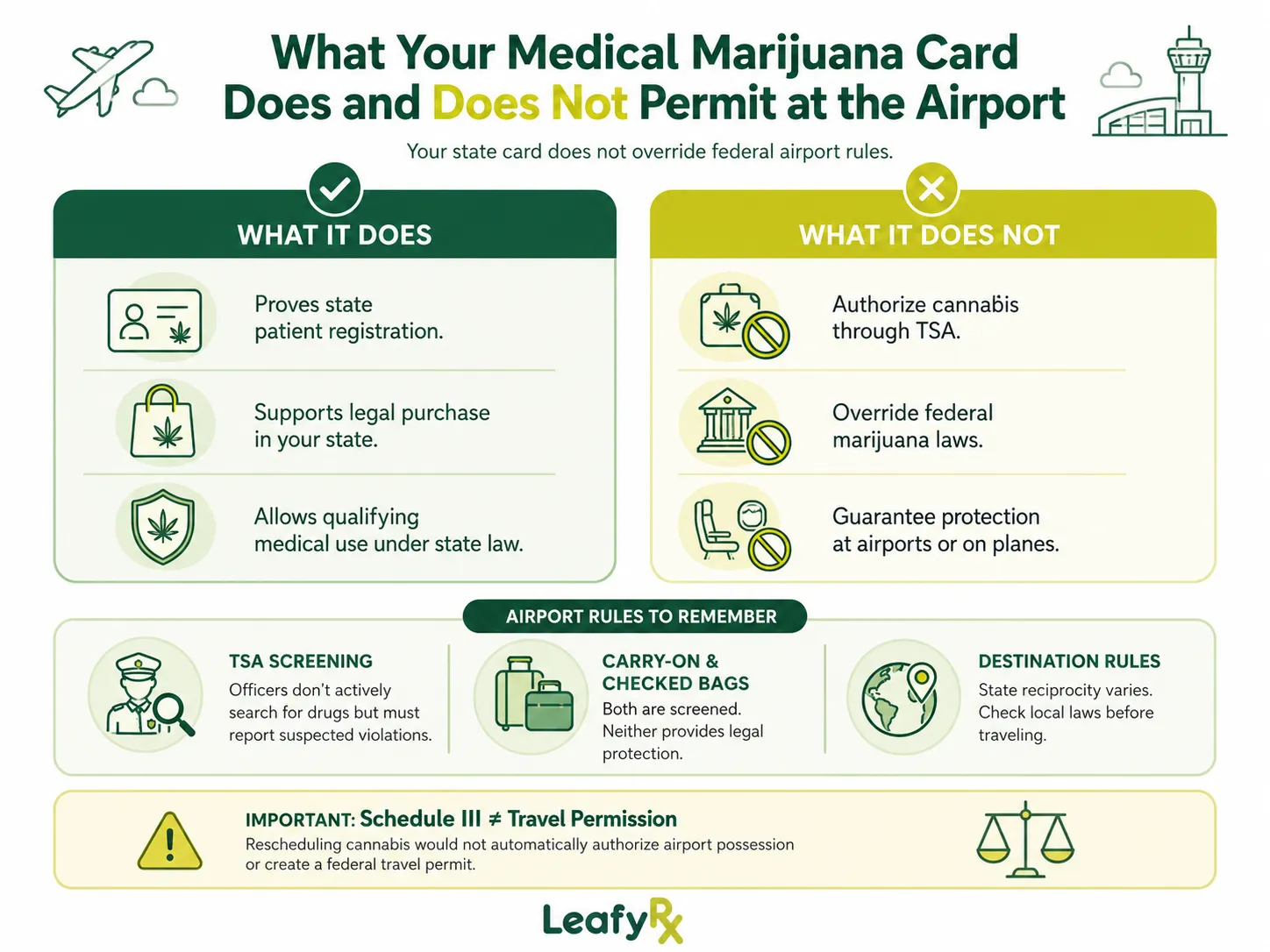
Your medical card proves you’re a registered patient in your state. It doesn’t give you permission to carry cannabis through an airport. TSA officers work under federal law, and federal law still treats marijuana as illegal. A state card carries no weight at the checkpoint.
A card from LeafyRX helps you buy and use cannabis legally at home. Once you head to the gate, though, you leave that state-level protection behind. Airports, planes, and security lines all fall under federal rules.
Why Schedule III would not change airport rules by itself
Moving cannabis to Schedule III would loosen some federal controls. Schedule III drugs still come with legal limits, and the move would not create a travel permit. Agencies would still need to write rules on how patients can possess and carry cannabis. The TSA would also need to update its screening guidance.
Until those rules exist, Flying With a Medical Marijuana Card stays a risk, even if the schedule changes. A patient who packs product because the news said cannabis is easier now could still face questions at security.
Rules also change at your destination. Some states accept out-of-state cards only in limited ways, so get information on how medical marijuana card reciprocity works between states before you book. Treat Flying With a Medical Marijuana Card as a trip that needs planning, not an assumption.
Flying With a Medical Marijuana Card: TSA Screening and Possession Rules
TSA officers mainly look for weapons and explosives, not drugs. Cannabis still counts as illegal under federal law, and airports follow federal rules. Flying With a Medical Marijuana Card gives you no federal protection, even if your state recognizes the card.
What the updated TSA guidance says
The TSA medical marijuana guidelines say officers don’t search for drugs. They must report suspected violations, including marijuana, to local law enforcement. What happens next often depends on the airport’s state and the officer’s judgment.
Your card is a state document, so it won’t stop a report. Some patients also wonder how medical marijuana cards appear on background checks after an airport stop. It helps to know the answer before you travel.
Carry-On vs. Checked Baggage: Packing Guidelines for Cannabis
Both bags get screened. Flying with cannabis in a carry-on means an X-ray, and an officer may open the bag while you watch. A checked bag can be opened when you aren’t there. A patient with a vape cartridge might prefer a carry-on to keep it close, but that gives no legal cover.
If you still decide to pack, use original dispensary packaging with intact labels. Keep your card and purchase receipt in the same bag. Edibles on a plane should stay sealed and clearly labeled. Liquids over 3.4 ounces in a carry-on will also get extra attention.
Many patients skip packing and visit a licensed dispensary at their destination instead. If you don’t have a card yet, LeafyRX lets you start the process online, so you can plan ahead. Flying With a Medical Marijuana Card works best when you know your route, your bag rules, and your backup plan.
Flying With a Medical Marijuana Card In Domestic Flights and Layovers
A domestic trip can cross several state lines in one day. Each state, and each airport, follows its own cannabis laws. Flying With a Medical Marijuana Card means checking the rules at your departure city, your layover, and your final stop.
Medical card reciprocity and local enforcement
Medical marijuana card reciprocity means one state accepts another state’s patient card. Some states do this. Others accept no outside cards, and some limit what visitors can buy or carry. Your home card may carry little weight once you land.
Rules differ widely, look at possession limits, accepted cards, and where patients can use cannabis. Take notes on every state on your route.
Local enforcement matters most on connections. Airport police answer to state and local law, not only to TSA. A patient who flies from a legal state through a state with no medical program could face state charges if officers find product. That risk is why Flying With a Medical Marijuana Card gets harder with each added stop.
Step-by-step trip planning checklist
Use this list a few weeks before you fly.
-
Confirm your card is active and note its expiration date.
-
Look up the laws in your destination and every connecting state.
-
Check whether your destination accepts out-of-state cards and what visitors may buy.
-
Pick a nonstop flight when you can, or avoid layovers in strict states.
-
Decide whether to pack product or visit a licensed dispensary after you land.
-
Carry your card, a photo ID, and a copy of your doctor’s recommendation.
-
Recheck the rules a few days before departure, since laws can change.
A nonstop flight is the simplest way to cut risk. A patient going from one legal state to another can skip connecting states entirely. Planning this way makes Flying With a Medical Marijuana Card far less stressful.
Prohibited Items and What Not to Pack While Flying?
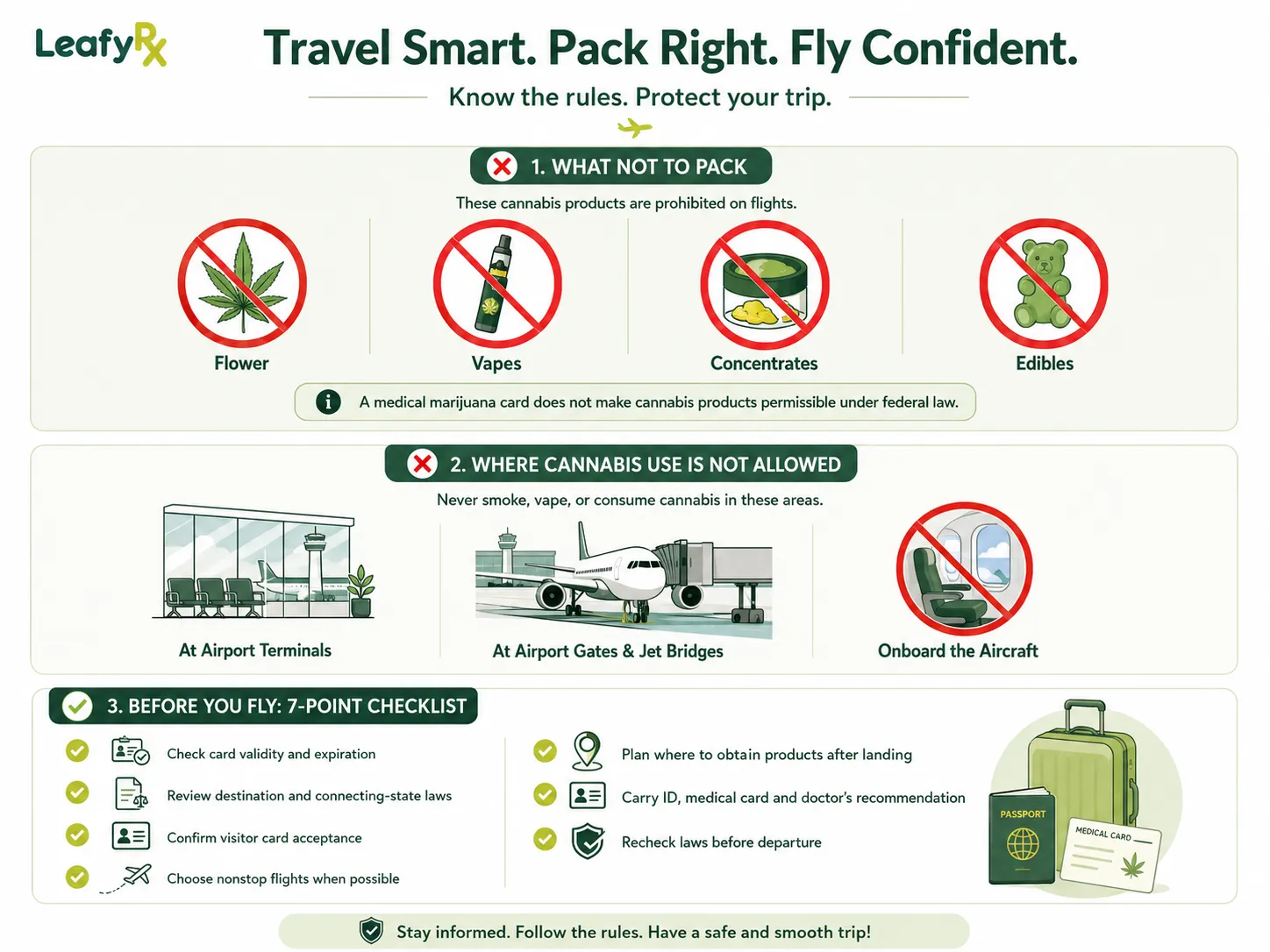
Flying With a Medical Marijuana Card does not make any cannabis product safe to pack. Flower, vapes, concentrates, and edibles all count as cannabis under federal law.
Using cannabis on board and in the airport
Never smoke, vape, or eat cannabis in the terminal, on the jet bridge, or in your seat. Airports and planes follow federal rules, even when your state allows use. Vape clouds can also set off alarms and prompt a crew report.
Once you know what a medical marijuana card allows at home, it’s easier to see why those rights stop at the gate. State protections rarely follow you into a federal space.
Edibles, flight anxiety, and cabin altitude
Flying With a Medical Marijuana Card gets harder with edibles on a plane. They can take an hour or more to kick in, so some people take a second dose too soon. Cabin air is drier and has less pressure than air at ground level, which can add dizziness or fatigue. THC may then feel stronger than you expect, and you can’t step outside.
Flight anxiety is a common reason patients want to medicate before boarding. Talk with your provider about other options, such as breathing exercises or a prescribed medicine. A patient with PTSD, for example, might arrive early, choose an aisle seat, and practice grounding steps. A calm plan for Flying With a Medical Marijuana Card works better than a gummy at cruising altitude.
Flying With a Medical Marijuana Card: CBD and Hemp vs. THC Products
Hemp-derived CBD sits in a different legal category than THC cannabis. Under the 2027 Farm Bill, hemp with no more than 0.3% delta-9 THC is federally legal. Marijuana from a state dispensary stays illegal under federal law. That gap shapes Flying With a Medical Marijuana Card more than the card does.
A patient with a hemp CBD tincture usually faces less risk than one carrying THC edibles on a plane. Keep products in original packaging, and bring a lab report that shows the THC level. Flying with CBD and delta-8 is different, because delta-8 sits in a gray area.
In November 2025, Congress passed a law that redefines hemp. It targets intoxicating hemp products and sets a very low total THC limit per container, reported as 0.4 milligrams. The rule was set to start about a year later, so check its current status before you pack.
Many CBD products with trace THC could fall outside the new definition, and delta-8 items would likely be hit hardest. A product you bought legally as hemp may not count as hemp on your return flight. Until you confirm a product’s status, treat any THC product as risky, hemp-derived or not. Flying With a Medical Marijuana Card also gets simpler when you know your destination’s hemp rules.
Conclusion
Your medical card is a state document. TSA follows federal rules, and federal law still treats cannabis as illegal. Even between two legal states, carrying cannabis through an airport carries real risk.
Rescheduling to Schedule III would not by itself change airport rules. The hemp redefinition from late 2027 may also affect CBD and delta-8 products, so check what you own before you pack. Use on an aircraft is prohibited, no matter where you’re headed.
Most surprises come from poor planning. Look up the laws at your destination, think through how you’d package anything you bring, and weigh your health needs for the trip. Then decide whether you need to bring anything at all.
Make sure your certification is active before your next trip. Patients who need to get certified or renew can complete an online evaluation with a licensed provider through LeafyRX. Then use the checklist in this guide, because flying with a medical marijuana card goes best with a plan.
Ready to plan your next trip? Start your online medical card evaluation with LeafyRX and fly with confidence.





 Ask ChatGPT
 Ask Claude
 Ask Perplexity