

Your medical weed card renewal deadline is coming up fast. Most states issue cards that expire after 12 to 24 months. When that date passes, you lose legal protection and dispensary access. You also lose the tax savings that come with medical patient status. The renewal process varies by state. Some let you start 60 days early. Others give you just 30 days. Processing times can stretch from same-day approval to several weeks.
This guide walks you through the complete medical weed card renewal process for 2026. You’ll learn when to start your renewal, how to use online telehealth services, what documents you need, and how to avoid common delays. We cover state-specific requirements, costs and fees, eligibility updates, and what happens after approval. You’ll also find out what to do if your card expires before your new one arrives. The goal is simple: keep your legal access without gaps or confusion.
Most patients can renew their medical marijuana card online now. This saves time and skips the clinic visit. You can complete your evaluation from home. The process takes less time than your initial application. Let’s break down each step so you can renew with confidence.
Understanding Medical Weed Card Renewal Process
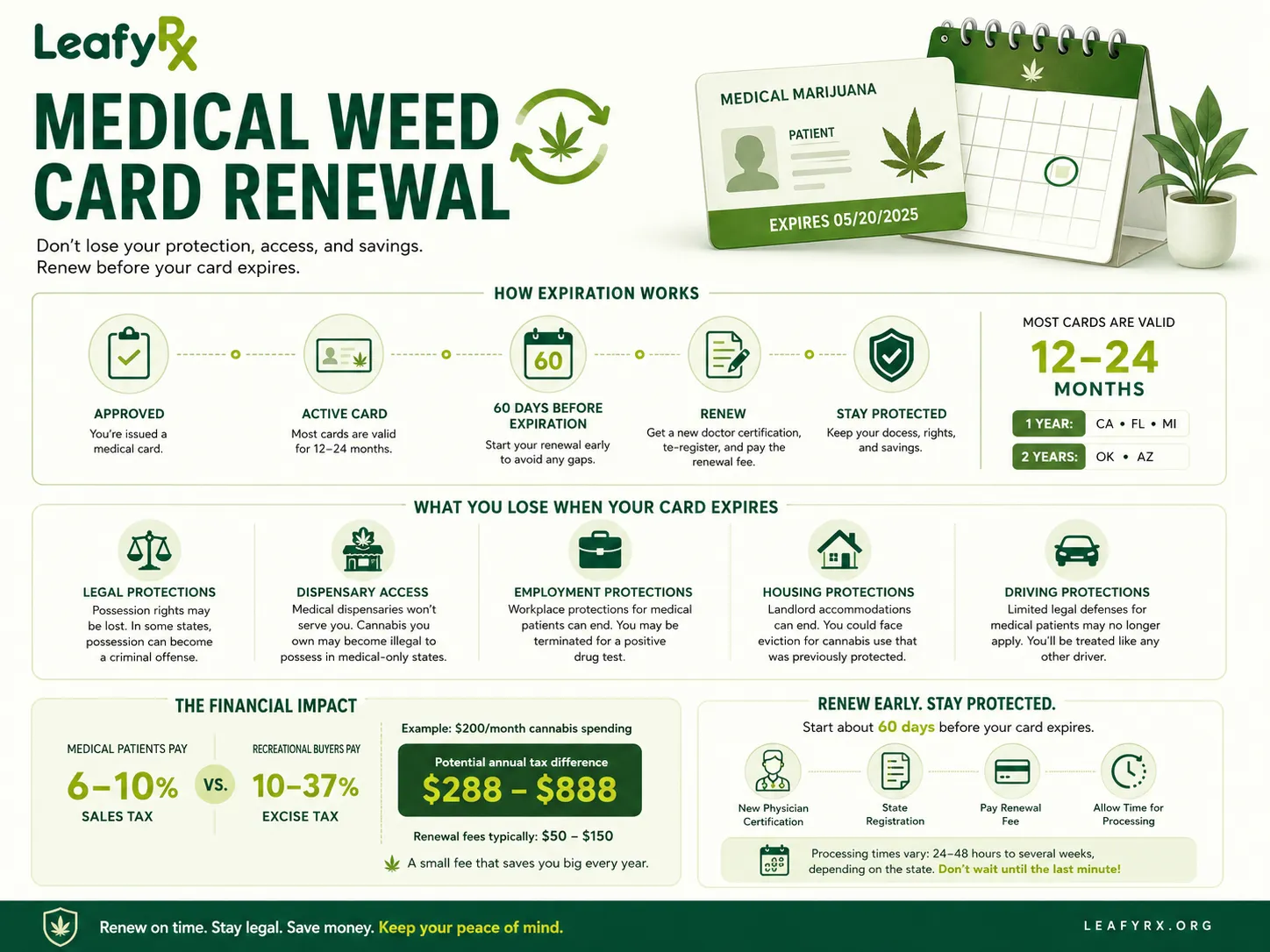
Your medical weed card renewal isn’t automatic. Most states issue cards that expire after one or two years. When that date passes, your legal protections vanish immediately. You lose dispensary access, possession rights, and employment safeguards. Understanding how expiration works prevents costly gaps in coverage.
This section explains what happens when your card expires. You’ll learn which legal protections disappear, how much money you lose to higher taxes, and why timing your renewal matters. Let’s start with how the expiration system actually works.
How Medical Card Expiration Works
Medical cannabis cards are temporary authorizations. They don’t last forever. Most states set expiration dates between 12 and 24 months from your approval date. California, Florida, and Michigan issue one-year cards. Oklahoma and Arizona offer two-year options.
Your card shows the exact expiration date printed on the front. That date is firm. Some states send renewal reminders 60 to 90 days before expiration. Others don’t notify you at all. It’s your responsibility to track the date and start your renewal early.
The renewal process mirrors your initial application. You need a new physician evaluation to confirm your qualifying condition still requires treatment. According to New York’s Office of Cannabis Management, patients must complete a new certification before their current card expires to maintain continuous legal status. Then you re-register with your state health department and pay the renewal fee.
Some states offer grace periods. Maryland allows a 30-day window after expiration where you can still purchase from dispensaries while your renewal processes. Most states don’t. In Pennsylvania, Colorado, and Florida, an expired card means immediate loss of all patient privileges.
Processing times vary widely. Electronic systems in Oklahoma and California approve renewals within 24 to 48 hours. States with manual review like New York and Pennsylvania can take two to four weeks. Plan accordingly. Start your renewal 60 days before expiration to avoid gaps.
Legal Protections You Lose When Your Card Expires
An expired card strips away every legal protection you had as a medical patient. First, you lose possession rights. In states where recreational cannabis remains illegal, possessing any amount becomes a criminal offense the moment your card expires. Even in recreational states, you drop to lower possession limits.
Dispensary access disappears immediately. Medical dispensaries won’t serve you with an expired card. You can’t purchase, and any cannabis you already own technically becomes illegal to possess in medical-only states. This creates a dangerous gap for patients who depend on cannabis for chronic pain, seizures, or PTSD symptoms.
Employment protections vanish too. Many states with medical programs prohibit employers from discriminating against valid card holders. That protection ends when your card expires. Employers can legally terminate you for a positive drug test, even if you were a protected medical patient yesterday. Understanding how to maintain medical marijuana card helps you avoid these employment risks entirely.
Housing protections also disappear. Landlords in some states must accommodate medical cannabis patients under disability laws. An expired card removes that accommodation requirement. You could face eviction for cannabis use that was previously protected.
Driving protections become murky. Some states offer limited defenses for medical patients who test positive for cannabis metabolites but aren’t actively impaired. Those defenses require a valid, current card. An expired card means you’re treated like any other driver with cannabis in their system.
Financial Impact of Expired Cards
The financial hit from an expired card adds up fast. Medical patients pay significantly lower taxes than recreational buyers. Recreational cannabis faces excise taxes ranging from 10 to 37 percent depending on the state. Medical patients typically pay only standard sales tax, which is 6 to 10 percent.
That difference costs real money. A patient who spends $200 monthly on cannabis products saves $24 to $74 per month with a medical card. Over a year, that’s $288 to $888 in tax savings alone. The card renewal fee of $50 to $150 pays for itself within two months for regular users.
Some states impose even higher recreational taxes. Illinois charges 25 percent on products with THC above 35 percent. Washington adds a 37 percent excise tax. Medical patients in these states avoid those rates entirely with a valid card. Letting your card expire means paying hundreds of dollars in unnecessary taxes annually.
Beyond taxes, you lose access to higher-potency products available only to medical patients. Recreational dispensaries often cap THC content or limit purchase quantities. Medical dispensaries don’t. Patients with severe conditions need higher doses. Buying equivalent amounts recreationally costs more per milligram and requires more frequent purchases.
According to Maryland’s Medical Cannabis Commission, patients who maintain continuous valid status also qualify for compassionate care programs that reduce costs for low-income patients. Those programs require an active card. An expired card disqualifies you from financial assistance programs entirely.
Home delivery services charge lower fees for medical patients in many states. Recreational delivery often includes higher service charges and smaller delivery zones. Medical patients get priority scheduling and lower minimums. These conveniences disappear when your card expires.
Step-by-Step Process Medical Weed Card Renewal
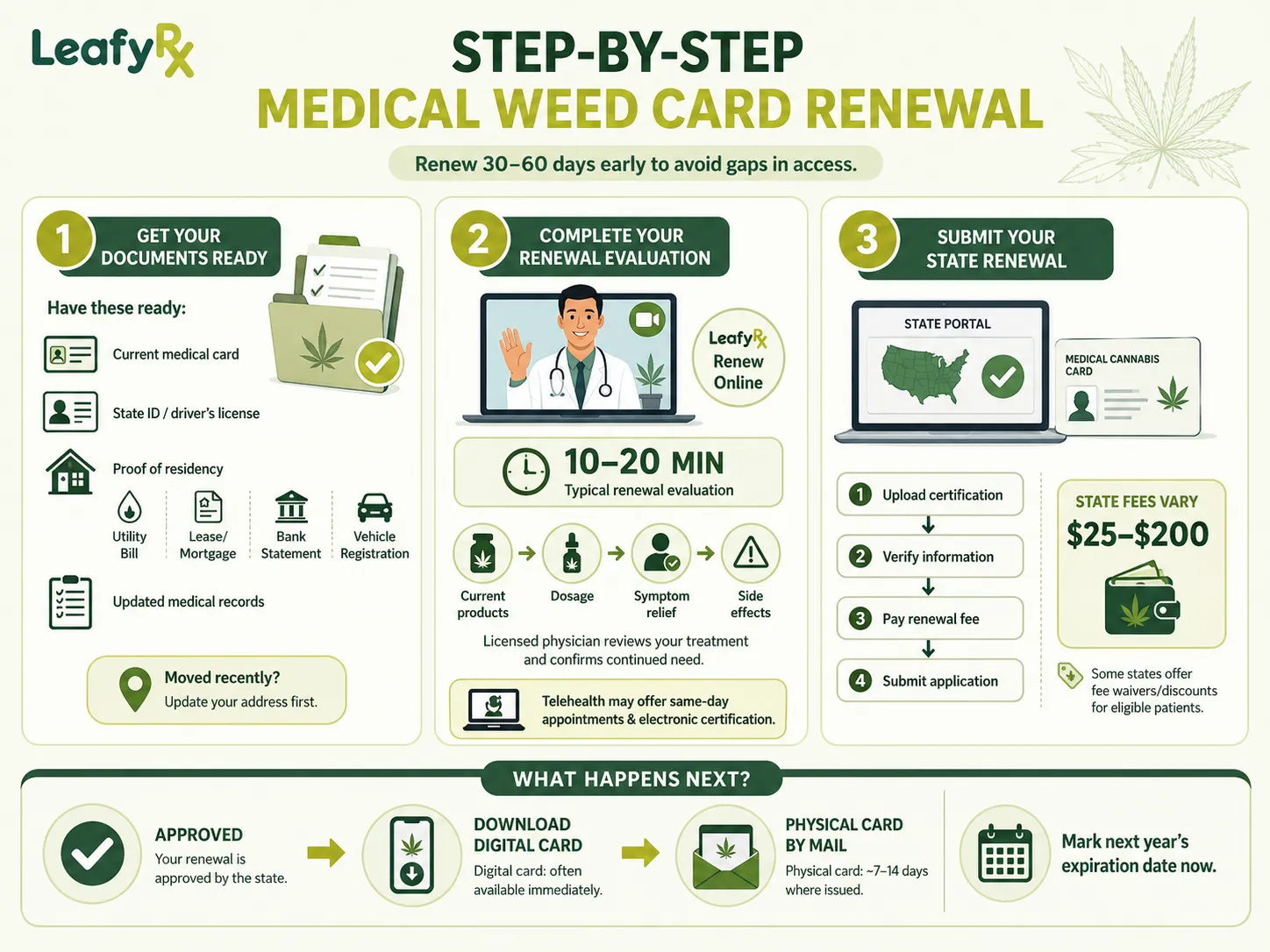
Renewing your medical weed card is simpler than the initial application. Most states require renewal every 12 months. The process takes less time because you already have an established patient record.
Begin your renewal 30 to 60 days before your card expires. This buffer prevents any gap in legal access to your medication.
Gathering Required Documentation
First, collect your current medical card. You’ll need the card number and expiration date for state registration systems. Keep a digital photo of both sides as backup.
Next, gather your valid state ID or driver’s license. The address must match your current residence. If you moved since your last renewal, update your ID first.
You also need proof of residency. Acceptable documents include:
-
Recent utility bill (electric, gas, water) dated within 60 days
-
Current lease agreement or mortgage statement
-
Bank statement showing your name and address
-
Vehicle registration with current address
Then, collect updated medical records. These should document your ongoing qualifying condition. Recent doctor’s notes, prescription records, or treatment summaries work well. According to the Pennsylvania Department of Health, patients must show continued need for medical cannabis treatment.
Some states don’t require new medical records if your condition is chronic. Check your state’s specific requirements before your appointment.
Scheduling Your Renewal Evaluation
Book your renewal evaluation with a licensed physician. You can return to your original certifying doctor or choose a new provider. Many patients find it easier to renew medical card online through telehealth platforms that offer same-day appointments.
Leafy Rx connects patients with licensed doctors who specialize in medical cannabis evaluations. The platform offers flexible scheduling with appointments available within hours, not weeks.
Renewal evaluations are shorter than initial visits. Most take 10 to 20 minutes. The physician reviews your treatment history and asks about symptom management. They want to know if cannabis is helping your condition.
Be ready to discuss:
-
Which products you currently use (flower, edibles, tinctures)
-
Your typical dosage and frequency
-
How well your symptoms are controlled
-
Any side effects you’ve experienced
-
Whether you need dosage adjustments
The doctor will issue your updated certification immediately after the evaluation. Telehealth appointments provide the certification electronically, usually within minutes.
Completing State Registration Renewal
After receiving your physician certification, log into your state’s medical cannabis registry. Each state operates its own system. The Illinois Department of Public Health provides detailed instructions for navigating their renewal portal.Upload your new physician certification to the state portal. The system will prompt you for the document. Most states accept PDF or JPEG files.
Then, verify your personal information. Update your address, phone number, or email if anything changed. Incorrect contact information delays card delivery.
Pay the state renewal fee. Fees vary by state:
-
Low-cost states: $25 to $50 (Colorado, New Mexico, Oregon)
-
Mid-range states: $50 to $100 (California, Michigan, Arizona)
-
Higher-cost states: $100 to $200 (Nevada, Massachusetts)
Some states waive fees for veterans, Medicaid recipients, or low-income patients. Check for available discounts before paying.
Submit your renewal application. The state reviews your documents and processes payment. Review times vary from instant approval to 10 business days.
Most states with electronic systems provide immediate downloadable cards. You can save the PDF to your phone and use it at dispensaries right away. Physical cards arrive by mail within 7 to 14 days in states that still issue them.
Your renewed card is valid for another year from the issue date. Mark your calendar now for next year’s renewal to avoid last-minute stress.
Medical Weed Card Renewal: Recommended Timeline
Timing your medical weed card renewal right can save you from gaps in access. Most states let you start the renewal process 30 to 60 days before your card expires. That window gives you enough time to handle any delays without losing dispensary access.
Some states offer more flexibility. According to the Oklahoma Medical Marijuana Authority, patients can renew up to 90 days early. This extended window helps people who travel often or have busy schedules.
State-Specific Renewal Windows
Each state sets its own renewal timeline. The Massachusetts Cannabis Control Commission allows patients to submit renewal applications 60 days before expiration. Florida follow similar patterns with 60-day windows.
Other states keep tighter schedules. Pennsylvania limits early renewal to 30 days before expiration. New York also uses a 30-day window.
California has its own renewal requirements. Patients renewing a California Medical Marijuana Identification Card (MMIC) generally apply through their county program, and the card is valid for up to one year. Because renewal procedures and processing times can vary by county, California patients should check their local county requirements and start the process before their current card expires.
LeafyRX can help simplify the medical evaluation portion of the renewal process through online telehealth, when eligible. Start your evaluation and get your California medical card online and prepare for the next step in your state’s renewal process.
Processing Time Considerations
Processing times vary widely by state. Florida and California offer same-day electronic approval for most renewals. You can get your new card within hours of submitting your application.
Other states take longer. Pennsylvania processes renewals manually, which takes 2 to 4 weeks. New York follows a similar timeline. The Arizona Department of Health Services notes that processing can take up to 10 business days during peak periods.
Starting your renewal 45 days before expiration provides a safety buffer. This accounts for:
-
Processing delays during high-volume periods
-
Missing or incorrect documentation that needs correction
-
Physician scheduling conflicts or appointment delays
-
Mail delivery time in states that send physical cards
Consequences of Late Renewal
Missing your renewal deadline creates real problems. Some states make you start over as a new patient. You’ll pay full initial fees again instead of lower renewal rates.
You lose dispensary access immediately when your card expires. Most states don’t allow grace periods. You can’t buy medical cannabis until your new card arrives.
A few states offer limited protection. Colorado and Oregon let you continue dispensary visits with proof of a pending renewal application. You need to carry your expired card plus confirmation of your submitted renewal.
Late renewals also mean higher costs. New patient applications cost more than renewals in most states. You might pay $200 to $300 instead of $50 to $100 for a simple renewal.
Medical Weed Card Renewal Telehealth Services
Renewing your medical weed card doesn’t require another trip to a clinic. Online telehealth services make the process faster and more affordable. You can complete your renewal from home in minutes.
Benefits of Online Renewal Services
Telehealth renewal eliminates travel to clinics. You skip the commute, parking hassles, and waiting rooms. This saves time and reduces stress.
Online services reduce appointment costs by 40 to 60 percent. Traditional clinics charge $150 to $300 for renewals. Telehealth providers like Leafy Rx often charge $49 to $99.
You get flexible scheduling with online renewals. Many providers offer evening and weekend appointments. This works better for people with busy schedules or limited mobility.
The process is simple:
-
Schedule an appointment online in minutes
-
Connect with a licensed physician via phone or video
-
Receive your certification immediately if approved
-
Submit your renewal to the state health department
Most patients complete the entire process in under 30 minutes. You can renew during lunch breaks or after work. No need to take time off.
What to Expect During a Telehealth Renewal Appointment
Online renewal appointments typically last 10 to 20 minutes. You’ll connect with a licensed physician via phone or video call. The doctor reviews your condition status and treatment effectiveness.
The physician asks about your current symptoms. They want to know if cannabis helps manage your condition. You’ll discuss any side effects you’ve experienced.
Licensed physicians evaluate whether your qualifying condition persists. They determine if cannabis remains appropriate treatment. This evaluation must happen before issuing renewal certification.
You should prepare before your appointment:
-
Have your current medical card ready
-
Note any changes in your condition or symptoms
-
List other medications you’re taking
-
Be ready to discuss treatment effectiveness
The doctor may ask about dosing and consumption methods. They want to ensure you’re using cannabis safely. This helps them provide better recommendations.
If approved, you receive your certification right away. Most states with online card options and digital systems process renewals within days. Some states issue digital cards immediately.
Choosing a Legitimate Telehealth Provider
Legitimate telehealth providers like Leafy Rx employ state-licensed physicians. These doctors hold active medical licenses in your state. They follow all state regulations for medical cannabis certifications.
Reputable services maintain HIPAA compliance. Your medical information stays private and secure. They use encrypted platforms for all appointments and data storage.
Good providers offer money-back guarantees if you’re not approved. This shows confidence in their evaluation process. It also protects you from paying for a service that doesn’t work.
According to the Utah online renewal system, patients must work with licensed providers who follow state protocols. This ensures your certification is valid and accepted by dispensaries.
Avoid unlicensed services promising guaranteed approvals without physician evaluation. These certifications are invalid. They can result in legal issues when you try to use them.
Red flags to watch for:
-
No physician consultation required
-
Guaranteed approval before evaluation
-
Prices that seem too good to be true
-
No verifiable physician license numbers
-
Poor reviews or complaints about invalid certifications
Leafy Rx has helped over 100,000 patients get approved. They connect you with licensed doctors who conduct proper evaluations. You get legitimate certifications accepted by all state-licensed dispensaries.
Costs and State Fees for Medical Weed Card Renewal
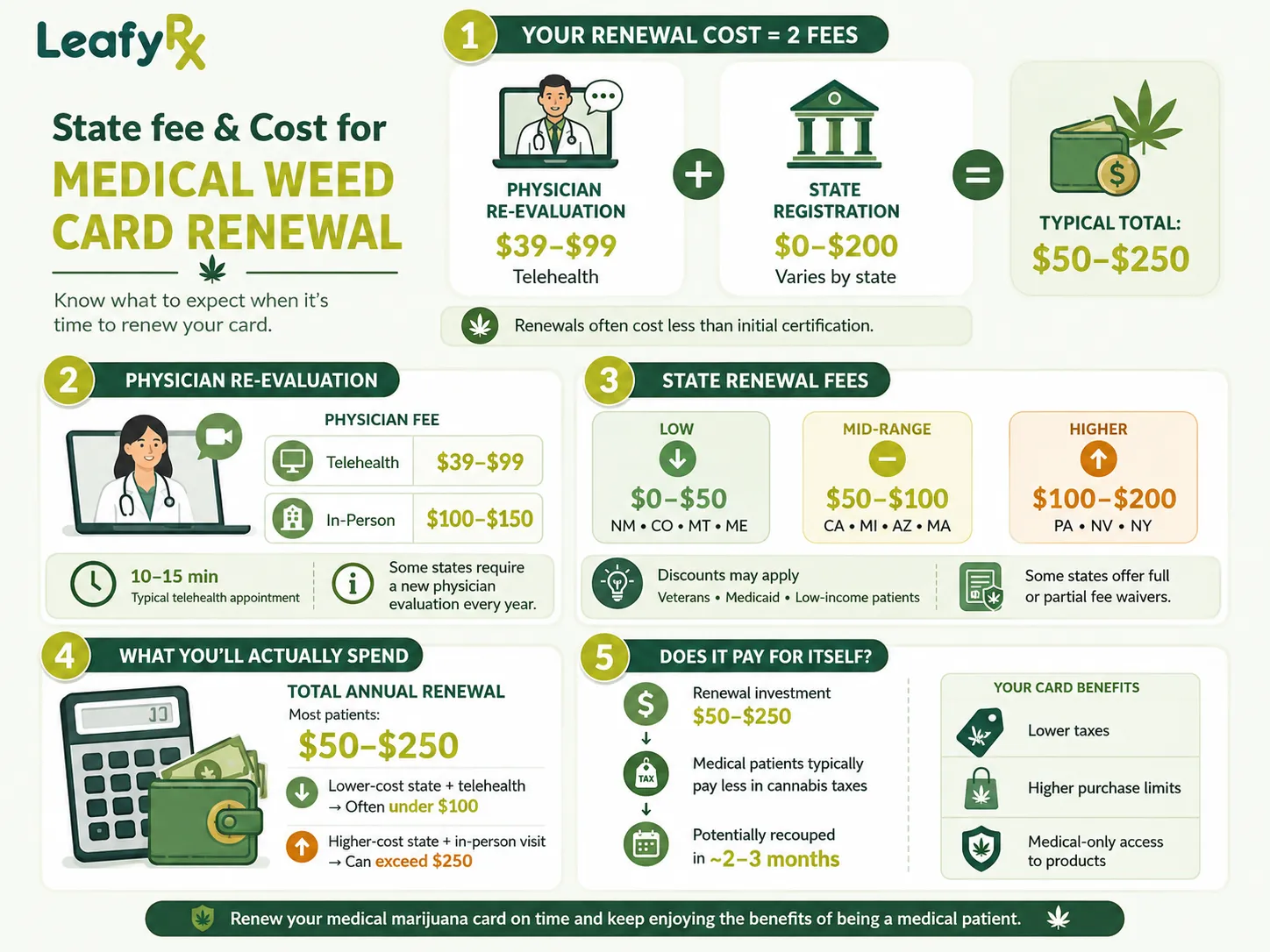
When your medical weed card renewal comes up, you’ll face two main expenses. First is the physician re-evaluation fee. Then comes the state registration cost. Together, these determine your total annual renewal investment.
Most patients find renewal costs lower than initial certification. That’s because you’re already in the system. Your doctor knows your history. The process moves faster.
Physician Re-Evaluation Fees
Renewal physician evaluations typically cost less than initial certifications. Telehealth services like Leafy Rx offer the lowest rates, ranging from $39 to $99. Traditional in-person clinics charge $100 to $150 for renewals.
The price difference comes down to overhead. Online platforms don’t maintain physical offices. They connect you with licensed doctors via video call. The appointment takes 10 to 15 minutes in most cases.
Some states require annual physician re-evaluation. Others let you renew without a new doctor visit. Check your state’s specific requirements before your card expires. Don’t wait until the last minute.
State Renewal Registration Costs
State renewal fees match initial registration fees in most programs. According to the Colorado Department of Public Health and Environment, renewal costs stay consistent year after year. New Mexico charges $0 for renewals. Some states charge up to $200.
Here’s what you can expect across different states:
-
Low-cost states: $0 to $50 (New Mexico, Colorado, Montana, Maine)
-
Mid-range states: $50 to $100 (California, Michigan, Arizona, Massachusetts)
-
Higher-cost states: $100 to $200 (Pennsylvania, Nevada, New York)
Many states offer reduced renewal fees for specific groups. Veterans often qualify for discounts. Medicaid recipients get fee waivers in several states. Low-income patients can apply for reduced rates with proper documentation.
Pennsylvania dropped its renewal fee to $50 for all patients. The state also offers complete waivers for qualifying individuals. Always check if you’re eligible for discounts.
Total Annual Renewal Investment
Total renewal costs average $50 to $250 in most states. This combines affordable telehealth evaluations with standard state fees. Before submitting renewal application, get knowledge about medical marijuana card costs to compare your options.
Low-cost states with telehealth services keep renewals under $100. High-cost states with in-person requirements can push totals above $250. Your choice of provider makes a big difference.
Medical card holders save far more than renewal costs. Dispensaries charge lower taxes to medical patients. Recreational buyers pay 10 to 25 percent more in most states. Typical patients recoup renewal expenses within 2 to 3 months of purchases.
Beyond tax savings, medical cards offer other benefits. You can possess larger quantities than recreational users. Some states allow higher-potency products for medical patients only. Home delivery services are often restricted to card holders.
The investment pays for itself quickly. Most patients spend $100 to $300 annually on medical products. The tax savings alone cover renewal costs. Add in access to better products and higher possession limits. The value becomes clear.
Eligibility and Qualifying Conditions for Medical Weed Card Renewal:
Your medical weed card renewal appointment is the right time to update your health information. You can add newly diagnosed conditions or change your primary condition if your health status has shifted. This keeps your certification accurate and helps your doctor recommend the best treatment options for your current needs.
Most states maintain the same qualifying conditions for medical marijuana card renewals as they do for initial applications. Common conditions include chronic pain, cancer, PTSD, epilepsy, and multiple sclerosis. If you’ve been diagnosed with a new qualifying condition since your last renewal, bring it up during your evaluation. Your doctor can add it to your certification.
Adding New Qualifying Conditions
Some states allow multiple qualifying conditions on a single card. Others list only the primary condition used for initial approval. Check your state’s rules before your renewal appointment to know what to expect.
Adding conditions may require additional medical records. You might need specialist letters or diagnostic test results proving the new condition meets state qualifying criteria. Gather these documents before your appointment to speed up the process.
Changing Primary Diagnosis
Changing your primary qualifying condition does not typically require a new application. You do need physician documentation of the new diagnosis. This can happen during your standard renewal evaluation.
Your doctor will review your medical history and current symptoms. If your health has changed, they’ll update your certification to reflect your primary condition. This ensures your treatment plan matches your current needs.
Documentation Requirements for Condition Updates
Updated conditions may affect your recommended cannabis products. Your doctor might suggest different dosing or delivery methods based on your new diagnosis. This makes renewal evaluations valuable for treatment optimization, not just paperwork.
Bring all relevant medical records to your renewal appointment. This includes recent lab results, imaging reports, and letters from specialists. The more documentation you provide, the easier it is for your doctor to verify your qualifying conditions and update your certification accurately.
Documentation Requirement for Medical Weed Card Renewal
When you renew your medical weed card, you need specific documents ready. Most states require proof of identity, residency, and medical status. Having these documents prepared speeds up the medical card renewal process and prevents delays. Each state sets its own requirements, so check your local rules before starting.
Identification and Residency Proof
You must prove who you are and where you live. A valid government-issued photo ID is required in every state. This includes a driver’s license, state ID card, or passport. Your ID must show your current address and date of birth.
If your ID address is outdated, you need additional residency proof. Most states accept documents dated within 30 to 60 days. These include utility bills, bank statements, lease agreements, or mortgage documents. According to the Connecticut Department of Consumer Protection, proof of residency is mandatory for all medical marijuana program renewals.
Some states accept digital utility bills or bank statements. Others require physical mail with your name and address. Check your state’s specific requirements before submitting documents.
Medical Documentation Requirements
Your medical records document your qualifying condition. Most states don’t require new medical records for straightforward renewals. You only need updated records if your condition changed or your doctor requests them.
If you do need records, gather documents showing continued treatment. These include doctor’s notes, prescription records, or treatment summaries. Your records should confirm you still have a qualifying condition. Data from the Ohio Division of Cannabis Control indicates that most patients renew without submitting new medical documentation.
Some states require a physician’s statement confirming ongoing treatment. Your certifying doctor can provide this during your renewal evaluation. This statement verifies you continue to benefit from medical cannabis treatment.
Previous Card and Certification Records
You need your current medical marijuana card or previous certification. This verifies your existing patient status and original approval date. Keep a copy of your card and certification letter for your records.
Your previous certification shows your qualifying condition and approval history. States use this information to process renewals faster. If you lost your card, contact your state’s medical marijuana program office for a replacement.
Caregiver renewals require additional documents. You need updated background check authorization and continued patient consent forms. The patient must sign new consent allowing you to continue as their caregiver. Some states require caregivers to renew background checks annually.
Payment methods vary by state. Most accept credit cards, debit cards, or money orders. State registration fees range from $0 to $200 depending on your location. Some states offer fee waivers for veterans, seniors, or low-income patients.
What Happens After Medical Weed Card Renewal Approval
Once your medical weed card renewal gets approved, the next steps depend on your state. Some states send electronic cards right away. Others mail physical cards that take weeks to arrive. You need to know what to expect so you can access dispensaries without delays.
Most states send email confirmation when your renewal application is approved. This email includes instructions for downloading your card or tracking physical card delivery. Your renewed card displays an updated expiration date. This date is typically one or two years from the renewal approval date depending on state regulations.
Electronic Card Delivery States
Electronic renewal states like Florida, California, Oklahoma, and Arizona provide immediate downloadable cards after state approval. You can usually download your card within 24 to 72 hours. According to the California identification card FAQs, patients receive email notification with a secure link to download their renewed card as a PDF file.
These digital cards work at all licensed dispensaries in your state. Save the PDF to your phone and keep a backup copy on another device. Some states also provide a printable version if you prefer carrying a physical copy. Electronic cards eliminate mailing delays and let you shop immediately after approval.
Physical Card Mailing States
Physical card states including Pennsylvania and New York mail renewed cards within 2 to 4 weeks. Processing times vary by state workload and mail delivery speed. Some states provide temporary approval letters for interim dispensary access while you wait for your card.
Check your state’s health department website for estimated processing times. Track your card delivery using any tracking number provided in your approval email. If your card doesn’t arrive within the expected timeframe, contact your state’s medical cannabis program office. Keep your old card until the new one arrives, though Leafwell notes that most states don’t allow dispensary purchases with an expired card even on the expiration date itself.
Immediate Dispensary Access
Most electronic card states grant immediate dispensary access once your renewal is approved. You can shop the same day you download your card. Physical card states may require you to wait until your card arrives by mail unless they provide temporary approval documentation.
Some states require you to update your dispensary registrations with your new card number. Others automatically sync state registry data so dispensaries see your updated status in real time. Call your regular dispensary before visiting to confirm they can see your renewed status in the state system.
Keep both digital and physical copies of your renewed card. Some dispensaries require physical cards while others accept digital versions on your phone. Having both options ensures you can shop anywhere without issues. Store your card information securely and never share your patient ID number with anyone except licensed dispensary staff.
Common Delays and Mistakes in Medical Weed Card Renewal
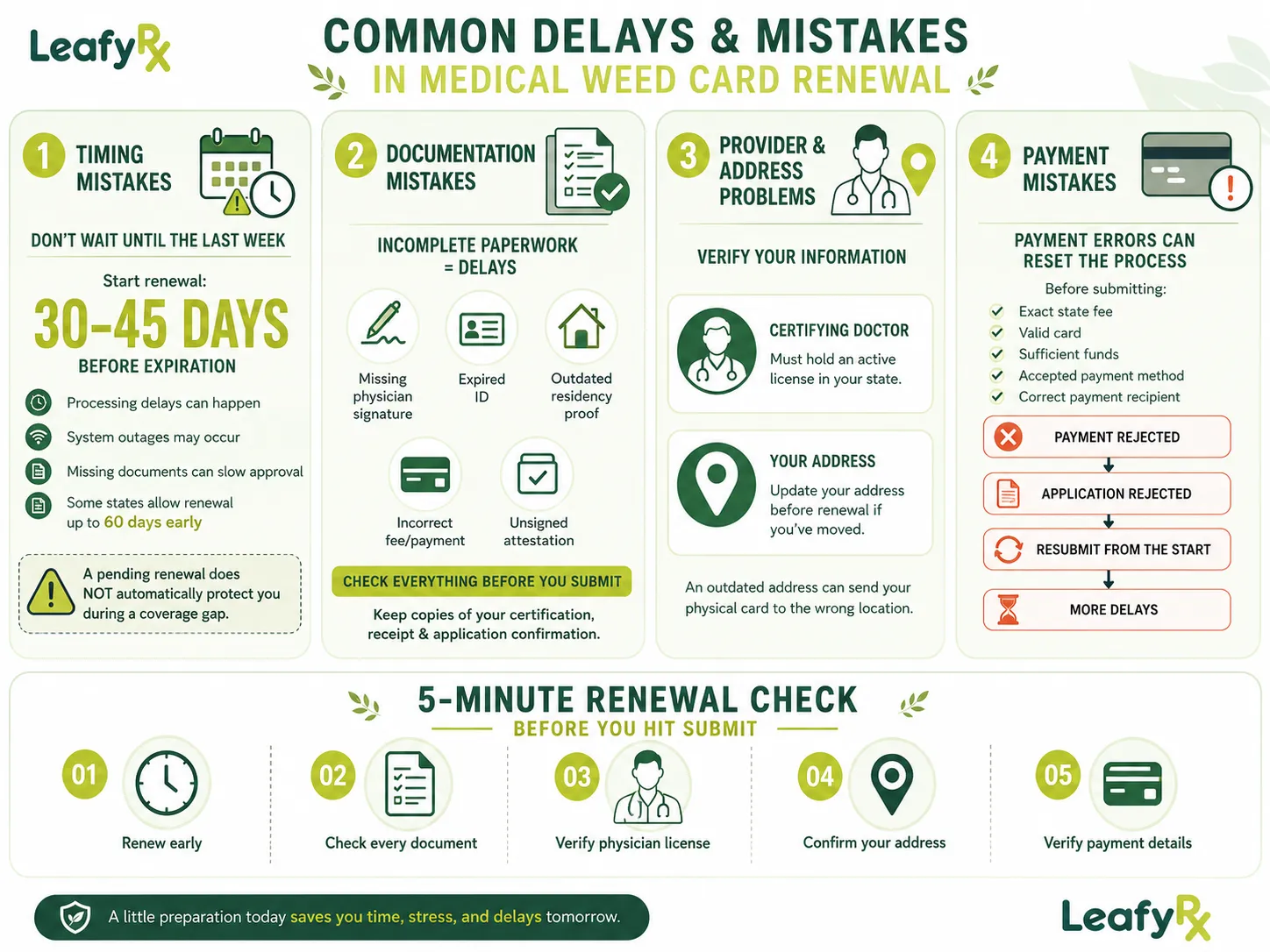
Renewing your medical weed card renewal should be straightforward. Yet many patients face delays that leave them without legal access. Most problems stem from timing errors, incomplete paperwork, or payment issues. You can avoid these pitfalls with proper planning.
Timing and Deadline Errors
Waiting until the last week before expiration creates serious risk. Processing delays happen. System outages occur. Missing documents surface at the worst time.
Start your medical weed card renewal 30 to 45 days before expiration. This buffer protects you from unexpected delays. According to the Oregon Health Authority, applications can take up to 30 days to process during peak periods.
Some states allow you to renew up to 60 days early. Check your state’s specific window. Don’t assume you can rush the process.
Late renewals force you into a coverage gap. You can’t legally possess or purchase cannabis during this period. Law enforcement won’t accept “pending renewal” as a defense.
Documentation and Application Issues
Incomplete applications get rejected automatically. No exceptions. You must submit every required document in the correct format.
Common documentation mistakes include:
-
Missing physician signatures on certification forms
-
Expired state identification or driver’s license copies
-
Incorrect fee amounts or payment method errors
-
Outdated proof of residency documents
-
Unsigned patient attestation forms
Data from the Michigan Cannabis Regulatory Agency shows that incomplete applications account for 40% of renewal delays. Double-check every field before submission.
Keep copies of everything you submit. Scan your physician certification, payment receipt, and application confirmation. These documents prove your pending status if questioned.
Provider and Payment Problems
Your certifying physician must hold an active license in your current state. Using a doctor licensed in another state invalidates your certification. This applies even if you recently moved.
Address changes cause major problems. States mail physical cards to your registered address. If you moved and didn’t update your information, your card goes to the wrong location.
Payment errors trigger automatic rejections. Check these before submitting:
-
Verify the exact fee amount for your state
-
Confirm your credit card hasn’t expired
-
Make sure you have sufficient funds available
-
Use accepted payment methods only
Some states require separate payments for the physician evaluation and state registration. Don’t confuse these two fees. Each must be paid to the correct entity.
Rejected payments require complete resubmission. Your application doesn’t stay in queue. You start over from the beginning, losing weeks of processing time.
What Happens After Your Medical Weed Card Expires
Your medical weed card renewal deadline is approaching. You might wonder what happens if it expires before your new card arrives. The answer depends entirely on your state’s laws. Some states offer full protection during the renewal process. Others leave you without legal coverage the moment your card expires.
Understanding these rules helps you avoid legal trouble and medication gaps. Let’s break down what you need to know about expired cards and pending renewals.
Legal Status While Renewal Is Pending
Legal protections during medical weed card renewal vary dramatically by state. Some states treat pending renewals as valid coverage. Others offer zero protection once your card expires.
According to the Washington State Department of Health, patients with expired cards and proof of submitted renewal applications can continue accessing dispensaries during processing. This grace period protects you from possession charges while waiting for approval.
States with grace periods typically require specific documentation. You need proof of your submitted renewal application. You also need your physician certification letter. Keep both documents with you at all times during the renewal window.
That said, not all states offer this protection. Florida and Pennsylvania require valid, non-expired cards for all legal protections. If your card expires in these states, you lose legal coverage immediately. You can’t possess cannabis until your new card arrives.
Employment protections also vary during renewal periods. Some states with strict workplace accommodation laws only protect employees with valid cards. An expired card may not shield you from workplace drug testing consequences. Check your state’s specific employment protection rules before your card expires.
Dispensary Access During Processing
Dispensary access rules during medical weed card renewal differ significantly across states. Some allow continued purchases with expired cards. Others shut off access completely.
Colorado, Oregon, and Michigan permit dispensary purchases with expired cards plus proof of submitted renewal. You show your expired card and renewal confirmation at checkout. The dispensary verifies your pending status and completes the sale.
The New Mexico Department of Health Medical Cannabis Program offers zero-cost renewals and allows continued access during processing with proper documentation. This prevents medication gaps for patients who depend on daily cannabis treatment.
In contrast, Florida and Pennsylvania enforce strict valid-card-only policies. Once your card expires, dispensaries can’t sell to you. This creates potential medication gaps lasting days or weeks during processing. Early renewal timing becomes absolutely necessary in these states.
Some states issue temporary cards or receipts immediately after renewal submission. These temporary documents allow dispensary access while your permanent card processes. Ask your state’s medical cannabis program if temporary cards are available.
Law Enforcement Interactions with Expired Cards
Law enforcement handles expired medical cards differently depending on your state. Most officers verify pending renewal status through state registries. However, you should always carry proof of your submitted application.
If stopped by police with an expired card, explain that your renewal is pending. Show your renewal confirmation and physician certification. Most states allow officers to verify pending applications through their database systems.
Without proof of pending renewal, you may face possession charges. States without grace periods treat expired cards as invalid. You have no legal protection until your new card arrives. This makes carrying documentation critical during the renewal window.
Some states require you to carry both your expired card and renewal paperwork. Others accept digital confirmation emails. Know your state’s specific documentation requirements before your card expires.
Early renewal is your best protection. Most states allow renewal 30 to 60 days before expiration. Submit your renewal early to avoid any gap in coverage. This prevents legal complications and ensures continuous dispensary access.
Conclusion
Your medical weed card renewal protects your legal access to treatment. This guide covered the complete renewal process from start to finish. You learned when to start your renewal to avoid gaps. You discovered how online telehealth makes renewals faster and easier. You now understand state fees and what documents you need ready.
The medical card renewal process is simple when you plan ahead. Start 30-60 days before your card expires. Gather your documents and update your health information. Choose a licensed telehealth service to skip the clinic visit.
Don’t let your card expire and lose your legal protections. Medical patients enjoy lower taxes and higher possession limits. These benefits make renewing worth the modest annual cost. You also maintain access to dispensaries and avoid legal risks.
Leafy Rx connects you with licensed physicians who complete your medical card renewal online in minutes. Over 100,000 patients trust our fast, affordable service. Get approved or receive your money back. Start your renewal today and keep uninterrupted access to your medicine.





 Ask ChatGPT
 Ask Claude
 Ask Perplexity