


North Carolina patients with qualifying medical conditions can now access medical cannabis through the state’s program. If you’re wondering how to get med card in North Carolina online, the process is simpler than most people think.
You need to confirm your condition qualifies, meet with a licensed physician, and register with the state.
This guide walks you through every step of getting your North Carolina medical marijuana card in 2026. You’ll learn precise costs, required documents, processing times, and where to find licensed dispensaries.
We cover the complete NC medical cannabis application process, from telehealth evaluations to avoiding common mistakes that delay approval. By the end, you’ll know precisely how to get a med card in North Carolina and start accessing the treatment you need.
Understanding North Carolina’s Medical Marijuana Program: How to Get Med Card in North Carolina
North Carolina’s medical marijuana program launched in 2026 after years of legislative work. The program became operational following the passage of the Compassionate Care Act.
According to North Carolina’s medical marijuana legislation, the state took a cautious approach to implementation. This means patients can now access medical cannabis legally through licensed dispensaries.
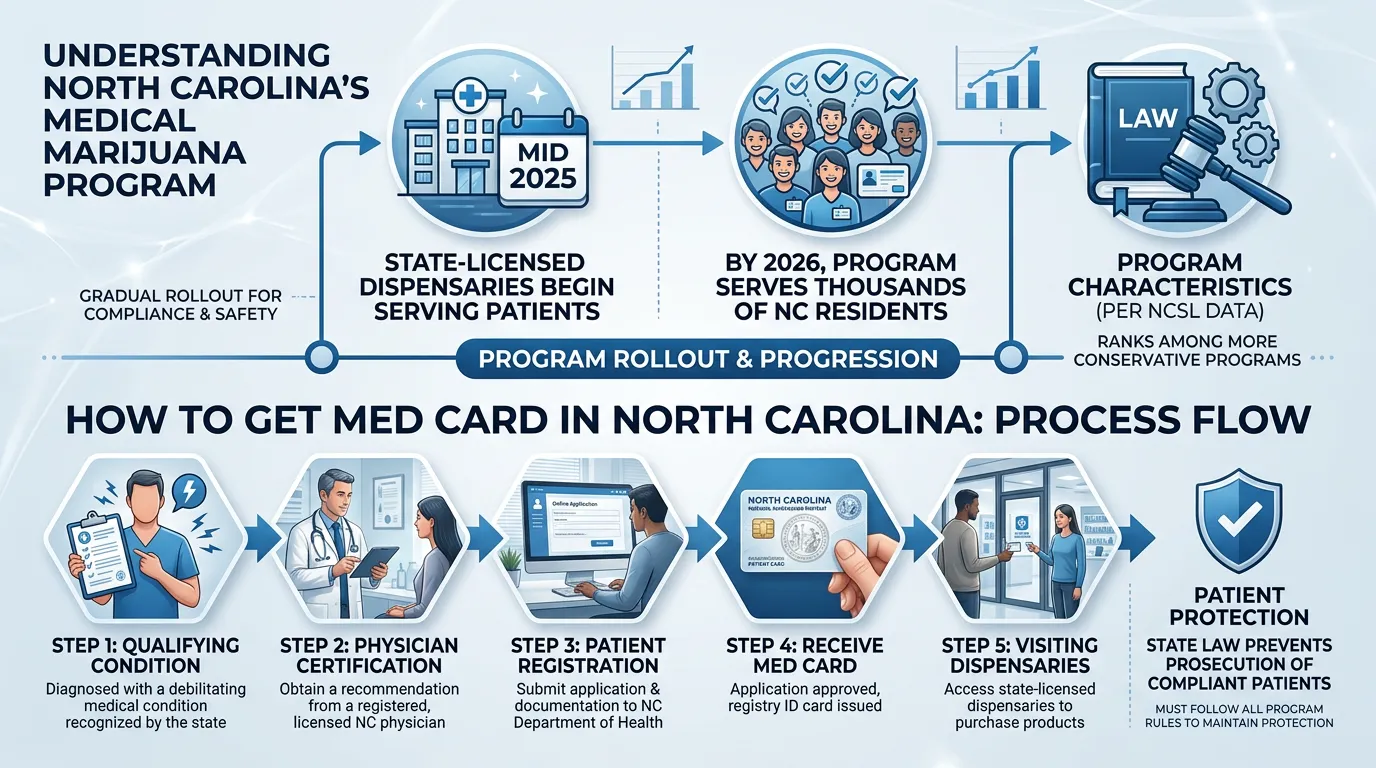
The program differs from comprehensive systems in other states. North Carolina restricts access to specific qualifying conditions only. Recreational use remains illegal under state law. Patients must meet strict eligibility requirements to participate.
Program Launch and Current Status
The program officially opened for patient registration in early 2025. State-licensed dispensaries began serving patients by mid-2025. The rollout was gradual to ensure compliance and safety.
By 2026, the program serves thousands of North Carolina residents.
Registration happens through the North Carolina Department of Health and Human Services. Patients need a physician certification to apply. The state issues digital cards within days of approval. This makes access faster than in many other states.
What Makes North Carolina Different
North Carolina’s program is more restrictive than states like California or Colorado. The state approved only a limited list of qualifying conditions. This contrasts with states that allow physician discretion for any condition.
According to medical cannabis laws by state compiled by the National Conference of State Legislatures, North Carolina ranks among the more conservative programs.
Key restrictions include:
-
No home cultivation allowed under any circumstances
-
Patients must purchase from state-licensed dispensaries only
-
Product types are limited compared to other states
-
Possession limits are lower than recreational states
The state does not permit smokable flower in all cases. Some product forms require additional approval. This makes North Carolina’s program more pharmaceutical in approach. This is covered in detail in North Carolina’s medical marijuana legislation.
Legal Protections for Cardholders
Medical cardholders receive legal protection from state prosecution. You can possess cannabis within program limits without criminal penalties.
This protection applies only to registered patients with valid cards. Law enforcement can verify your status through the state registry.
The program does not protect you from federal law. Cannabis remains federally illegal as of 2026. However, state law prevents North Carolina authorities from prosecuting compliant patients. You must follow all program rules to maintain protection.
Employers can still enforce drug-free workplace policies. The law does not require employers to accommodate medical cannabis use. Landlords may also prohibit cannabis in rental agreements. These limitations are common across most state programs.
Qualifying Medical Conditions in North Carolina
North Carolina maintains a specific list of qualifying conditions rather than allowing physician discretion. This means you can’t get a med card in North Carolina unless your diagnosis matches the state’s approved list. The program operates under strict guidelines set by the state health department.
Complete List of Approved Conditions
The state approves several serious medical conditions for cannabis treatment. Cancer qualifies automatically, along with epilepsy and seizure disorders.
Chronic pain patients can access the program if their condition is documented and persistent.
PTSD and multiple sclerosis both appear on the approved list. HIV/AIDS qualifies under specific circumstances, as does Crohn’s disease. Severe nausea that doesn’t respond to conventional treatment also makes the cut.
Terminal illness with life expectancy under one year qualifies automatically. This provision ensures end-of-life patients can access relief without bureaucratic delays. Understanding how to verify your condition qualifies helps you prepare your application correctly.
Documentation Requirements
You must provide medical records documenting your diagnosis from a licensed healthcare provider. These records should show your condition’s history, previous treatments attempted, and current status. The state requires proof that conventional treatments were tried first.
Your documentation needs to be recent and comprehensive. A single doctor’s note won’t suffice. You’ll need treatment records, test results, and a clear diagnosis statement from your physician.
Conditions Under Review for Future Approval
The state health department reviews petitions to add new qualifying conditions annually. Patient advocates and physicians can formally request additions to the approved list. This process allows the program to evolve as medical research advances.
Several conditions are currently under consideration for future approval. The review process examines clinical evidence, patient testimony, and safety data. Comparing qualifying conditions across all states shows how North Carolina’s list may expand over time.
Step-by-Step Application Process for Your North Carolina Med Card
Getting your North Carolina medical card follows a clear process. You need to gather documents, meet with a doctor, and register with the state. The entire process takes two to four weeks from start to finish.
Step 1: Gather Medical Documentation
Start by collecting your medical records. You need proof of your qualifying condition diagnosis. This includes treatment history, prescription records, and doctor’s notes.
Your documentation should show ongoing care for your condition. Most physicians want to see at least three months of treatment history. Bring any lab results or imaging studies that support your diagnosis.
Step 2: Schedule Physician Evaluation
Next, book an appointment with a North Carolina-licensed physician certified to recommend medical cannabis. You can choose between in-person visits or telehealth evaluations.
Telehealth options through services like Leafy Rx offer faster appointments and lower costs. Most online evaluations take under 30 minutes. The doctor reviews your medical history and determines if cannabis is appropriate for your condition.
During your evaluation, be honest about your symptoms and treatment goals. The physician needs accurate information to make a proper recommendation. If approved, you receive a certification document immediately.
Step 3: Complete State Registration
Once you have your physician certification, register with the North Carolina medical cannabis program. You need your certification, a valid state ID, and proof of residency.

Submit your application through the state health department portal. Pay the registration fee during submission. Keep copies of all documents for your records.
The state reviews your application for completeness and accuracy. Processing times vary by county. Most applications are approved within two to four weeks if all information is correct.
Step 4: Receive Your Patient Card
After approval, your patient card arrives by mail or becomes available for download. Some counties offer digital cards you can access immediately. Others mail physical cards within five to seven business days.
Once you have your card, you can get your medical card renewed annually to maintain access. Visit any licensed dispensary in North Carolina with your card and valid ID. Store your card safely and bring it to every dispensary visit.
Cost Breakdown: What You’ll Pay for a North Carolina Medical Card
Getting a medical card in North Carolina involves several costs. You need to budget for both the physician evaluation and state registration. Understanding these expenses helps you plan ahead.
Physician Evaluation Fees
Physician evaluation fees range from $99 to $300. Telehealth services typically cost less than in-person clinics. Leafy Rx offers evaluations starting at competitive rates with a money-back guarantee if you don’t get approved.
Online evaluations save you time and money. You can complete the process from home in under 30 minutes. Traditional clinics charge more because of higher overhead costs.
State Registration Costs
North Carolina charges a state registration fee of approximately $50 to $100. This fee covers your official patient ID card. Check with the state health department for the current exact amount.
Your total first-year cost typically ranges from $150 to $400. This includes both the physician evaluation and state registration. Some states offer fee waivers for veterans or low-income patients.
Annual Renewal Expenses
Annual renewal requires a follow-up physician evaluation and state re-registration. Renewal costs are often lower than initial application fees. You can expect to pay $100 to $200 total for renewal.
Medical cardholders save 10 to 20 percent on dispensary purchases compared to recreational buyers. These savings quickly offset your card costs. For a detailed comparison of medical card costs by state, check current pricing across different programs.
Required Documents and Eligibility Requirements
North Carolina requires specific paperwork before you can apply. You need three main document types to prove you qualify.
Proof of Residency
You must show you live in North Carolina. The state accepts utility bills, lease agreements, or mortgage statements. The online medical card process goes into more depth on this.
All documents must be dated within 60 days. Bank statements and pay stubs also work if they show your current address.
Keep digital copies of these documents. You’ll upload them during your online application process.
Medical Records
Your medical records must clearly document your qualifying condition. The diagnosis needs to come from a licensed physician.
Include treatment history, current prescriptions, and detailed physician notes. Records should show ongoing care for your condition, not just a single visit.
Most applicants need at least three months of documented treatment. This proves your condition is chronic and requires ongoing management.
Identification Requirements
You need a valid North Carolina driver’s license or state-issued ID card. Expired IDs won’t work for your application.
Applicants must be 18 years or older. Minors can apply with parental consent but need two physician recommendations and a designated caregiver.
Out-of-state medical cards aren’t recognized in North Carolina. You must apply through the state’s official process even if you hold cards from other states.
Using Your North Carolina Medical Marijuana Card
Once you get your North Carolina medical marijuana card, you can start using it right away. The state makes it easy to find dispensaries and buy products. You just need to know the rules.
Finding Licensed Dispensaries
North Carolina maintains a registry of licensed medical marijuana dispensaries on the state health department website. You can search by zip code or city. All dispensaries must pass strict safety inspections.
Most dispensaries require you to show your medical card and a valid ID. Some also ask for proof of residency. Call ahead to confirm what documents you need.
Dispensaries offer flower, oils, edibles, and topicals. Staff can help you choose products based on your condition. Many locations also provide online ordering for pickup.
Possession Limits and Purchase Restrictions
Patients can possess up to a 30-day supply as determined by their certifying physician. This amount varies based on your treatment plan. Your doctor sets the limit when they approve your card.

Dispensaries track purchases electronically to prevent exceeding monthly limits. According to state medical cannabis laws, this system protects patients and ensures compliance. You can’t buy more than your approved amount in any 30-day period.
Medical cannabis must remain in original, labeled packaging during transport. Keep your receipt with you. This proves you bought it legally.
Traveling with Your Medical Card
Smoking or consuming cannabis in public places remains illegal even with a medical card. Use it only in private residences. Parks, sidewalks, and vehicles don’t count as private.
North Carolina medical cards are only valid within state borders. Other states won’t recognize your card. You can’t use it for NC dispensary access outside the state.
Crossing state lines with cannabis remains a federal offense regardless of medical status. Don’t take your medicine to another state. Buy what you need locally and leave it at home when you travel.
Telehealth Evaluations: The Fastest Way to Get Your Med Card
Telehealth platforms like Leafy Rx connect patients with North Carolina-licensed physicians via phone or video. You can schedule appointments same-day or next-day. The entire process happens from your home.
Appointments typically last 15 to 30 minutes. You discuss your condition, treatment history, and medical cannabis goals with the physician. If approved, the physician issues a certification immediately.
How Telehealth Appointments Work
First, you create an account on a telehealth platform. Then, you select an available appointment slot. Most services offer same-day availability.
During the call, the physician reviews your medical history. They ask about your symptoms and previous treatments. The conversation is confidential and HIPAA-compliant.
After approval, you receive your certification digitally. You can use it right away for state registration. The whole process takes less than an hour from start to finish.
Benefits of Online Evaluations
Telehealth evaluations cost less than in-person clinic visits. Lower overhead means lower fees for patients. You save time by skipping the commute and waiting room.
Online services offer flexible scheduling. You can book appointments around your work schedule. Evening and weekend slots are often available.
Most telehealth services offer money-back guarantees if you’re not approved. This removes financial risk from the process. You only pay if you qualify.
What to Expect During Your Virtual Visit
The physician will ask about your qualifying medical conditions in North Carolina. Be ready to describe your symptoms in detail. Mention any medications you’ve tried before.
You don’t need to provide medical records in most cases. The physician bases approval on your consultation. However, having records ready can help if your case is complex.
If approved, you receive your certification immediately. The physician explains next steps for state registration. You can start shopping at dispensaries once your state card arrives.
Common Mistakes to Avoid When Applying
Getting a med card in North Carolina requires attention to detail. Small errors can delay your approval or lead to outright denial. Understanding these common pitfalls helps you avoid frustration and wasted time.
Incomplete Documentation
Submitting incomplete medical records is the most common reason for application delays or denials. Your physician needs proof of your qualifying condition. This means diagnosis letters, treatment history, or prescription records.
Gather all relevant documents before your evaluation. Missing paperwork forces you to restart the process. That costs you time and money you can’t get back.
Keep copies of all application documents for your records. You’ll need them if questions arise later. Digital copies stored securely work best for quick access.
Choosing Unlicensed Providers
Verify that your physician is licensed in North Carolina and certified to recommend medical cannabis. According to the North Carolina medical card application process, only state-approved doctors can issue valid certifications. Unlicensed providers can’t help you get approved.
Some online services operate in legal gray areas. Use only state-recognized telehealth platforms like Leafy Rx. These platforms connect you with properly licensed physicians who follow state regulations.
Don’t purchase cannabis from unlicensed sources even while waiting for your card. This remains illegal and puts you at legal risk. Wait for official approval before making any purchases.
Missing Renewal Deadlines
Missing your annual renewal deadline means reapplying from scratch and paying full fees again. Your card doesn’t automatically renew. You must take action before it expires.
Set calendar reminders 60 days before your card expiration date. This gives you plenty of time to schedule your renewal evaluation. Most states require a brief check-in with your certifying physician.
Renewal appointments are typically faster and less expensive than initial evaluations. Don’t let your card lapse. Staying current keeps your legal protections intact and avoids unnecessary expenses.
Conclusion
Getting your med card in North Carolina doesn’t have to be complicated. You now know the qualifying conditions, required documents, and application steps. You understand the costs involved and how to avoid common mistakes. You also learned how telehealth evaluations speed up the process.
Most patients complete their North Carolina medical marijuana card application in 2-4 weeks. The critical step is gathering your medical records early and choosing a trusted evaluation service. Once approved, you gain legal access to dispensaries across the state.
Start your application today through a licensed telehealth platform. You can complete your evaluation from home in minutes. No need to wait weeks for an in-person appointment. Get your certification fast and start managing your condition with legal medical cannabis.
Leafy Rx connects you with North Carolina-licensed physicians who understand how to get med card in North Carolina. Over 100,000 patients approved nationwide with a money-back guarantee. Take the first step toward better health management and legal NC dispensary access right now.





 Ask ChatGPT
  Ask Claude
  Ask Perplexity