

The number of patients using cannabis for medical purposes has increased more than 600 percent since 2016, and yet dosing guidance for new patients remains one of the most underdeveloped parts of the entire experience. Most people leave their physician consultation with a card, a list of qualifying conditions, and almost no practical direction on how much to actually take.
Say you make it to the dispensary. MMJ Card in hand. And suddenly you’re staring at a wall of products covered in percentages, milligrams, and ratios nobody explained to you. How much do you take? What does 20% THC actually mean in practice? And what happens if you take too much?
This medical marijuana dosing guide for beginners answers all of that. You’ll get to know exactly how much to start with, how each consumption method changes your dose, how to read a product label, and how to find the amount that works for your specific condition. There’s no universal number, but there is a system. And once you understand it, the whole process becomes a lot less intimidating.
Why There Is No Standard Medical Marijuana Dose (And What That Means for You)
If you were prescribed a blood pressure medication, the bottle would say “take one 10mg tablet daily.” Medical cannabis doesn’t work that way, and understanding why is the first step toward dosing it correctly.
Every person’s endocannabinoid system is different. The density of your CB1 and CB2 receptors, your natural endocannabinoid levels, your metabolism, your body composition, and even your gut microbiome all affect how cannabis compounds are absorbed and processed. Two people can take the exact same 5mg THC edible and have completely different experiences. One feels mild relief. The other feels overwhelmed. Neither is doing it wrong.
Several factors shape your personal dose:
Key Factors That Affect Your Personal Medical Marijuana Dose
| Factor | How It Affects Your Dose |
|---|---|
| Body weight and composition | THC is fat-soluble; higher body fat can affect absorption and duration |
| Metabolism rate | Faster metabolism may require more frequent dosing |
| Prior cannabis experience | Cannabis-naive patients need lower starting doses |
| Condition being treated | Anxiety requires less THC than chronic pain in most cases |
| Consumption method | Edibles deliver a different form of THC than inhaled products |
| Other medications | Some drugs interact with cannabinoid metabolism |
| Tolerance | Regular use builds tolerance over time |
There’s another layer to this worth knowing. Cannabinoids are biphasic, meaning low doses and high doses can produce opposite effects. THC at 2.5mg might reduce anxiety. The same person taking 15mg might trigger it. CBD at a low dose can be mildly energizing. At higher doses it becomes sedating. This isn’t a quirk, it’s a consistent pharmacological property that explains why so many new patients accidentally overshoot their therapeutic window by assuming more is better.
Your therapeutic window is the dose range where cannabis relieves your symptoms without causing side effects. It’s narrow for some people and wider for others. The entire point of the approach outlined in this guide is to find yours safely.
According to a consensus panel of global medical cannabis experts, clinicians are specifically encouraged to titrate medical cannabis to the effects desired by each patient rather than targeting a fixed dose. That guidance applies to you as a patient too.
The Golden Rule of Medical Cannabis Dosing: Start Low, Go Slow
Every experienced cannabis physician says the same thing. Start low, go slow. It sounds simple, but most new patients don’t follow it because nobody gives them actual numbers.
Here’s what it means in practice.
-
Start low means beginning at 2.5mg of THC or 5mg of CBD, not the amount you think you might need, and not the dose your friend with years of experience uses. The same international expert consensus cited above agreed that 2.5mg THC is the appropriate clinical starting point for cannabis-naive patients regardless of their condition or prior cannabis exposure. For CBD-dominant products, 5mg twice daily is the recommended entry point.
-
Go slow means waiting 2 to 3 days at the same dose before increasing. Not 2 to 3 hours. Not the next morning. Two to three days gives your body time to respond, lets you assess effects accurately, and prevents you from stacking doses before the first one has fully shown you what it does.
The temptation to skip ahead is real, especially if the first dose doesn’t seem to do much. Don’t. Many new patients feel little to nothing at their first dose, and that’s completely normal. Cannabinoid receptors can take a few exposures to respond consistently, particularly if your endocannabinoid system has been understimulated. What feels like “nothing happening” is often just your body calibrating.
When you do increase, go up by 2.5mg of THC or 5mg of CBD at a time. Not double. Not triple. Small increments protect your therapeutic window and make it easy to identify exactly where things shifted.
One more thing. Higher potency does not mean more effective. Research consistently shows that many patients find complete symptom relief at 5mg or less. The 25% THC flower at the dispensary is not more medicinal than the 15% flower. For most conditions and most new patients, it’s actually the wrong choice.
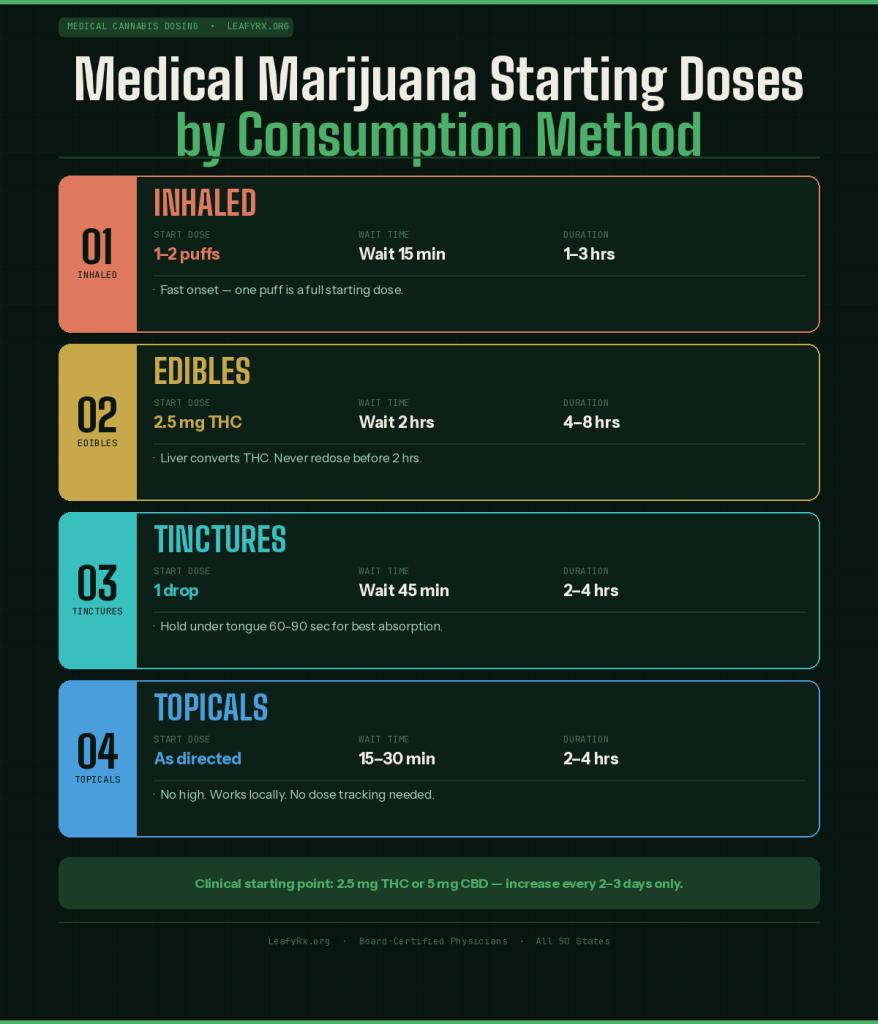
Medical Marijuana Starting Doses by Consumption Method
How you consume medical cannabis may be the single most important dosing variable. The same mg of THC taken in four different ways will produce four different onset times, four different durations, and four different intensities. Understanding this before you visit the dispensary prevents the most common new patient mistake: comparing doses across methods as if they’re equivalent.
Inhaled Cannabis (Smoking or Vaping): Start With 1 to 2 Puffs
Inhalation is the most forgiving method for beginners because of how quickly effects arrive. Cannabinoids go from your lungs directly into your bloodstream, bypassing the liver entirely. Onset is typically 2 to 10 minutes, which means you don’t have to guess whether it’s working, you’ll know relatively quickly.
For new patients, one short puff is a full starting dose. Wait at least 15 minutes before taking more. The effects from a second puff before the first has fully registered are what leads to the uncomfortable overconsumption experiences new patients describe.
Look for flower or vape cartridges with a balanced THC:CBD ratio (1:1 is ideal) or CBD-dominant products when starting out. A product with 10 to 15% THC is more appropriate for a first inhaled experience than the 25% or 30% products sitting next to it.
Edibles and Capsules: 2.5mg THC, Wait 2 Hours Minimum
Edibles are where most new patients get into trouble. And it’s entirely understandable, because the mechanism is genuinely unintuitive.
When you eat cannabis, your liver processes it before it enters your bloodstream. During that process, THC is converted into a compound called 11-hydroxy-THC, which is significantly more psychoactive than THC itself and has a longer half-life. This is why the same mg of THC in an edible hits harder and lasts longer than the same mg inhaled.
Onset ranges from 45 minutes to 2 hours depending on your metabolism, whether you’ve eaten recently, and your body composition. This delay is the problem. New patients take a 5mg edible, feel nothing after an hour, take another one, and then both kick in together.
Start at 2.5mg THC for edibles. If a standard product is 10mg, take a quarter of it. Wait the full 2 hours before drawing any conclusion. If you feel little effect after your first session, wait until your next scheduled dose before adjusting, not the same day.
Tinctures and Sublingual Products: Start With a Single Drop
Tinctures are liquid cannabis extracts absorbed under the tongue. They occupy the middle ground between inhaled and edible: faster than an edible (typically 15 to 45 minutes), slower than inhaling, and easier to dose precisely because you control the amount drop by drop.
Start with a single drop, hold it under your tongue for 60 to 90 seconds before swallowing, and wait 45 minutes before assessing. Products will have a concentration listed (for example, 30mg per 1ml), which lets you calculate exactly how much a single drop delivers. Most tinctures include a 1ml dropper, one full dropper at 30mg/ml is a full dose, not a starting dose. Quarter-dropper for a beginner is more appropriate.
Tinctures are often the most practical option for patients who want precise control over their dose, particularly for chronic conditions requiring daily consistent dosing.
Topicals: No Psychoactive Dose Needed
Cannabis-infused creams, balms, and lotions applied to the skin work on CB2 receptors locally and don’t produce a high because they don’t reach the bloodstream in meaningful amounts. They’re appropriate for localized pain, joint inflammation, and certain skin conditions.
There is no psychoactive dosing consideration with topicals. Apply to the affected area as directed on the label. Effects are localized and typically felt within 15 to 30 minutes.
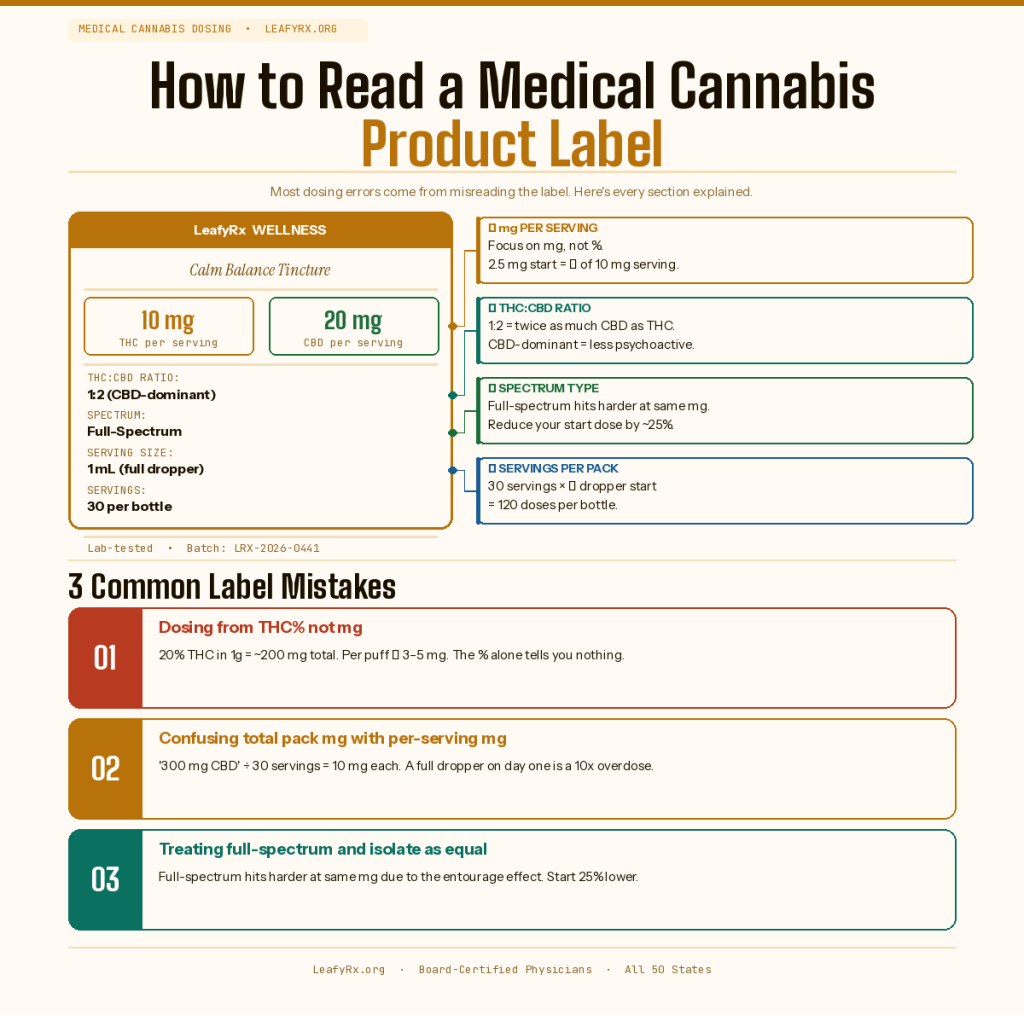
How to Read a Medical Cannabis Product Label
The dispensary is full of products with numbers on them that don’t mean anything until someone explains them. Here’s what to look for.
THC% vs THC mg
A percentage tells you the concentration of THC in the product. A milligram number tells you how much THC is in a specific serving or the entire package. For dosing purposes, milligrams are what you need to track. A product that says 20% THC in a 1g cartridge contains roughly 200mg of THC total. If that cartridge delivers 3 to 5mg per puff, you’re looking at 40 to 65 doses in one cartridge.
Focus on the mg per serving number, not the percentage. Dispensaries in legal medical markets are required to provide this information. If it’s not on the label, ask your dispensary staff before purchasing.
THC:CBD ratio
This tells you the relationship between the two primary cannabinoids. A 1:1 ratio means equal parts THC and CBD. A 20:1 ratio means very high THC relative to almost no CBD. For beginners, a balanced or CBD-dominant ratio (1:1, 1:2, or 1:4 THC:CBD) is generally more forgiving because CBD moderates some of THC’s psychoactive effects.
Products available to medical marijuana cardholders typically include higher-potency and more varied ratio options than recreational products, which is an advantage when you need precise formulations for a specific condition.
Serving size vs total package
Always check whether the mg listed refers to a single serving or the entire package. A 100mg THC chocolate bar divided into 20 squares is 5mg per square, not 100mg per square. New patients who miss this distinction account for a significant portion of overconsumption incidents.
Full spectrum vs broad spectrum vs isolate
Full-spectrum products retain all the cannabinoids, terpenes, and flavonoids from the plant. Broad-spectrum removes THC but keeps other compounds. Isolate contains only a single cannabinoid (usually CBD or THC). Full-spectrum products generally produce stronger effects at lower doses due to the entourage effect, which is worth factoring into your starting dose.
Condition-Specific Medical Cannabis Dosing: Where to Start
The condition you’re treating is one of the most important variables in your starting dose. A patient using cannabis for anxiety needs a fundamentally different approach than a patient managing chronic neuropathic pain. Starting from the same place regardless of condition is one of the most common beginner mistakes.
The complete list of qualifying conditions by state varies significantly across medical programs. Your qualifying condition shapes not just your legal access but the specific cannabinoid profile and dose range that’s most likely to help.
Here’s where to start based on condition category:
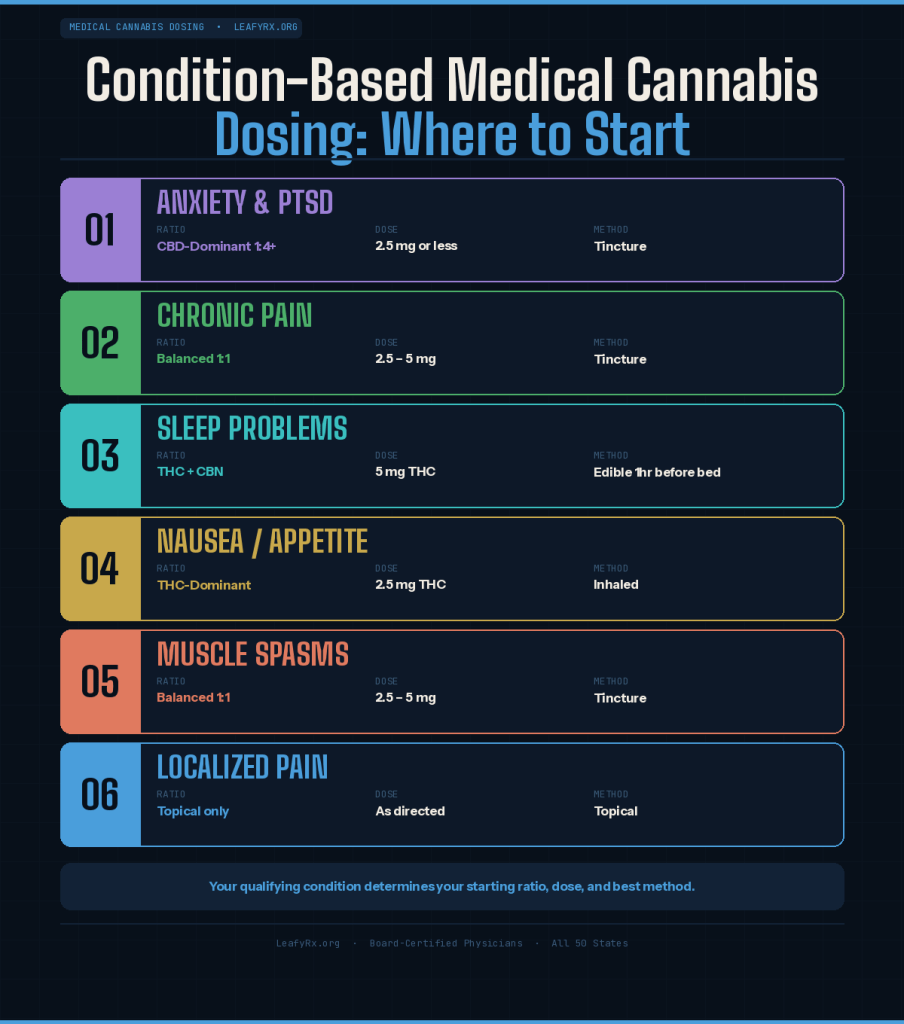
A few things worth noting from this table. Anxiety patients specifically benefit from CBD-dominant products with minimal THC because, as the biphasic property of THC shows, even moderate doses can worsen anxiety in sensitive individuals. Start lower than you think necessary and treat any increase with extra caution.
Sleep patients often benefit from taking their dose about an hour before bed rather than immediately before lying down, particularly with edibles. The delayed onset aligns effects with the window where sleep usually occurs.
Pain patients may find that combining CBD and THC at a 1:1 ratio outperforms higher THC alone. The consensus research on chronic pain dosing specifically recommends starting with a CBD-predominant formula and introducing THC only after establishing a CBD baseline, particularly for patients new to cannabis.
What to Do If You Take Too Much Medical Marijuana
It happens. Especially with edibles. And the first thing to know is that you cannot fatally overdose on cannabis. Unlike opioids, cannabinoids do not suppress respiratory function. You will feel deeply uncomfortable. It will pass. You are not in danger.
A cannabis overconsumption experience, sometimes called a “green out,” can include intense anxiety or paranoia, rapid heartbeat, dizziness, nausea, and feeling like time has stopped. These effects are temporary and typically resolve within 1 to 3 hours for inhaled cannabis and up to 6 to 8 hours for edibles, depending on dose and individual metabolism.
According to the National Institute on Drug Abuse, high doses of THC can trigger anxiety, paranoia, and acute psychological distress, which is precisely why starting low matters so much for new patients.
If you’ve taken too much, here’s what to do:
-
Sit or lie down in a comfortable, familiar space. Don’t drive. Don’t try to push through it. Find somewhere you feel safe and stay there.
-
Hydrate with water or a non-caffeinated drink. Avoid alcohol entirely, as it can intensify THC’s effects.
-
Take CBD if you have it available. CBD interacts with THC’s binding at CB1 receptors and can take the edge off. A tincture or capsule works best here.
-
Try the black pepper trick. Sniffing or chewing a few black peppercorns has anecdotal and some research support for reducing THC-induced anxiety. The terpene beta-caryophyllene in pepper interacts with CB2 receptors in a way that may calm the reaction.
-
Remind yourself it will pass. The most distressing part of cannabis overconsumption is often the anxiety itself. Knowing the timeline, this will be over in an hour or two for inhaled, longer for edibles, provides genuine comfort.
After the experience, don’t take the same dose again. Cut back to half the amount and rebuild more slowly. Consider this data, not failure.
How to Track Your Medical Marijuana Dose: The Dosing Journal
Finding your therapeutic window is not a one-session task. It’s a process of gathering data about how your body responds to specific products, doses, methods, and timing. The patients who find their ideal dose fastest are the ones who keep records.
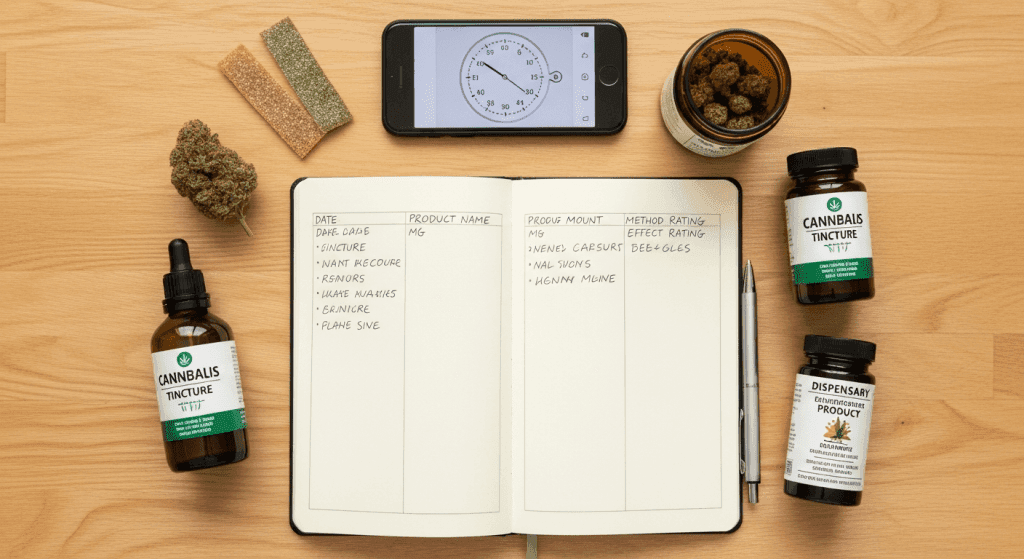
A dosing journal doesn’t need to be elaborate. A notes app on your phone or a simple notebook works fine. For each session, log:
-
Date and time
-
Product name, type, and batch
-
THC and CBD mg per dose
-
Consumption method
-
How you felt before dosing (condition severity)
-
Onset time
-
Effects felt (relief, side effects, intensity on a 1 to 10 scale)
-
Duration of effects
-
How you felt 4 hours after
After two weeks of consistent logging, patterns become obvious. You’ll see which products and doses consistently produce relief without side effects. You’ll notice timing patterns, maybe your condition responds better to a morning dose than an evening one, or that edibles consistently last longer than you expected for your specific metabolism.
This data also makes your physician conversations far more productive. Rather than “I’ve been trying different things,” you can say “I’ve been on 5mg balanced THC:CBD tinctures twice daily for 10 days and I’m getting 60% pain relief but some morning drowsiness.” That’s actionable clinical information.
Speaking of physicians: if you’ve been on a consistent dose for three to four weeks without reaching your symptom goals, or if you’re experiencing persistent side effects, that’s when to loop your doctor in rather than continuing to self-titrate.
Summing Up
Finding the right medical marijuana dosing as a beginner comes down to one principle: respect the process. Start at 2.5mg THC or 5mg CBD, give your body time to respond, and increase in small increments every few days rather than jumping ahead. Your condition, your metabolism, and your consumption method all shape what works for you, and none of that can be figured out on the first try.
Track your sessions. Be patient with the timeline. And if you get it wrong once, adjust and move forward. Most patients find their therapeutic window within two to four weeks of consistent, careful dosing.
The fastest route to the right dose for your specific condition is a conversation with a physician who specializes in medical cannabis. At LeafyRx, board-certified physicians are available via telehealth to review your condition, your current medications, and your goals, then recommend a starting point built for you.
Get matched with a LeafyRx physician today and start your dosing journey with confidence.




 Ask ChatGPT
  Ask Claude
  Ask Perplexity