


If you’re a Georgia resident with a qualifying medical condition, a Georgia medical card gives you legal access to medical cannabis. You can get it through the state’s registry program. First, a registered physician certifies you. Then you send an application to the Georgia Department of Public Health. Many patients feel unsure about whether they qualify, what documents they need, or how much it costs.
This guide covers all you need to know about how to get a Georgia medical marijuana card in 2026. You’ll learn which conditions qualify. You’ll see how to finish each step of the application process. You’ll also learn what fees to expect and how to renew your card. You may be applying for yourself. You may be helping a minor family member. Either way, you’ll find clear answers here.
Georgia Medical Card: Who This Guide Is For
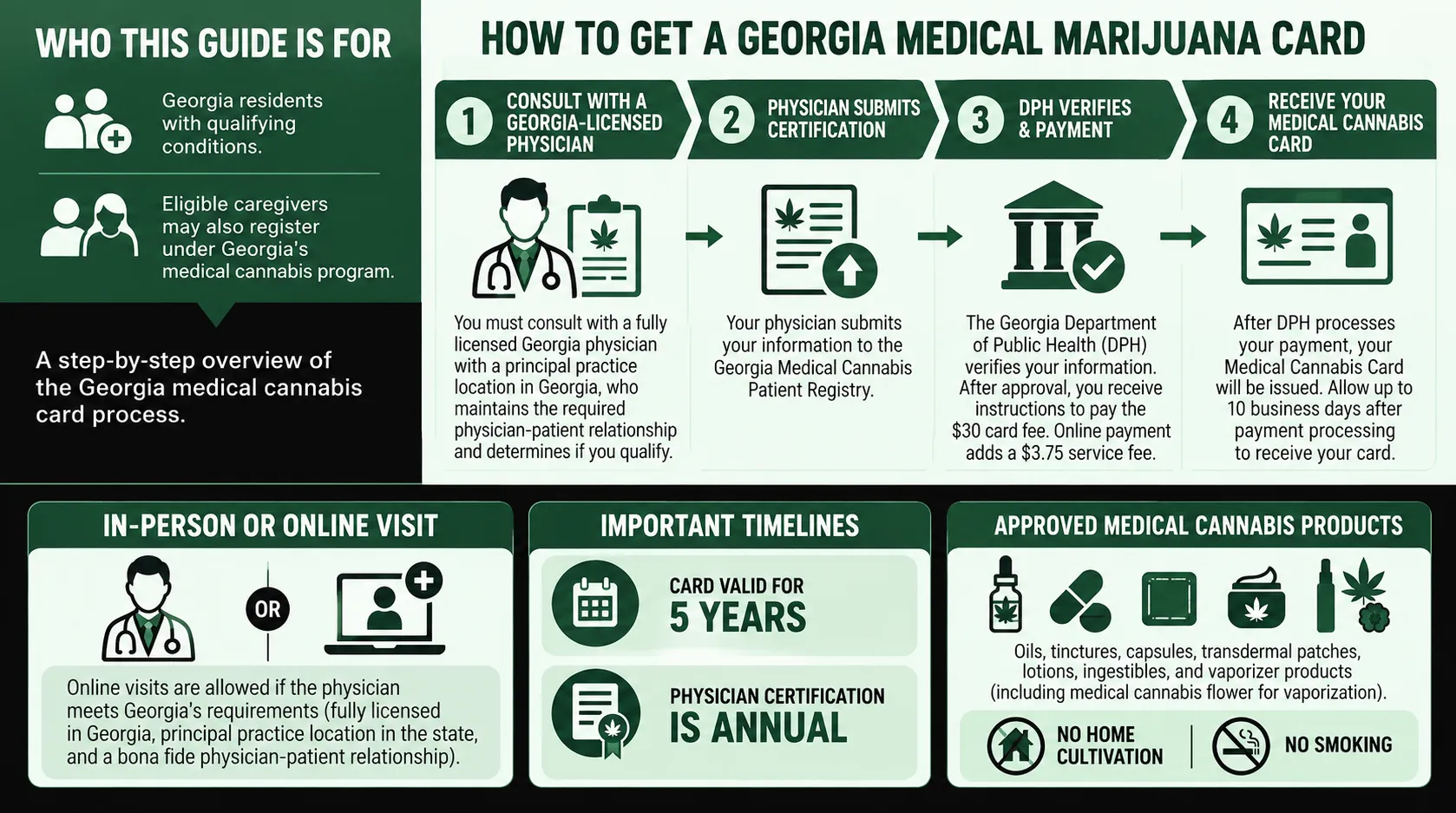
This guide helps Georgia residents with qualifying medical conditions who want legal access to medical cannabis through the state registry. You’ll find step-by-step instructions for the entire application process, from finding a physician to receiving your card in the mail.
Caregivers who help minors or patients who can’t manage their own care will learn the added requirements and paperwork for registry approval. The guide also explains Georgia’s current 2026 regulations. You’ll see which product forms are legal and where you can buy them.
Key Considerations
Are you comparing in-person doctor visits with online evaluations? This guide breaks down both options with realistic timelines and costs. Understanding how the Georgia medical card process works before you start saves time. It also helps you avoid common mistakes that delay approval.
You need a documented diagnosis from a licensed physician and supporting medical records. Self-diagnosis won’t meet registry requirements. Gather your medical history before you apply.
The guide covers the real costs you’ll pay, including state fees and physician consultation rates. You’ll also learn about employment protections, driving restrictions, and travel limits that affect cardholders in Georgia.
What Is a Georgia Medical Marijuana Card and How Does It Work?
A Georgia medical marijuana card is an official registry card issued to qualified patients. It gives you legal protection to buy and possess medical cannabis products within the state. The card proves that you have met Georgia’s requirements for medical cannabis access.
Georgia’s Medical Cannabis Patient Registry
According to the Georgia Department of Public Health, the state operates a Medical Cannabis Patient Registry that issues cards to certified patients and caregivers. Your physician uploads your certification and required information to the registry. DPH then verifies the information before you receive instructions to pay for your card.
The Georgia Access to Medical Cannabis Commission oversees dispensary licensing and sets product safety standards. This two-part system separates patient registration from product regulation.
What You Can Access With Your Card
Your registry card lets you buy approved medical cannabis products from licensed dispensaries and independent pharmacies in Georgia. These products include oils, tinctures, transdermal patches, lotions, capsules, ingestibles, and vaporizer products, including medical cannabis flower intended for vaporization. Smoking cannabis remains prohibited.
You cannot grow cannabis at home or hold products outside the approved registry rules. Buy only from state-licensed dispensaries, and keep products in their original packaging.
How Georgia’s Program Differs From Other States
Unlike recreational states where anyone over 21 can buy cannabis, Georgia requires physician certification and state registration. You need a documented medical condition and ongoing physician care to keep legal protection.
Many patients use platforms like LeafyRx to reach licensed Georgia physicians. These physicians can check their eligibility and give the required certification. The state’s program has grown beyond low-THC oil to more product forms, though rules remain tighter than in many medical cannabis states.
Qualifying Medical Conditions for Georgia Medical Marijuana Cards
Understanding Georgia’s Qualifying Conditions
Georgia law lists the medical conditions that qualify for a medical cannabis card. These include cancer, seizure disorders, multiple sclerosis, Crohn’s disease, mitochondrial disease, Parkinson’s disease, sickle cell disease, and PTSD.
Additional qualifying conditions cover ALS, Alzheimer’s disease, autism spectrum disorder, AIDS, peripheral neuropathy, and Tourette syndrome. Intractable pain and terminal illnesses may also qualify when conventional treatments have proven inadequate.
Documentation Requirements
You need a diagnosis from a licensed physician, backed by full medical records. The state does not accept self-diagnosis or conditions without proper records.
Physicians in Georgia’s Medical Cannabis Patient Registry check whether your condition and history meet program rules. Many patients use services like LeafyRx to reach licensed Georgia physicians who can review their records and decide on eligibility fast.
Before your evaluation, gather all relevant medical records, test results, and treatment history. This documentation helps physicians assess whether your condition qualifies for medical cannabis under current state regulations.
What to Do If Your Condition Isn’t Listed
If your condition isn’t listed, talk with a registered physician. They can judge whether your symptoms match a qualifying condition, or whether you have intractable pain that failed standard treatments.
Bring detailed medical records that show your diagnosis, past treatments, and why standard therapies haven’t given you enough relief. This helps physicians decide if your condition meets Georgia’s medical necessity standards for registry approval.
Step-by-Step Application Process for Your Georgia Medical Marijuana Card
The application process has two main stages: getting certified by a physician and submitting your state registry application. Each step requires specific documents and follows a clear sequence. Learn how to get your card before you start the application.
Getting Your Physician Evaluation and Certification
You need certification from a Georgia-licensed physician registered with the Medical Cannabis Patient Registry program. The physician must set up a real doctor-patient relationship. They must also review your full medical history and records.

Online evaluations through platforms like LeafyRx can speed up the certification step with licensed Georgia doctors. These services let you start your application online. They often book appointments within 1-3 business days.
Completing Your State Registry Application
After receiving physician certification, submit your application through the Georgia Department of Public Health online portal. The portal walks you through each required field and document upload.
For minors, a parent, guardian, or legal custodian of the patient can apply as the caregiver. The caregiver must meet Georgia’s registry requirements and provide the required identification and residency documents.
Documents to Have Ready
You will need a valid Georgia driver’s license or state ID, proof of residency, a physician certification form, medical records, and the application fee. Keep copies of every document and your confirmation number so you can track your application.
Timeline: Evaluation Visit vs State Processing
Getting your Georgia medical card involves two distinct phases with different timeframes. The physician evaluation happens quickly, while state processing takes longer.
You can often book a physician visit within 1-3 business days. Online services offer same-day slots, so the first step moves faster than many expect.
The evaluation itself takes 15-30 minutes. Physicians issue certification immediately if you qualify, so you leave the appointment with documentation in hand.
After DPH verifies your information and processes your payment, allow up to 10 business days to receive your Medical Cannabis Card.
Key Considerations
After DPH processes your payment, your card is shipped to your mailing address. DPH says to allow up to 10 business days from payment processing to receive it.
You must have an active Medical Cannabis Registry Card to purchase medical cannabis. Georgia law allows you to show a physical or electronic registration card.
Incomplete applications or missing documents can add 2-4 weeks to processing time. Double-check all requirements before you submit to avoid delays. If you want to compare costs across different states, note that timelines and fees vary by location.
Georgia Medical Marijuana Card Costs and Fees in 2026
Getting a Georgia medical card involves two separate fees: the physician consultation and the state application. Knowing these costs helps you budget for the full process.
State Application Fees
Georgia charges a $30 fee for the Medical Cannabis Card. If you pay through the DPH online payment portal, there is an additional $3.75 service fee. This is covered in detail in other state guides.
The Medical Cannabis Card is valid for five years. The expiration date is printed on the card.
When your card expires, you must consult with your physician to renew your card. The current Medical Cannabis Card fee is $30.
Physician Consultation Costs
Physician consultation fees range from $150 to $300 depending on the provider and evaluation method. In-person visits typically cost more than online evaluations.
Online services often charge less and offer money-back guarantees if you don’t qualify. LeafyRx offers fast online visits with licensed Georgia physicians.
Some doctors give renewal discounts to current patients, usually 20-30% off the first visit fee. The first-time total typically runs from $175 to $325, with doctor and state fees.
Minors and Caregivers
Minors under 18 can use Georgia’s medical cannabis program, but they cannot hold a registry card themselves. A parent or legal guardian must register as the designated caregiver. The caregiver then receives the card for the minor.
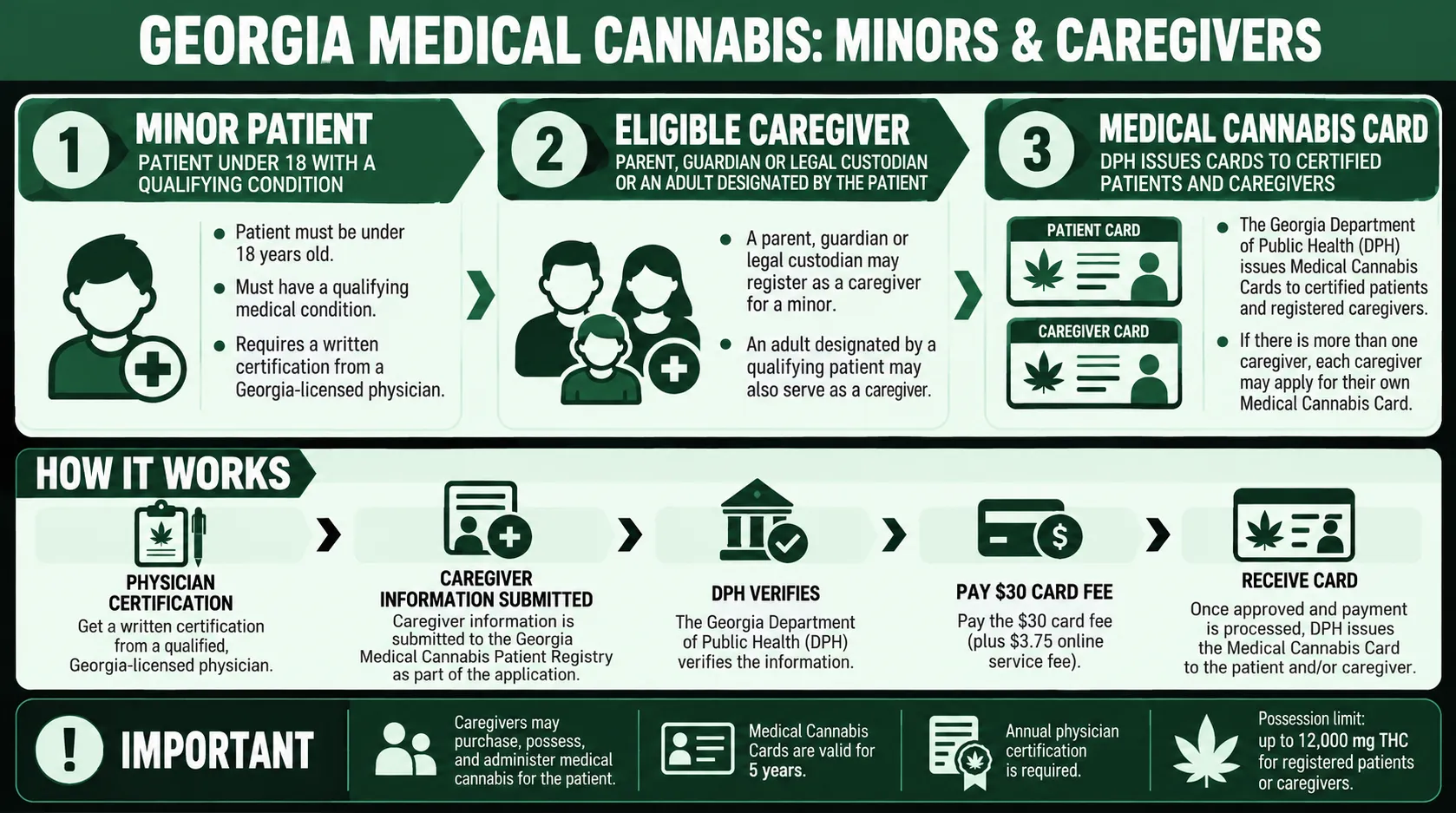
The caregiver takes full charge of buying, holding, and giving cannabis to the minor. This protects young patients and keeps an adult in charge of all cannabis use.
Adult patients who can’t manage their own care due to physical or cognitive limits can also name a caregiver. According to the Georgia Department of Public Health, caregivers must meet the state’s eligibility requirements before receiving a Medical Cannabis Card.
Key Considerations
Caregivers must have no disqualifying criminal history. The state reviews each background check before it grants caregiver status.
Minor patients need extra paperwork. You’ll need birth certificates, custody papers if they apply, and a doctor’s certification written for children.
If a patient has more than one caregiver, each caregiver can apply for a Medical Cannabis Card. Each caregiver must meet the state’s registry requirements.
Caregivers get the same legal protection as patients when they carry approved cannabis products. Keep your caregiver card with you whenever you handle cannabis for your patient.
Buying and Using Medical Cannabis After Approval
Once you receive your registry card, you can buy medical cannabis from licensed dispensaries across Georgia. Learn where to shop, what products you can buy, and what legal limits apply. This protects your access and keeps you within state law.
Licensed Dispensary Locations and Access
You can find current licensed dispensary locations through the Georgia Access to Medical Cannabis Commission. Show your valid registry card and state photo ID for every purchase.
According to the Georgia Access to Medical Cannabis Commission, dispensaries cannot ship products. All purchases must be made in person at licensed locations, so plan your visits accordingly if you live far from the nearest dispensary.
What Products Are Available in Georgia
Available products include oils, tinctures, transdermal patches, lotions, capsules, ingestibles, and vaporizer products, including medical cannabis flower intended for vaporization. Georgia law prohibits smoking cannabis and cannabis-infused candies and cookies.
Products vary by dispensary, but all meet state testing and labeling rules. Staff can help you pick products that fit your condition and your doctor’s advice.
Possession Limits and Usage Rules
Patients may hold cannabis products bought from licensed Georgia dispensaries, up to state limits. Keep all products in their original packaging with proper labels.
Carry your registry card whenever you have medical cannabis. Police may ask to see it. They may also check that your products are in the right packaging.
Travel, Employment, and Driving Considerations
Your Georgia medical card does not automatically authorize medical cannabis possession in another state. Each state has its own rules, and some states may recognize an out-of-state medical cannabis card under specific conditions.
This can cause trouble when you travel, apply for some jobs, or deal with police. Knowing these limits helps you avoid legal trouble.
Key Considerations
Taking medical cannabis across state lines breaks federal law. This is true even if you travel to another medical cannabis state. Leave your products at home when you travel outside Georgia.
Federal jobs often require drug tests, and a positive cannabis test can cost you the job, even with medical approval. The same goes for gun ownership rights and some professional licenses.
Private employers in Georgia can set drug-free workplace rules. They may act against you for a positive cannabis test. This holds even with a valid card and use outside work hours.
Driving under the influence of cannabis remains illegal. Georgia law prohibits driving under the influence of cannabis, even with a valid Medical Cannabis Registry Card.
Landlords may ban cannabis use on their property, even if you have a medical card. Check your lease before you use cannabis at a rental.
These are general tips, not legal advice. Ask an attorney about your own situation.
Renewing and Maintaining Your Georgia Medical Marijuana Card
When and How to Renew
Medical Cannabis Registry Cards expire after five years. Check the expiration date printed on your card and renew before it expires.
Start your renewal 60-90 days before your card expires. This prevents any gap in coverage that would stop you from buying products.
Renewal needs a new physician certification. Your doctor must confirm that your condition persists and that cannabis still suits your treatment.
You can renew through the Georgia Department of Public Health Medical Cannabis Patient Registry with updated physician certification.
If your card expires, you are no longer authorized to purchase or possess medical cannabis under the registry. You need an active Medical Cannabis Registry Card to purchase legally.
Updating Your Registry Information
You can send address changes, name changes, and caregiver updates through the registry portal. Keep your details current so your new card reaches you.
If your card is lost or stolen, ask the state for a new one. You will pay a replacement fee.
Conclusion
A Georgia medical card gives you legal access to care that may ease your condition when other treatments have not worked. You need a doctor’s certification and a state registration. Online visits now let you do both from home.
If you believe medical cannabis could benefit your condition, schedule a consultation with a registered physician. They can review your medical history and determine if you qualify. Gather your medical records, valid Georgia ID, and documentation of your diagnosis before starting your application. Once approved, you’ll receive your registry card within a few weeks and can begin purchasing from licensed dispensaries across the state.
LeafyRx links you with licensed Georgia doctors. They can check your condition and sign your certification fast. You can start your application on the LeafyRx site today.







 Ask ChatGPT
 Ask Claude
 Ask Perplexity