


A California medical marijuana card gives registered patients tax savings, higher possession limits, and more legal protections than recreational users. The state’s Medical Marijuana Identification Card Program (MMICP) provides these benefits. Many people do not know that they need both a doctor’s recommendation and a state-issued card to get these benefits. The difference between these two documents can be confusing. People often ask which conditions qualify, how much the application costs, and if the state card is worth the extra cost. Test
This guide covers what you need to know about getting and using your card in 2027. You will learn how California’s two-part system works and which medical conditions qualify. We explain the full application process, expected timelines, fees, and special rules for minors and caregivers. You will also learn how the card can affect purchases, employment, and travel.
How the California Medical Marijuana Card Program Works in 2027

California has a two-part medical cannabis system that can confuse new patients. You need a doctor’s recommendation to use medical cannabis legally, but the state-issued MMICP card is optional MMICP State Card vs. Doctor’s Recommendation: What’s the Difference?
A physician’s recommendation is written approval from a licensed California doctor. It allows you to use medical cannabis. This document alone gives you legal access to dispensaries.
The MMICP card is a voluntary state ID issued by county health departments. You must first get a doctor’s recommendation. Then, you can apply for the card through your county.
Most patients start with only a doctor’s recommendation. You can use it at dispensaries right away without waiting for the state card.
Legal Protections Under California Health and Safety Code
Under California cannabis laws and rules, the state card provides legal protections that a recommendation alone does not. MMICP cardholders can possess up to 8 ounces of cannabis, while recreational users are limited to 1 ounce.
The card also exempts you from state and local cannabis sales taxes. These taxes often add 15% to 30% to the purchase price. This can lead to major savings for regular users.
Your card is official government proof of your patient status. Law enforcement can check your registration through a state database. This gives you stronger legal protection than a doctor’s recommendation alone.
Who Issues Medical Marijuana Cards and How the System Functions
Licensed California doctors provide recommendations after checking your qualifying condition. Online services like LeafyRx offer telehealth appointments that take about 10 to 15 minutes.
County health departments manage the MMICP program. Each of California’s 58 counties has its own application process. Fees and processing times can vary by county.
Knowing the benefits of a medical card can help you decide whether to get only a doctor’s recommendation or also apply for the state card. Recreational cannabis is legal for adults 21 and older. Medical patients can receive tax exemptions, higher possession limits, and access to higher-potency products that may not be available to recreational customers.
California Medical Marijuana Card Qualifying Conditions
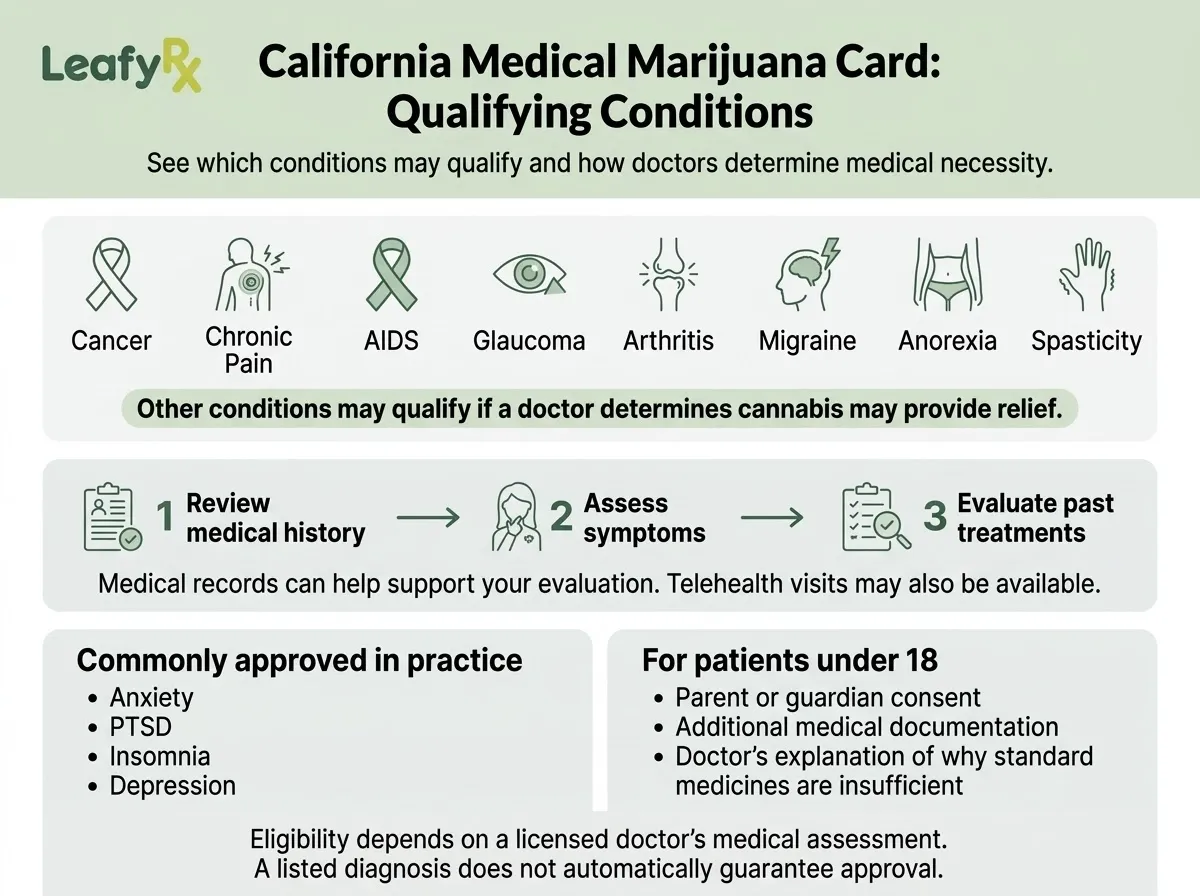
California’s medical cannabis program helps patients with many health conditions. Knowing which conditions qualify can help you see if you may qualify for medical cannabis under state law.
Primary Qualifying Conditions Listed in Proposition 215
California law lists several medical conditions that may qualify for medical cannabis. These include cancer, anorexia, AIDS, chronic pain, spasticity, glaucoma, arthritis, and migraine. The law also says cannabis may be used for “any other illness for which marijuana provides relief.”
This broad rule allows doctors to recommend cannabis for other health conditions not listed by name. It gives doctors more flexibility when deciding if cannabis may help a patient.
How Physicians Determine Medical Necessity
Licensed California doctors have broad discretion when approving patients for medical cannabis. They review your medical history, current symptoms, and past treatments. This helps them decide if cannabis may provide medical benefits. See determine if you qualify.
You should have medical records or documents that support your condition before your evaluation. The exact documents needed can vary by doctor. Most doctors want proof of your diagnosis or ongoing symptoms. Online services like LeafyRx make the process easier through telehealth visits that review your medical history.
Most Commonly Approved Conditions in Practice
Chronic pain is one of the most common conditions approved for medical cannabis in California. Anxiety disorders, PTSD, insomnia, and depression are also often approved.
Minors under 18 may qualify, but they need consent from a parent or legal guardian. They also need extra documentation from the recommending doctor. The doctor must explain why regular medicines are not enough for the minor’s specific condition.
How to Apply for a California Medical Marijuana Card
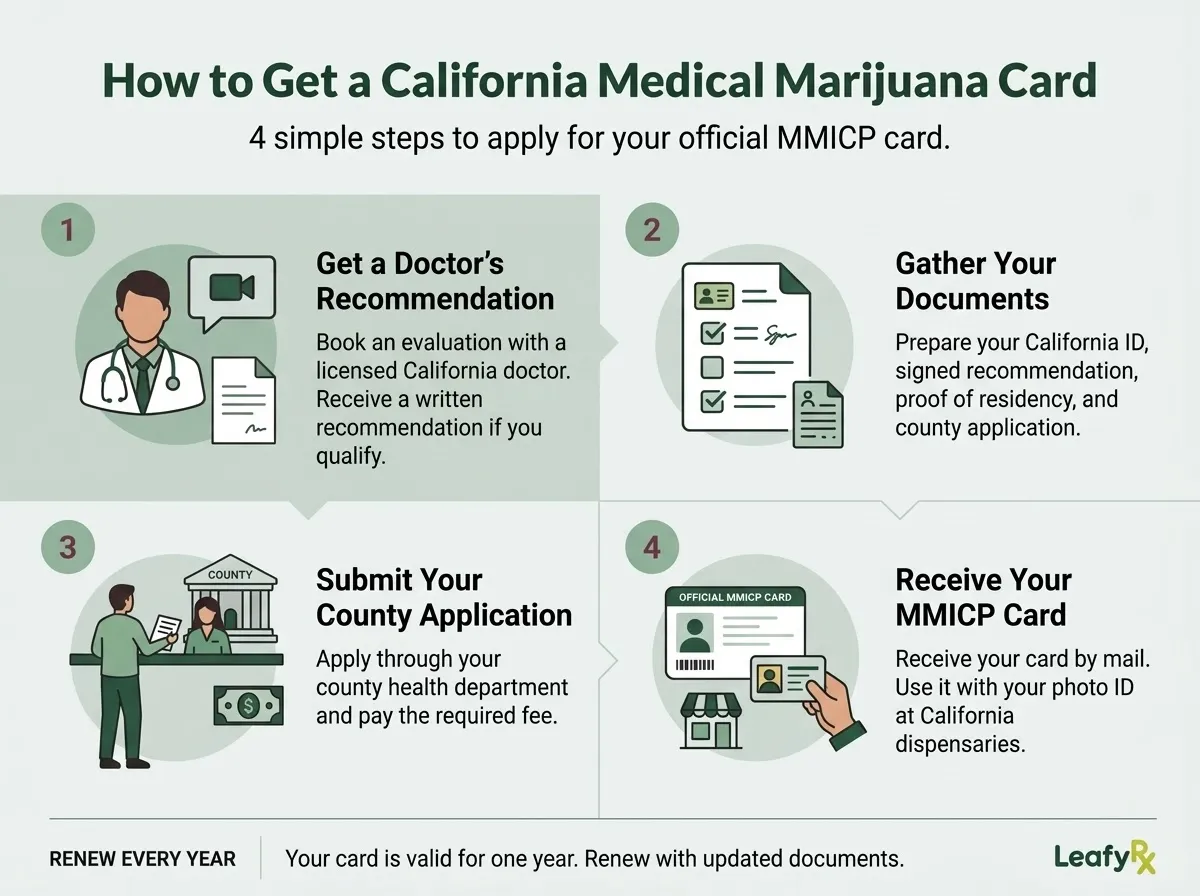
Getting a California medical marijuana card takes four simple steps. You need a doctor’s evaluation and county registration to get your official state ID card.
Step 1: Obtain a Physician’s Recommendation
Book an evaluation with a licensed California doctor who can give medical marijuana recommendations. Online services like LeafyRX offer easy telehealth visits that take 10–15 minutes.
During the visit, you will talk about your health and qualifying condition. If you qualify, the doctor will give you a written recommendation on official letterhead.
Step 2: Gather Required Documents for County Application
You will need a valid California ID or driver’s license, the original signed doctor’s recommendation, and proof of California residency. You must also complete your county’s application form. You can download it from your county health department website.
Keep copies of all your documents. Some counties accept digital applications, while others need original documents.
Step 3: Submit Your Application to Your County Health Department
According to the Santa Clara County Public Health Department, you can submit your application in person, by mail, or online where available. You must also pay an application fee. Fees range from $100 to $166, based on your county.
Processing times vary by county. San Francisco offers same-day processing for walk-in applications, while Los Angeles can take up to 35 days. Most counties take about 14–21 business days.
Step 4: Receive and Activate Your MMICP Card
Your card is sent by mail and is valid for one year from the date it is issued. It includes your photo, unique ID number, and expiration date.
You can use your card at any California dispensary once you receive it. Show your MMICP card and photo ID for verification. If you need a new recommendation or want to renew your card, you must follow the process again each year with updated documents.
California Medical Marijuana Card Timeline Online Visit vs. State Processing

Getting your California medical marijuana card involves two distinct phases: the physician recommendation and county processing. Understanding each timeline helps you plan when you’ll have full access to medical cannabis benefits.
How Long Does the Doctor Recommendation Take?
Online physician evaluations through telehealth platforms take 10-15 minutes for the actual appointment. Most services issue your recommendation immediately after approval, though some take up to 24 hours.
Traditional in-person doctor visits require scheduling 1-2 weeks out. You’ll also spend time in the waiting room and during the appointment itself, making the total process longer than online options.
County Processing Times Across California
County health departments vary dramatically in processing speed. San Francisco offers same-day processing for in-person applications, making it the fastest option in the state.
Los Angeles takes up to 35 days due to high application volume. Most other counties average 14-21 business days from submission to card arrival.
Understanding medical card costs and county fee variations helps you budget for both time and money when choosing where to apply.
Total Timeline from Start to Card in Hand
The fastest route takes about 6 days. This includes an online doctor visit with an immediate recommendation and same-day county processing in areas with faster service.
The slowest timeline can take up to 6 weeks. This may happen when doctor appointments are delayed and counties have a high volume of applications.
You can use your recommendation at dispensaries as soon as you receive it. You do not need to wait for the physical state card to arrive for basic medical cannabis access.
California Medical Marijuana Card Fees and Program Costs
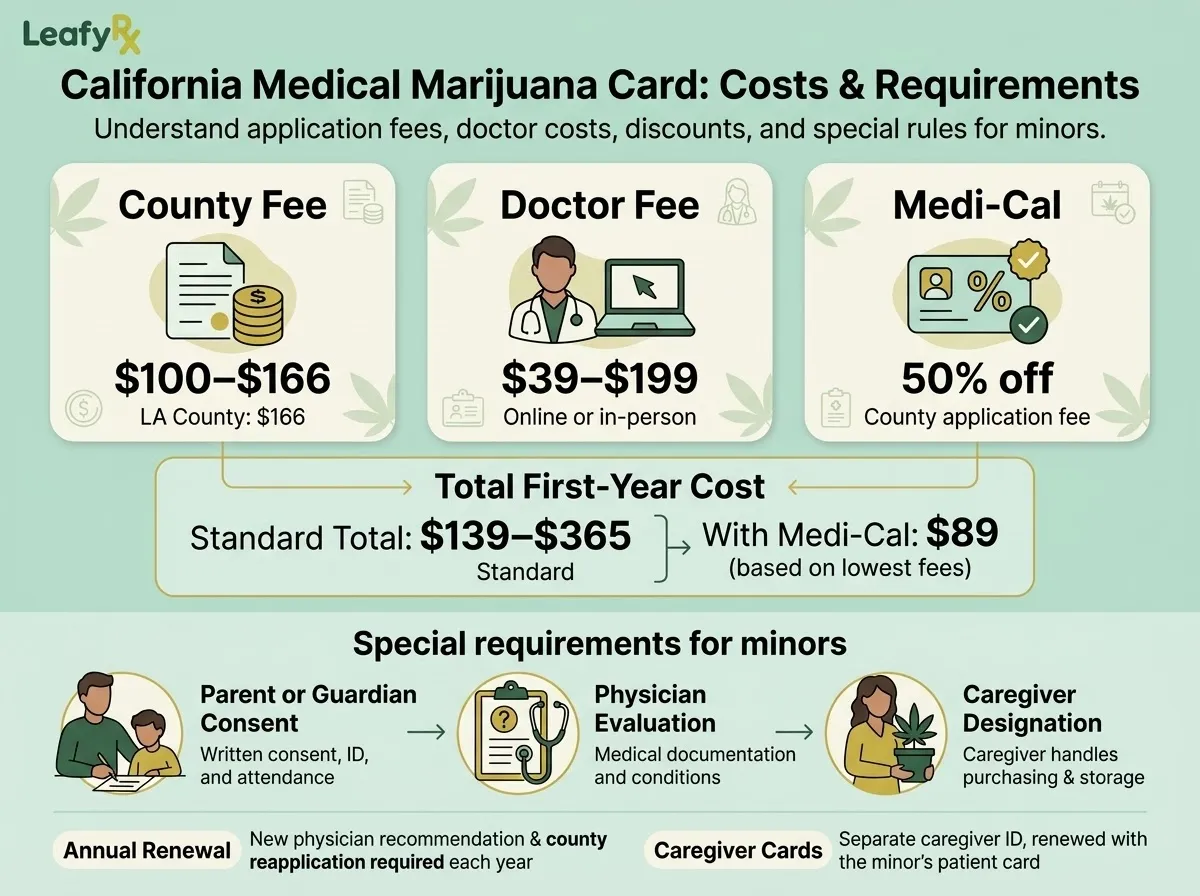
Getting a California medical marijuana card involves two separate expenses: the physician recommendation and the county application fee. Understanding these costs helps you budget for both your initial card and annual renewals.
County Application Fees by Region
Most California counties charge $100 for the state card application. Los Angeles County charges the highest fee at $166.
According to the Sacramento County program FAQs, application fees vary by location but typically fall within the $100-$166 range. You pay this fee directly to your county health department when submitting your application.
Physician Recommendation Costs: Online vs. In-Person
Online telehealth services charge $39-$79 for medical marijuana evaluations. Traditional in-person doctor visits cost $100-$199.
Online platforms offer the most affordable option. You complete a video consultation, and the doctor issues your recommendation within 24 hours if you qualify.
Fee Reductions for Medi-Cal Beneficiaries
Medi-Cal beneficiaries receive a 50% discount on county application fees. Instead of paying $100-$166, you pay approximately $50-$83.
You need to provide proof of Medi-Cal enrollment when submitting your application. This reduction applies to both initial applications and annual renewals.
Total First-Year and Renewal Costs
Your total first-year cost ranges from $139 to $365. The lowest cost combines an online doctor ($39) with a low-fee county ($100) and Medi-Cal discount. The highest cost uses an in-person doctor ($199) with Los Angeles County’s fee ($166).
Annual renewal costs match your initial expenses. You need a new physician recommendation each year and must reapply with your county.
For frequent cannabis users, the 15-30% sales tax exemption can offset your annual card cost within 2-3 months of regular purchases. This makes the card a worthwhile investment if you buy cannabis products consistently.
California Medical Marijuana Card for Minors and Caregivers
Minors under 18 can obtain medical marijuana cards in California, but the process includes additional safeguards. A parent or legal guardian must provide written consent and attend the physician evaluation with the minor.
The recommending physician must submit extra documentation explaining why conventional medications haven’t worked and why medical cannabis is appropriate for the minor’s specific condition. This requirement helps ensure medical cannabis is used only when other treatments prove insufficient.
Requirements for Minors Under 18 to Obtain Medical Cards
Common qualifying conditions for minors include epilepsy, severe autism, cancer treatment side effects, and chronic pain from serious medical conditions. The physician must document these conditions thoroughly before recommending cannabis treatment.
Parents or legal guardians must be present during the entire evaluation process. They will need to provide their own identification and proof of their legal relationship to the minor.
Primary Caregiver Designation and Responsibilities
According to the California MMIC program, parents or legal guardians must be designated as the primary caregiver on the application. They receive their own caregiver identification card separate from the minor’s patient card.
Primary caregivers handle all cannabis acquisition, storage, and administration. Minors cannot purchase or possess cannabis without their designated caregiver present. The caregiver must accompany them to dispensaries and manage all products at home.
Application Process Differences for Minor Patients
Caregiver cards cost the same annual fee as patient cards and must be renewed simultaneously each year. Both cards expire on the same date to maintain continuous legal protection.
The application requires additional forms documenting the parent-child or guardian-minor relationship. Processing times remain similar to adult applications, but counties may request extra verification before issuing cards to minor patients.
Using Your California Medical Marijuana Card: Buying, Travel, Work, and Driving
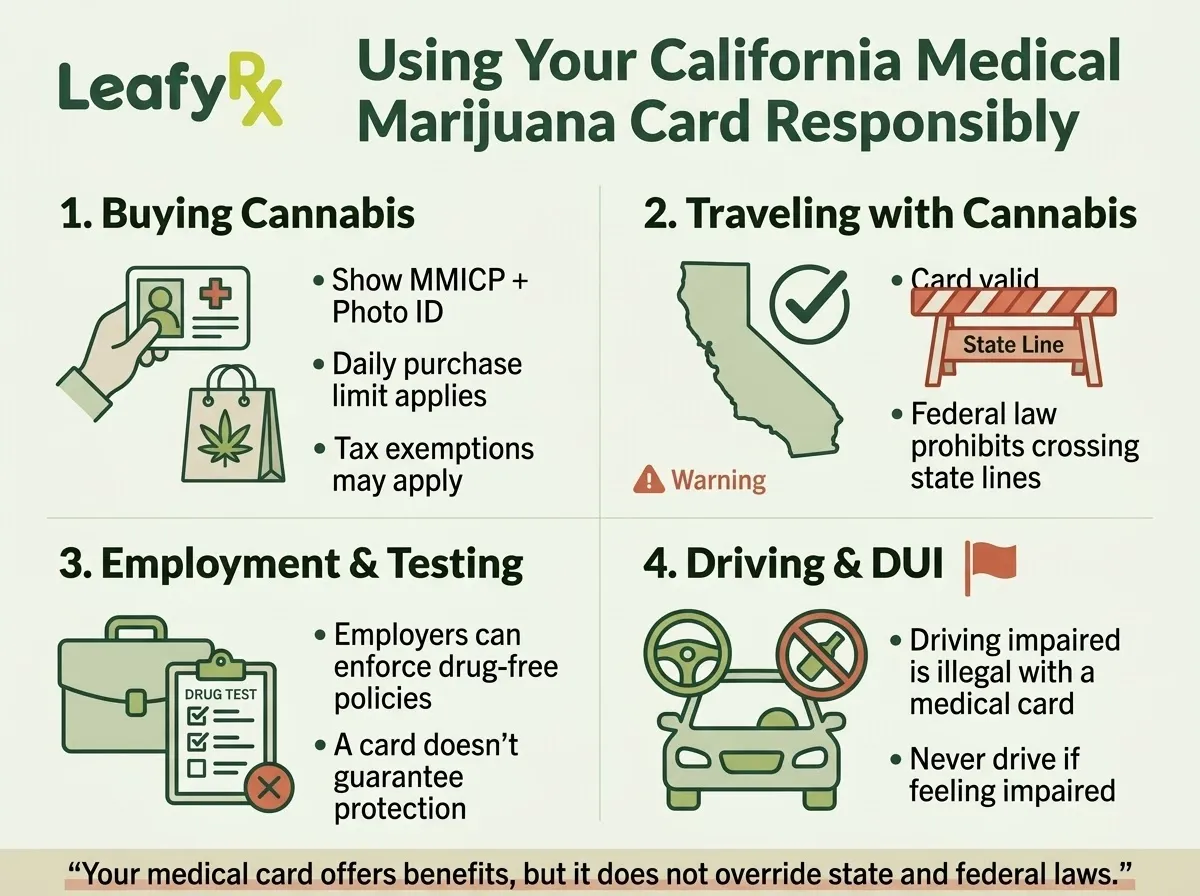
Once you receive your card, you can access benefits that recreational users don’t get. Understanding how to use it properly helps you avoid legal problems and get the most value from your medical status.
Purchasing Cannabis at Dispensaries with Your MMICP Card
Present both your MMICP card and valid photo ID at dispensary entrances for verification. Medical patients access separate menus with higher-potency products not available to recreational customers.
You can purchase up to 8 ounces per day compared to 1 ounce for recreational users. According to California’s medical cannabis program regulations, cardholders also receive complete exemption from state and local cannabis sales taxes, which typically range from 15-30%.
Many dispensaries offer medical patient discounts of 10-20% on top of tax exemptions. Medical delivery services can bring products directly to your home with card verification. This offers convenience for patients with mobility issues or those in areas without nearby dispensaries.
Traveling Within California and Across State Lines
Your card is valid throughout California, giving you the same purchase limits and tax exemptions at any licensed dispensary in the state. You can transport your medicine between cities and counties without legal issues.
However, your card provides no legal protection when crossing state lines. Transporting cannabis across state borders remains a federal offense even to states with legal programs like Oregon or Nevada.
Employment Protections and Drug Testing Considerations
California law does not require employers to accommodate medical marijuana use. Employers can still enforce drug-free workplace policies and terminate employees who test positive for cannabis.
Your card does not protect you from workplace drug testing or employment consequences. Some employers may be more understanding, but they’re not legally obligated to make exceptions for medical patients.
Driving Laws and DUI Regulations for Medical Patients
Driving under the influence of cannabis is illegal for both medical and recreational users. Your medical card provides no protection against DUI charges if you’re impaired while operating a vehicle.
Law enforcement can arrest you for driving impaired regardless of your medical status. Wait several hours after using cannabis before driving, and never drive if you feel any impairment.
Conclusion
A California medical marijuana card offers real financial and legal advantages that recreational users simply can’t access. The complete tax exemption alone saves frequent cannabis users hundreds of dollars annually. Higher possession limits and stronger legal protections provide peace of mind that’s worth the investment.
Start by scheduling an online evaluation with a licensed California physician to receive your recommendation within 24 hours. Once you have that document, gather your ID and proof of residency, then submit your county application. Most patients receive their cards within 2-3 weeks and begin saving money immediately on every dispensary purchase.
Ready to start your application? They help you get your recommendation quickly so you can move forward with your county application and start enjoying the benefits of being a registered medical patient.







 Ask ChatGPT
 Ask Claude
 Ask Perplexity