
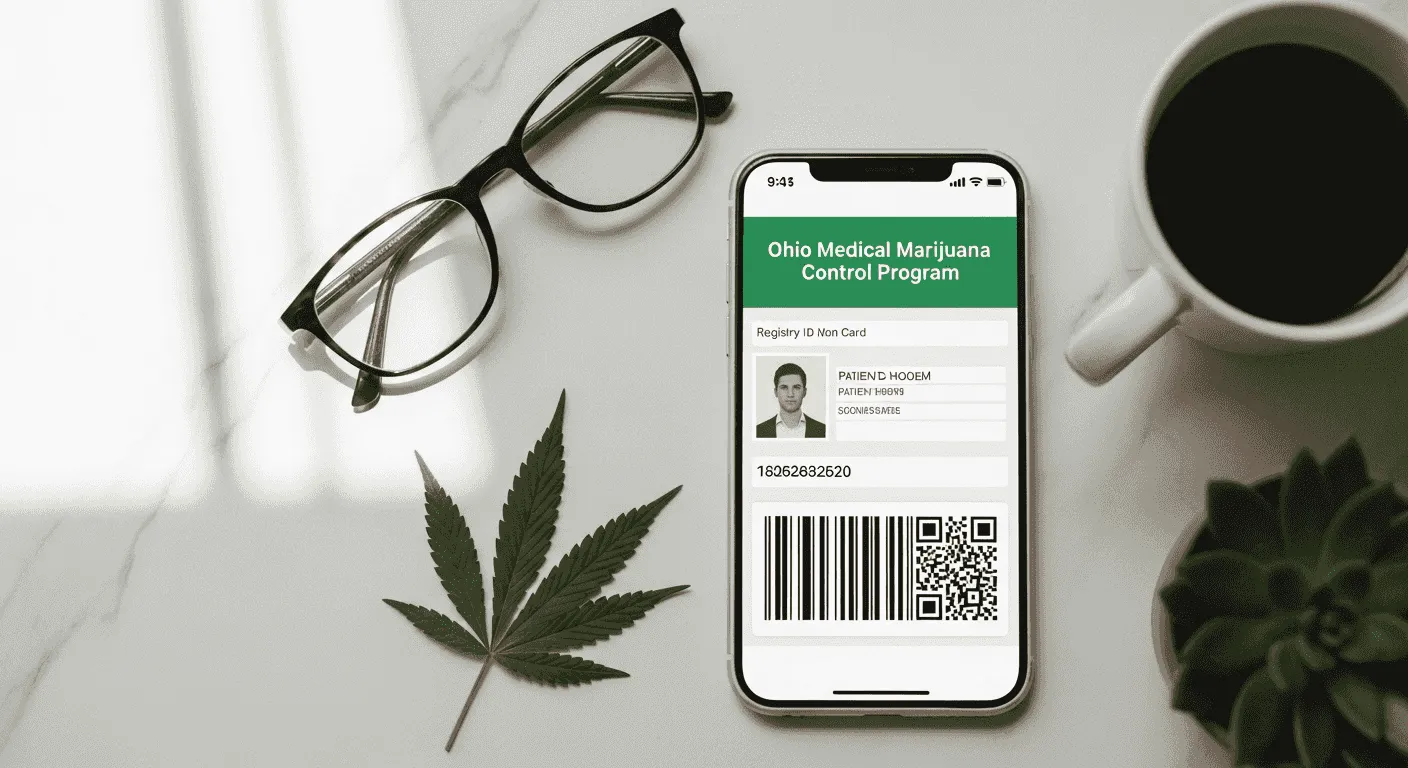

Ohio legalized recreational cannabis in November 2023 and adult-use sales started in August 2024. So you might be wondering: is there any reason to bother with a medical marijuana card anymore?
The short answer is yes, and the reasons are more significant than you’d think.
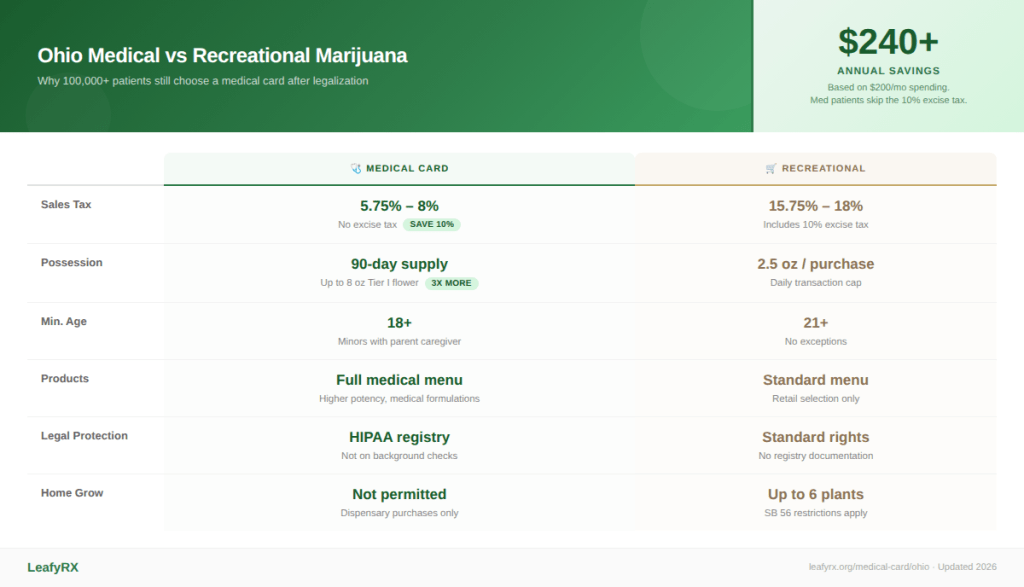
Medical cardholders in Ohio skip the 10% recreational excise tax on every purchase, can possess up to a 90-day supply instead of the tighter daily recreational limits, get access to medical-only product formulations, and can purchase at age 18 rather than waiting until 21. Over the course of a year, the tax gap between medical and recreational marijuana alone can add up to hundreds of dollars in savings for regular patients.
This guide walks you through everything you need to get your Ohio medical marijuana card online in 2026, from qualifying conditions and eligibility requirements to the step-by-step registration process and what to expect at the dispensary.
Ohio Medical Marijuana Card vs Recreational: Why a Med Card Is Still Worth It
With recreational dispensaries now open across the state, plenty of Ohio residents assume the medical program is outdated. It is not. In fact, there are six concrete advantages that make the medical card worth having, especially if you use cannabis regularly or rely on it to manage a diagnosed condition.
Medical Marijuana Tax Savings in Ohio
Recreational cannabis purchases in Ohio carry a 10% state excise tax on top of the standard state and local sales tax. Depending on your county, the total tax burden for recreational buyers lands somewhere between 15.75% and 18%, with the highest combined rate of 18% in Cuyahoga County and up to 18.25% in areas covered by the Central Ohio Transit Authority.
Medical marijuana patients are exempt from the 10% excise tax entirely. You will only pay Ohio’s regular combined sales tax, which ranges from 5.75% (state base rate only) to 8% depending on your county. In the most common scenario, patients pay around 7.25%.
To put that in perspective: if you spend $200 a month at the dispensary, that 10% excise tax exemption alone saves you $240 a year. Factor in the difference in local rates and your medical marijuana card costs are more than offset, with net savings approaching $300 annually.
Higher Possession Limits for Medical Patients
Medical patients in Ohio can possess up to a 90-day supply of cannabis, which works out to approximately 8 ounces of Tier I flower (under 23% THC) or 5.3 ounces of Tier II flower (23% THC and above). Recreational buyers are limited to 2.5 ounces of flower per transaction.
While recreational customers can technically make daily purchases, the 90-day medical supply offers significantly more flexibility and legal protection when transporting larger quantities. If you are a regular user managing a chronic condition, the convenience of stocking up during each 45-day fill period instead of making frequent dispensary trips is a meaningful quality-of-life improvement.
Buy Medical Cannabis at 18 Instead of 21
Ohio’s recreational program is restricted to adults 21 and older. The medical program is open to patients 18 and older, and even minors can qualify with a parent or legal guardian serving as their designated caregiver. For younger patients dealing with chronic pain, epilepsy, or other qualifying conditions, the medical marijuana card is the only legal path to cannabis in Ohio.
Priority Access to Medical-Grade Cannabis Products
Medical dispensaries stock formulations designed specifically for therapeutic use, including high-CBD products, precise-dose tinctures, patches, and topicals that are not always available on the recreational side. When supply shortages occur, medical patients often receive priority access over recreational customers. Ohio’s dual-licensing system means most dispensaries serve both markets, but medical inventory is maintained separately and protected from recreational demand spikes.
Legal Protections for Ohio Medical Marijuana Patients
Having a valid Ohio medical marijuana card gives you documented proof that you are a registered patient under the Ohio Medical Marijuana Control Program. If you are ever questioned by law enforcement about possession, the card provides an immediate, verifiable defense. This is especially important when carrying larger quantities within your 90-day supply, which could otherwise raise questions even though recreational possession is technically legal for smaller amounts. Your registration is also HIPAA-protected, and since medical marijuana cards do not appear on background checks, the card adds protection without creating a public record.
Ohio Dispensary Discounts for Medical Cardholders
Many Ohio dispensaries run exclusive promotions, loyalty programs, and first-time patient discounts that are only available to medical cardholders. These deals can stack on top of the tax savings and make a meaningful difference in your annual cannabis costs. Some dispensaries also offer veterans and indigent patients additional discounts of up to 30% at participating locations.
Ohio Medical Marijuana Qualifying Conditions (Full 2026 List)
Ohio has specific requirements for medical marijuana patients. Unlike some states that let physicians recommend cannabis for any condition they see fit, Ohio maintains a defined list of qualifying conditions and a clear set of eligibility rules. Understanding these requirements before you start the process will save you time and help you prepare for your physician evaluation.
Ohio Medical Marijuana Card Eligibility Requirements
To apply for an Ohio medical marijuana card, you must meet the following criteria:
You must be a resident of Ohio with valid proof of residency, such as an Ohio driver’s license or a state identification card issued by the Bureau of Motor Vehicles.
You must be 18 years of age or older. Patients under 18 can qualify, but a parent or legal guardian must consent to treatment and register as the patient’s caregiver. Caregivers must be at least 21 years old, with an exception for parents of qualifying minors who are under 21.
You must establish what Ohio calls a “bona fide physician-patient relationship” with a doctor who holds a Certificate to Recommend (CTR) from the State Medical Board of Ohio. Under Ohio Revised Code Section 4731.30, this relationship requires an examination of the patient (which can be conducted via telemedicine), a review of the patient’s medical history, and an expectation of ongoing care. This relationship is established through your initial consultation and maintained through annual evaluations, though how long a medical marijuana card takes from first appointment to active registration is typically just a few days.
You must be diagnosed with at least one of Ohio’s qualifying medical conditions, which your CTR-certified physician will confirm during the evaluation.
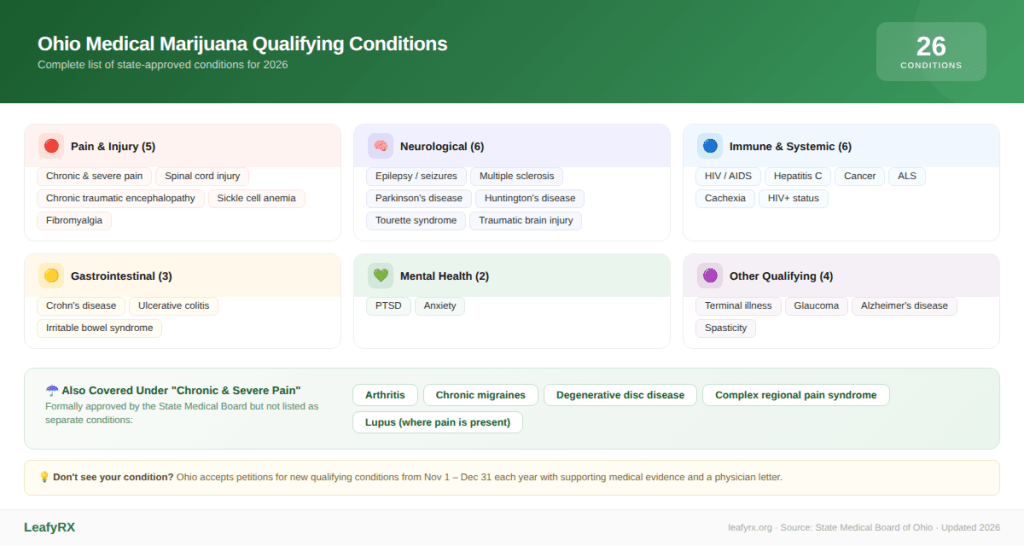
All 26 Qualifying Conditions for Medical Marijuana in Ohio
Ohio currently recognizes 26 medical conditions for medical marijuana treatment. This list has expanded multiple times since the program launched in 2019, and the state accepts petitions to add new conditions every year during a submission window from November 1 through December 31.
The full list of qualifying conditions for medical marijuana includes:
-
AIDS
-
Alzheimer’s disease
-
Amyotrophic lateral sclerosis (ALS)
-
Cachexia
-
Cancer
-
Chronic traumatic encephalopathy (CTE)
-
Crohn’s disease
-
Epilepsy or seizure disorders
-
Fibromyalgia
-
Glaucoma
-
Hepatitis C
-
Huntington’s disease
-
Inflammatory bowel disease
-
Irritable bowel syndrome (IBS)
-
Multiple sclerosis
-
Pain that is either chronic and severe or intractable
-
Parkinson’s disease
-
Positive status for HIV
-
Post-traumatic stress disorder (PTSD)
-
Sickle cell anemia
-
Spasticity
-
Spinal cord disease or injury
-
Terminal illness
-
Tourette syndrome
-
Traumatic brain injury
-
Ulcerative colitis
Several additional conditions qualify under the “pain that is either chronic and severe or intractable” category even though they are not listed separately. The State Medical Board’s Medical Marijuana Committee has formally ruled that the following are covered under chronic pain:
-
Arthritis (confirmed February 2021)
-
Chronic migraines (confirmed February 2021)
-
Complex regional pain syndrome (confirmed February 2021)
-
Degenerative disc disease (confirmed February 2022)
-
Lupus where pain is present (confirmed February 2022)
One important distinction for lupus: the Medical Board specifically ruled that lupus qualifies only “where pain is present.” A lupus diagnosis alone, without documented pain symptoms, does not meet the threshold for medical marijuana certification in Ohio.
Conditions That Do Not Qualify for Ohio Medical Marijuana
Unlike states such as New York or Maine where physicians can recommend cannabis for essentially any condition they believe would benefit from treatment, Ohio does not allow doctors to certify patients for conditions outside the approved list. If your condition is not on the list above and does not fall under one of the umbrella categories like chronic pain, you cannot receive a medical marijuana recommendation regardless of how debilitating it may be.
However, if you believe your condition should be added, you can submit a petition during the annual review period (November 1 through December 31 each year) with supporting medical evidence and letters of support from licensed physicians. The State Medical Board reviews each petition and issues a final decision. Conditions that have previously been petitioned but not approved include anxiety disorder, insomnia, and autism spectrum disorder, though new scientific evidence can support a fresh petition for any previously rejected condition.
How to Get Your Ohio Medical Marijuana Card Online (Step-by-Step)
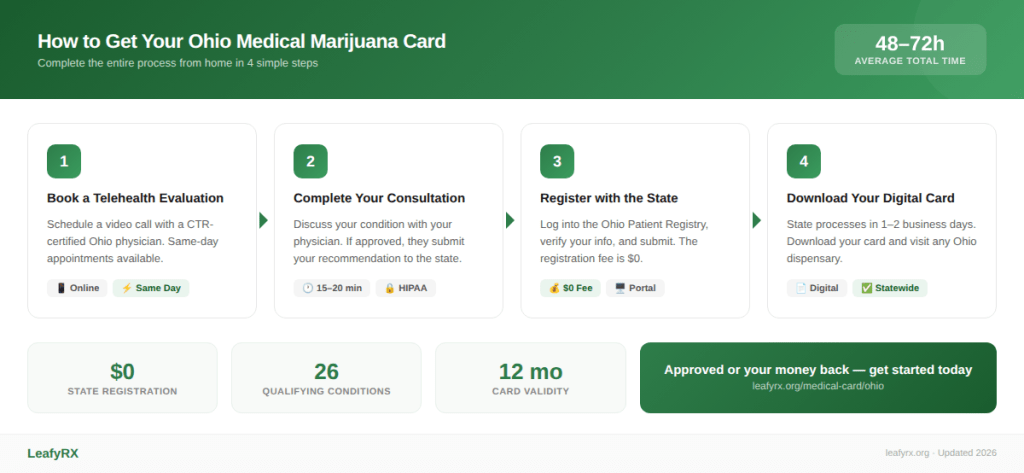
The process for getting an Ohio medical marijuana card involves two main steps: getting certified by a qualified physician and completing your registration with the state. Ohio allows telehealth evaluations, which means you can complete the entire doctor’s visit from home. Here is how each step works.
Step 1: Book an Online Evaluation with a Certified Ohio Physician
You need to see a doctor who holds a Certificate to Recommend (CTR) issued by the State Medical Board of Ohio. Not every physician has this credential, so you cannot simply ask your regular doctor. Platforms like LeafyRX connect you with certified physicians who can help you get your Ohio medical marijuana card the same day via video call.
Before your appointment, gather any medical records that document your qualifying condition. While Ohio does not require you to submit medical records as part of the application, having them available helps your physician develop a more effective cannabis treatment plan and speeds up the evaluation. Useful records include doctor’s notes, existing prescriptions, lab results, or imaging reports related to your condition. You can upload these to your LeafyRX account before the appointment so the physician can review them in advance.
Step 2: Complete Your Medical Marijuana Consultation
During the evaluation, your physician will review your medical history, discuss your symptoms, and determine whether you meet the criteria for one of Ohio’s qualifying conditions. The consultation typically takes 15 to 30 minutes. Your physician will also request a report from Ohio’s Prescription Drug Monitoring Program (the state “drug database”) covering at least the 12 months before your consultation, as required by Ohio law.
If the doctor approves you, they will create your patient profile directly in the Ohio Medical Marijuana Patient and Caregiver Registry and upload your certification to the system. You will receive a confirmation email from the Ohio Medical Marijuana Control Program with login instructions to finalize your registration.
If the doctor determines you do not meet the criteria, LeafyRX offers a money-back guarantee, so you will not be charged for the evaluation.
Step 3: Register with the Ohio Medical Marijuana Patient Registry
Once your physician has submitted your certification, you need to finalize your registration through the Ohio Medical Marijuana Patient and Caregiver Registry portal. Log in using the credentials from your confirmation email, verify your personal information, and complete the application.
As of May 15, 2024, the Ohio Division of Cannabis Control eliminated the state registration fee entirely. Registration is now free for both patients and caregivers. Previously, patients paid $50 per year and caregivers paid $25. The DCC initially reduced the fee to $0.01 in March 2024 as a temporary measure while updating their software, then removed the fee altogether two months later. This makes Ohio one of the most affordable states in the country for medical marijuana registration.
Step 4: Download Your Ohio Medical Marijuana Card
After the state processes your application, typically within one to two business days, you can download your digital Ohio medical marijuana card directly from your Registry account. The state does not issue physical cards, so you will either use the digital version on your phone or print a copy to bring to the dispensary.
That is it. Once you have your card, you can visit any licensed medical marijuana dispensary in Ohio.
How Much Does an Ohio Medical Marijuana Card Cost in 2026?
One of the biggest improvements to Ohio’s program in recent years is the elimination of the state registration fee. Here is a breakdown of what you can expect to pay.
Ohio Medical Marijuana Registration Fee
As of May 15, 2024, Ohio charges no registration fee for medical marijuana patients or caregivers. The Ohio Division of Cannabis Control eliminated this cost entirely to improve program accessibility. This applies to both new applications and annual renewals. There are no separate fees for caregiver registration, card replacements, or address changes.
To put this in context: Ohio previously charged $50 per year for patients and $25 for caregivers. The elimination of these fees makes Ohio’s medical program one of the most affordable in the nation and removes a financial barrier that previously deterred some patients from applying.
Ohio Medical Marijuana Doctor Evaluation Fee
The physician consultation is where most of your cost will come from. Evaluation fees vary by provider and typically range from $100 to $200 for an initial certification. Renewal evaluations are often less expensive. LeafyRX offers some of the lowest evaluation costs in the industry with a money-back guarantee if you are not approved.
Total Cost to Get an Ohio Medical Card in 2026
Your only costs for an Ohio medical marijuana card in 2026 are the physician evaluation fee and whatever you spend on cannabis products at the dispensary. With no state fee, no caregiver fee, and no card replacement fees, the total out-of-pocket cost to get your card is just the doctor’s consultation. At LeafyRX’s rates, most patients are looking at some of the lowest charges to get fully certified and registered.
When you factor in the 10% excise tax savings on every dispensary purchase throughout the year, the card pays for itself within the first month or two for most regular patients.
Ohio Medical Marijuana Possession Limits, Product Forms, and Purchase Rules
Understanding your legal limits is important because exceeding them can result in criminal charges and loss of your medical marijuana privileges, even as a registered patient.
Ohio Medical Marijuana 90-Day Supply Explained
Ohio structures medical marijuana possession around a 90-day supply, which is divided into two 45-day fill periods. Each fill period is tied to your current physician recommendation. You can purchase up to a full 45-day supply at any point during that fill period, but unused amounts do not roll over. In practical terms, most regular patients will have no more than a 45-day supply on hand at any given time.
The daily unit limits, as defined by Ohio Administrative Code Rule 3796:8-2-04, break down by product type:
-
Plant material (flower): 2.83 grams (1/10 of an ounce)
-
Topicals (patches, lotions, creams): 295 milligrams of THC
-
Edibles and oral products (tinctures, capsules, edibles): 110 milligrams of THC
-
Vaporization oils: 590 milligrams of THC
Your 90-day supply can include a combination of different product forms, but the total cannot exceed the 90-day limit when all forms are added together. The aggregate 90-day maximums are:
-
Tier I flower (under 23% THC): up to 8 ounces
-
Tier II flower (23% THC and above): up to 5.3 ounces
-
Topicals: up to 26.55 grams of THC
-
Edibles and oral products: up to 9.9 grams of THC
-
Vaporization oils: up to 53.1 grams of THC

What Types of Medical Marijuana Can You Buy in Ohio?
Ohio medical marijuana dispensaries carry a wide range of products including flower for vaporization, concentrates, tinctures, capsules, edibles, topical creams, lotions, and transdermal patches.
One important restriction to know: Ohio law requires that all flower be vaporized rather than smoked. Combustion (smoking) is not permitted under the medical program. The State Board of Pharmacy has approved a list of specific vaporization devices that patients may use. All products are lab-tested for potency, contaminants, pesticides, heavy metals, and mold before reaching dispensary shelves, and the potency of manufactured products (concentrates, edibles, tinctures) is capped at 70% total THC.
Expanded Limits for Terminal Illness Patients
Ohio provides expanded possession limits for patients diagnosed with a terminal illness (defined as a life expectancy of six months or less). Terminal patients and their caregivers are collectively allowed an additional five days’ supply during each 45-day fill period. This means terminal patients can access a larger total 90-day supply across all product forms. Your physician must specifically indicate the terminal illness designation when submitting your certification to the Registry.
How to Renew Your Ohio Medical Marijuana Card
Ohio medical marijuana cards are valid for one year from the date of issuance. The state does not send renewal reminders, so it is your responsibility to track your expiration date and start the renewal process in advance.
When Does Your Ohio Medical Marijuana Card Expire?
Begin at least 45 days before your card expires to avoid any gap in dispensary access. If your registration has already expired by the time you attempt to renew, you will need to obtain a new physician recommendation before the state will process your renewal. An expired card means you cannot legally possess or purchase medical marijuana during the gap, so proactive renewal is essential.
Ohio Medical Card Renewal Process and Cost
Renewing is simpler than your initial application. Schedule a recertification appointment with a CTR-certified physician, who will conduct an annual evaluation and update your recommendation in the Ohio Medical Marijuana Registry. Ohio law requires at least one in-person or telemedicine visit with your certified physician per year to maintain your bona fide physician-patient relationship.
After your physician updates your recommendation, log in to your Registry account, click the “RENEW CARD” button, confirm your information, and the renewal is processed at no cost. Your updated digital card will be available within one to two business days. For questions or issues during renewal, contact the Ohio Division of Cannabis Control at [email protected].
Ohio Cannabis Law Update: How Senate Bill 56 Affects Medical Patients in 2026
On December 19, 2025, Governor DeWine signed Senate Bill 56 into law, making several significant changes to Ohio’s cannabis regulations. If you are getting your medical card in 2026, here is what you need to know.
Ohio Delta-8 and Hemp THC Product Ban
SB 56 effectively bans intoxicating hemp products in Ohio, including THC-infused beverages and Delta-8 products that were previously sold in unregulated retail stores. The Ohio Division of Cannabis Control confirmed that these products “are not simply moving into dispensaries; they are no longer permitted to be sold anywhere.” Governor DeWine also used a line-item veto to reject a provision that would have allowed THC beverages to be sold through the end of 2026, meaning the ban took immediate effect.
Changes to Ohio Recreational Dispensary Licensing
The bill caps the total number of marijuana dispensaries at 400 statewide, requires a one-mile buffer between dispensary locations, and prohibits dispensaries within 500 feet of a school, playground, or church. It also eliminated Level III cultivator licenses and 50 dispensary licenses that had been earmarked for social equity applicants under the original Issue 2 framework.
Repealed Cannabis Non-Discrimination Protections
One of the more controversial provisions of SB 56 is the repeal of several non-discrimination protections that Issue 2 had established. Under the original voter-approved law, Ohioans could not be stripped of professional licenses, denied custody of their children, denied medical care (including organ transplants), or denied public benefits solely for legal cannabis use. SB 56 removed these protections. This change affects both recreational users and medical patients, though medical cardholders still benefit from HIPAA-protected registry records and the legal documentation the card provides.
Ohio SB 56 Referendum: 2026 Ballot Challenge
A group called Ohioans for Cannabis Choice filed a referendum petition in late December 2025 seeking to repeal portions of SB 56 and restore the original Issue 2 language. Ohio Attorney General Dave Yost certified the petition language in February 2026. The campaign needs approximately 248,000 valid signatures to place the measure on the November 2026 ballot. If successful, the challenged provisions of SB 56 would be put on hold pending the vote.
How SB 56 Benefits Ohio Medical Marijuana Cardholders
The 10% excise tax on recreational cannabis remains unchanged, and the medical program’s core structure and tax exemptions continue as before. For medical patients, the practical takeaway is that the advantages of holding a medical card have become more relevant, not less. With hemp-derived THC products off the shelves, the only legal way to access cannabis in Ohio is through the licensed dispensary system, where medical patients continue to enjoy lower taxes and higher possession limits than recreational buyers.
What to Expect at Your First Ohio Dispensary Visit
Walking into a dispensary for the first time can feel intimidating, but the process is straightforward.
Bring your Ohio medical marijuana card (digital or printed) and a valid government-issued photo ID. The dispensary staff, often called budtenders or patient care consultants, will verify your registration in the state system and help you navigate the product menu. Your first visit may include a brief intake process where the dispensary creates a patient profile in their system, which enables you to earn loyalty rewards and access patient-specific deals.
If you are new to cannabis or switching from a different treatment, let the staff know your condition and what symptoms you are trying to manage. They can recommend specific product types, strains, and dosages based on your needs. Ohio dispensary staff are trained on the state’s product offerings and can explain the differences between tiers, formulations, and consumption methods. Start with a low dose, especially with edibles and concentrates, and give yourself time to evaluate how your body responds before adjusting.
Ohio dispensaries maintain strict compliance with state regulations. Every product is labeled with detailed potency information, ingredient lists, and batch testing results. Your purchase will be logged against your 45-day fill period so you can track how much of your supply you have used. Many dispensaries offer online ordering and some provide curbside pickup for patients who prefer not to browse in-store. Dispensaries are located throughout the state, with the largest concentrations near Cleveland, Cincinnati, Toledo, and Columbus. Patients looking for a medical marijuana card in Columbus have the most dispensary options within a short drive.

Can You Grow Marijuana at Home in Ohio?
Ohio’s medical marijuana program does not permit home cultivation. All medical cannabis must be purchased from state-licensed dispensaries.
However, under the recreational law passed through Issue 2, adults 21 and older may grow up to 6 plants per person and 12 plants per household for personal use. This applies to recreational cultivation only and is separate from the medical program.
SB 56 added new restrictions to home cultivation that take effect in March 2026. Plants must be grown in a secured closet, room, greenhouse, or other enclosed area that prevents access by individuals under 21 and is not visible by normal unaided vision from a public space. Growing is prohibited in any residence that operates as a childcare home (Type A or Type B). Landlords may also prohibit cultivation through the terms of a rental agreement. Additionally, transporting homegrown cannabis improperly in a motor vehicle is now classified as a criminal offense under SB 56.
Get Your Ohio Medical Marijuana Card Today
Getting your Ohio medical marijuana card is faster, cheaper, and more straightforward than most people expect. The state registration fee has been completely eliminated, telehealth evaluations mean you never have to leave home, and the tax savings alone justify the cost of the annual physician consultation many times over.
Whether you are managing chronic pain, recovering from a serious diagnosis, or looking for a natural alternative to prescription medication, the medical card gives you legal protection, financial savings, and access to the best products Ohio’s dispensary system has to offer.
Get started with LeafyRX today and speak with a licensed Ohio physician from home. Approved or your money back.






 Ask ChatGPT
  Ask Claude
  Ask Perplexity