


If you’re considering a Florida medical marijuana card, you probably have one pressing concern: what are the consequences of getting a medical card Florida? You gain legal access to medical cannabis at licensed dispensaries through a Florida medical marijuana card online when you meet the state’s requirements. You also face federal firearms restrictions and potential employment questions. Florida protects your privacy through strict state registry rules. Your information stays confidential unless you consent to share it. But federal law still classifies cannabis as illegal. This creates real conflicts with gun ownership and certain jobs.
Over 900,000 Florida residents now hold active medical marijuana cards. Yet confusion persists about what happens after approval. Will your boss find out? Can you buy a firearm? What about custody rights or insurance coverage? These questions deserve clear answers based on current Florida statutes and federal regulations.
This guide covers every consequence of becoming a registered medical marijuana patient in Florida. You’ll learn the step-by-step process to apply. You’ll see the costs and fees for 2026. You’ll know which health issues qualify. You’ll read about job protections. You’ll learn how gun rules work. We also explain florida mmj card privacy protections, florida medical card cost 2026 breakdowns, and practical considerations from real patient experiences. Think of this as your complete resource for understanding the consequences of getting a medical card florida before you apply.
Quick Answer: What Are the Main Consequences of Getting a Medical Card in Florida?
-
Can getting a medical card affect my job? A Florida medical marijuana card does not automatically protect you from workplace drug testing or employer drug-free workplace policies.
-
Can getting a medical card affect gun ownership? Yes. Federal law creates restrictions for people who use marijuana, even when medical marijuana is legal under Florida law.
-
Does a Florida medical card show up on a background check? Medical Marijuana Use Registry information is generally confidential and is not typically included in standard criminal background checks.
-
What other consequences should I consider? A medical card provides legal protections under Florida’s medical marijuana program, but federal restrictions may still affect areas such as firearms, federal employment, and certain federally regulated positions.
Consequences of Getting a Medical Card in Florida
Getting a medical card in Florida brings both protections and restrictions. You gain legal access to medical cannabis within state limits. You also face federal limitations that affect gun ownership and certain jobs. Understanding these rules can help you make an informed choice.
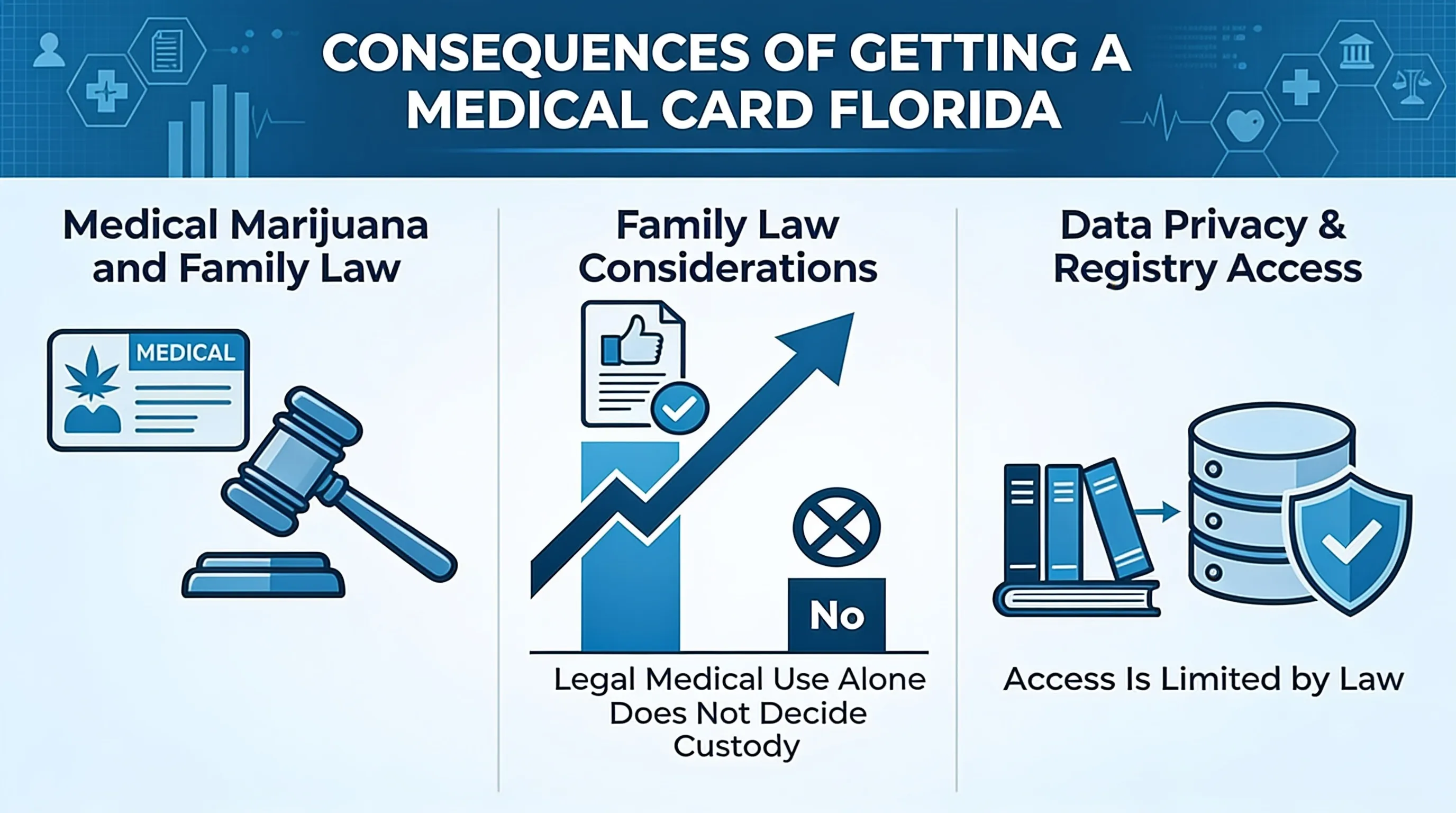
The card protects you under state law. It also creates complications with federal regulations. Most patients find the medical benefits and legal protections worth navigating these trade-offs.
Legal Protections You Gain
Florida law shields medical marijuana cardholders from arrest for possession within legal limits. You can possess up to a 70-day supply as prescribed by your doctor. This protection applies only when you follow state regulations.
Florida Statute 381.986 establishes these protections. You cannot be denied custody in family court solely for legal medical marijuana use. Courts evaluate parenting ability based on overall fitness, not card status alone.
Florida’s medical marijuana program gives registered patients access to cannabis through licensed medical marijuana treatment centers. Patients also receive physician-authorized orders based on their medical needs.
-
Legal possession up to 70-day supply prescribed by physician
-
Protection from arrest for cannabis possession within limits
-
Access to medical marijuana through licensed Florida treatment centers
-
Access to higher-potency medical-grade products
-
Cannot lose custody rights based solely on card status
Federal Restrictions You Face
Federal law creates serious restrictions for medical marijuana patients. The most significant involves firearms. Federal law restricts firearm possession and purchases for people who meet the federal definition of an unlawful marijuana user.
These federal restrictions can apply even though Florida law permits medical marijuana use. ATF Form 4473 asks firearm buyers whether they are an unlawful user of marijuana or another controlled substance under federal law. Medical marijuana qualifies as such a substance.
Employment rules depend on your job and employer. Florida private employers may enforce drug-free workplace policies and conduct workplace drug testing, even when you have a medical marijuana card. Federal employees must follow federal rules, which do not allow marijuana use even when state law permits medical marijuana. DOT-regulated workers, including commercial drivers, must follow federal drug-testing rules that prohibit marijuana use.
Health insurance won’t cover medical marijuana costs. The substance remains federally illegal, so insurers exclude it from coverage. You pay out-of-pocket for all cannabis products and doctor visits.
-
Federal firearm restrictions may apply to marijuana users
-
Federal employees prohibited from medical marijuana use
-
DOT-regulated workers face strict testing requirements
-
No health insurance coverage for cannabis products
-
Life insurance premiums may increase during underwriting
Florida employers can enforce drug-free workplace policies. Florida law does not require employers to accommodate medical marijuana use in the workplace or an employee working while under the influence of marijuana. Your card doesn’t guarantee workplace accommodation.
Professional licensing boards evaluate cannabis use case-by-case. Healthcare workers and commercial drivers face additional scrutiny. Each board applies different standards when reviewing medical marijuana use.
Privacy and Confidentiality
Your patient information receives strong legal protection in Florida. Florida law protects personal information in the Medical Marijuana Use Registry. The state allows access only to authorized users and for specific purposes set by law.
The state maintains a confidential database of registered patients. Your employer cannot search this database. Background checks don’t reveal medical card status unless you disclose it.
Your medical records receive privacy protections under applicable health privacy laws. Your physician must follow the rules that govern the release of your medical records.
-
Registry protected under Florida Statute 381.986
-
Registry information is available only to authorized users for specific purposes
-
Employers cannot search patient database
-
Medical records receive applicable privacy protections
-
Background checks don’t reveal card status
Life insurance companies may ask about cannabis use during underwriting. You must answer truthfully on applications. Disclosure can affect premiums but varies by insurer and policy type.
Step-by-Step Process: How to Get Your Florida Medical Marijuana Card
Getting your Florida medical marijuana card is simpler than most people think. The process involves three main stages: physician evaluation, state registration, and receiving your card. Each step has specific requirements you need to meet.
The timeline varies by patient. Your physician evaluation may take less than an hour, while the state ID card application can take longer to process. Having your documents ready can help avoid delays.
Physician Evaluation and Certification
First, confirm you have a qualifying medical condition recognized by Florida law. The state approves conditions like chronic pain, cancer, epilepsy, PTSD, Crohn’s disease, and several others. You can aslo review the complete list of qualifying conditions by state.
Next, gather your medical records. You need documentation that shows your diagnosis. This includes treatment history, prescription records, or letters from your current doctor. Having these ready speeds up your evaluation.
Then, schedule an evaluation with a Florida-licensed physician qualified to certify medical marijuana patients. For your initial certification, Florida requires an in-person physical examination with a qualified physician. After that initial examination, physicians may conduct follow-up evaluations through telehealth when allowed by current state rules. Telehealth platforms like LeafyRX can help eligible patients with the online evaluation process.
Complete your physician evaluation. The doctor reviews your medical history and current condition. They ask about symptoms, previous treatments, and how your condition affects daily life. Most evaluations take 15 to 30 minutes.
If you qualify, the physician enters your certification into the Florida Medical Marijuana Use Registry. This is a secure state database. Your physician certification can remain active for up to 210 days. You must also complete the state ID card application before you can purchase medical marijuana.
State Registration with Florida Department of Health
After your physician certifies you, register with the Florida Department of Health Office of Medical Marijuana Use. The application happens online through the state’s portal after your physician enters your information into the Medical Marijuana Use Registry.
You need several documents for registration. Bring a valid Florida driver’s license or state ID. You also need proof of Florida residency if your ID shows an out-of-state address. Acceptable proof includes utility bills, bank statements, or rental agreements dated within the last two months.
Pay the state application fee during registration. Florida charges $75 for the annual card. Veterans and SNAP recipients qualify for a reduced fee. The state offers these discounts to make the program more accessible.
Submit your application with all required documentation. The state reviews your information and verifies your physician’s certification. The OMMU says online ID card applications take an average of 10 business days to process.
Receiving Your Card and Visiting Dispensaries
Once the state approves your ID card application, you can access your card through the Medical Marijuana Use Registry. Keep your approved card and a valid photo ID available when you visit a dispensary.
Your card is valid for one year from the issue date. It includes your photo, patient ID number, and expiration date. Keep this information secure and don’t share it with others.
Visit any licensed Florida dispensary with your card to purchase medical cannabis products. Just bring your card and a valid ID. Dispensary staff can help you choose products based on your condition and preferences.
Florida dispensaries offer various product types. You can buy flower, vapes, tinctures, capsules, topicals, and edibles. Your physician sets purchase limits based on your condition. Florida sets a rolling 35-day limit of 2.5 ounces for marijuana ordered for smoking, subject to the patient’s physician orders and state rules.
Plan for annual renewal before your card expires. You need a new physician evaluation and must re-register with the state. Many patients find the online medical card process faster for renewals since doctors already have your history on file.
Renewal costs include both the physician fee and the state fee again. Budget around $150 to $250 total for most renewal appointments. Some physicians offer discounted renewal rates for returning patients.
Costs and Fees: What You Will Pay for a Florida Medical Card in 2026
Getting a medical card in Florida involves several costs. You need to budget for the physician evaluation and annual renewal expenses. Understanding these fees helps you plan financially for your certification.
The total first-year cost includes your physician evaluation and the Florida state ID card fee. The state charges a $75 processing fee, and online payments also include a $2.75 convenience fee.
Physician Evaluation Costs
The physician evaluation is one of the main costs of getting a Florida medical marijuana certification. Traditional in-person clinics may charge around $150 to $300 for initial consultations, depending on the provider.
LeafyRX currently lists its Florida medical marijuana evaluation at $179 for a one-time evaluation or $159 with a subscription, before the state’s separate $75 ID card fee. Compare the total provider and state fees when choosing a service.
Some providers offer discounts or special pricing, but these offers vary by clinic. For example, some providers advertise veteran discounts or reduced pricing for certain returning patients. Check the provider’s current pricing and eligibility requirements before booking.
State Registration Fee
Florida charges a $75 processing fee for the Medical Marijuana Use Registry ID card. After your physician enters your certification into the registry, you must complete the state ID card application and pay the required fee.
Annual Renewal Expenses
Your physician certification can last up to 210 days. Your Medical Marijuana Use Registry ID card remains valid for one year. You must keep both your physician certification and ID card active to continue using the program.
Renewal evaluations typically cost $75 to $150. This is less than the initial evaluation because the appointment is shorter. Your physician reviews your treatment progress and updates your certification in the state registry.
For comprehensive details on medical marijuana card costs across different states and providers, you can compare pricing structures and find the best value for your situation.
Dispensary products are not covered by health insurance. Marijuana remains federally illegal, so insurance companies cannot reimburse cannabis purchases. You pay out of pocket for all products at dispensaries.
Eligibility and Qualifying Conditions: Who Can Get a Florida Medical Card
Before you apply, you need to know if you qualify. Florida runs a comprehensive medical marijuana program with specific eligibility rules. The state defines which conditions qualify, which doctors can certify you, and who can apply.
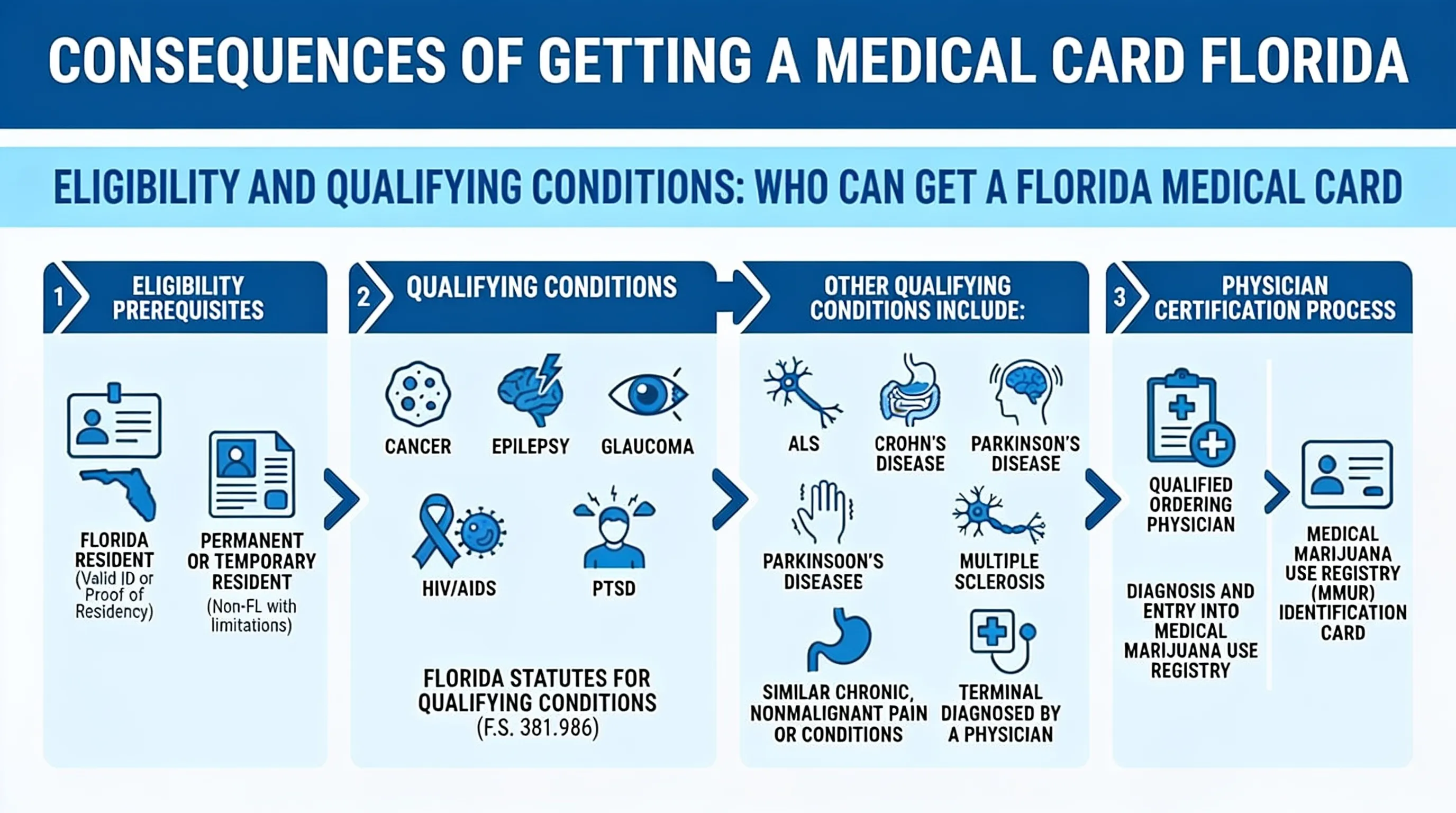
Understanding these requirements helps you make an informed decision. Let’s break down exactly who can get a Florida medical card in 2026.
Florida’s Qualifying Medical Conditions
Florida recognizes a specific list of medical conditions that qualify for a medical card. According to Florida statutes for qualifying conditions, the state approves patients with cancer, epilepsy, glaucoma, HIV/AIDS, and PTSD. Other qualifying conditions include ALS, Crohn’s disease, Parkinson’s disease, and multiple sclerosis.
Chronic nonmalignant pain can also qualify when it results from or originates from a qualifying medical condition and continues beyond the usual course of that condition. Your physician must determine whether your condition meets Florida’s requirements.
Terminal conditions automatically qualify. If you have a life expectancy under one year, you can get certified. Your physician makes this determination based on your medical records and current health status.
Florida law also allows physicians to certify patients for conditions of the same kind or class. This gives doctors flexibility to help patients with similar debilitating conditions. Your certifying physician reviews your case and decides if your condition fits the criteria.
If you’re unsure about your condition, you can determine if you qualify by consulting with a licensed physician. They review your medical history and current symptoms to make an assessment.
Physician Requirements and Certification Process
Not every doctor can certify you for a Florida medical card. Your certifying physician must hold an active, unrestricted license in Florida. They must also register with the Florida Medical Marijuana Use Registry before they can issue certifications.
The physician must establish a physician-patient relationship with you. This means they review your complete medical history and conduct an evaluation. They cannot certify you without understanding your condition and treatment history.
During your evaluation, the doctor assesses whether medical marijuana is appropriate for your condition. They consider your symptoms, prior treatments, and overall health. If they determine you qualify, they enter your information into the state registry.
The certification process takes place online through the registry system. Your physician submits your certification electronically. You then receive instructions to complete your patient application with the Florida Department of Health.
Most patients complete this process quickly. Online platforms like LeafyRX connect you with licensed Florida physicians who can evaluate you via telehealth. This eliminates the need for in-person clinic visits and speeds up the entire process.
Out-of-State Patients and Reciprocity
Florida does not offer reciprocity for out-of-state medical marijuana cards. If you hold a valid card from another state, it does not work in Florida. You cannot purchase or possess medical marijuana in Florida with an out-of-state card.
Seasonal Florida residents can also qualify. You must provide the documents the state accepts to prove Florida residency when you apply for your Medical Marijuana Use Registry ID card.
The OMMU lists specific residency documents for permanent and seasonal residents. Check the current requirements before submitting your application. Your certifying physician must verify your qualifying condition and your residency status.
Minors can also qualify for Florida medical cards. They need parental or legal guardian consent. Patients under 18 need a second physician to concur with the certification. A parent or legal guardian must also provide the required consent.
A minor must have a registered caregiver. Only the caregiver may purchase or administer medical marijuana for a minor. This ensures proper supervision and compliance with state regulations.
Conclusion
You now know the full picture of the consequences of getting a medical card florida. We covered the step-by-step process, costs and fees for 2026, and who qualifies. You learned about privacy protections, legal safeguards, and workplace considerations. The benefits include legal protection, higher possession limits, and access to quality products. The restrictions involve federal law conflicts, gun ownership issues, and potential employment complications.
Most Florida patients find the benefits outweigh the risks. Over 900,000 residents already use medical marijuana legally. Your decision depends on your medical needs and personal situation. If you have a qualifying condition, a qualified physician can help you decide whether medical marijuana may be appropriate for you.
Ready to explore your options? Start your Florida medical marijuana evaluation with LeafyRX. Connect with a licensed physician, understand your eligibility, and take the next step toward medical cannabis access. Approved or your money back.





 Ask ChatGPT
  Ask Claude
  Ask Perplexity